
Modern biological science generates vast amounts of biological data every single day. From decoding human DNA to understanding how viruses mutate, researchers produce billions of biological data points that are impossible to analyze manually. This is where bioinformatics comes into play. By merging computer science, mathematics, statistics, and molecular biology, bioinformatics provides the tools and algorithms necessary to store, organize, analyze, and interpret complex biological information.
If you are new to the field, understanding what bioinformatics is, how it works, its various branches, and its wide-ranging scope can open up a clear view of modern life sciences. In this guide, we will break down the essential concepts of bioinformatics in a simple, beginner-friendly way.
What is Bioinformatics?
Bioinformatics is an interdisciplinary field that develops computational algorithms, software tools, and databases to understand biological data, particularly large and complex datasets like genomic or proteomic sequences.
The term is made of two parts: biology (the study of living organisms) and informatics (the practice of processing data for storage and retrieval). Put simply, bioinformatics acts as a digital bridge between raw laboratory experiments and meaningful biological insights.
To understand its importance, consider the Human Genome Project. Completed in the early 2000s, this massive global effort mapped the 3 billion chemical base pairs that make up human DNA. Analyzing three billion letters manually would take lifetimes. Using high-performance computers, automated databases, and specialized algorithms, computational scientists processed this massive genetic blueprint in a fraction of the time, ushering in the modern era of data-driven biology.
The Central Dogma and Bioinformatics Data
To understand how bioinformatics works, it helps to remember the central dogma of molecular biology:
- DNA contains the genetic instructions.
- RNA acts as a messenger to transmit those instructions.
- Proteins execute cellular functions based on those instructions.
Bioinformatics tools analyze data at every step of this biological pipeline, translating sequence patterns into structural models, functional predictions, and biological discoveries.
Major Branches of Bioinformatics
Because biological systems are complex, bioinformatics is divided into several specialized sub-disciplines or branches. Each branch focuses on a specific type of biological molecule or system.
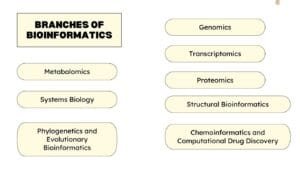
1. Genomics
Genomics is the branch focused on analyzing complete genomes—the entire DNA content of an organism. Genomic bioinformatics includes sequence assembly, gene prediction, and comparative genomics (comparing the genomes of different species or individuals).
- Key task: Assembling short sequence reads from Next-Generation Sequencing (NGS) machines into complete genome maps.
- Application: Identifying disease-causing genetic mutations in patient genomes.
2. Transcriptomics
Transcriptomics studies the full set of RNA transcripts produced by the genome under specific conditions. While DNA remains largely static across cells, RNA expression changes depending on environment, disease states, and developmental stages.
- Key task: Quantifying expression levels using technologies like RNA sequencing (RNA-Seq).
- Application: Comparing gene expression between healthy tissue and cancerous tumor tissue to identify overactive genes.
3. Proteomics
Proteomics deals with the large-scale study of proteins, including their structures, functions, interactions, and post-translational modifications. Because proteins carry out most cellular work, understanding the proteome is vital for understanding cell behavior.
- Key task: Analyzing mass spectrometry data to identify and quantify proteins present in a cell sample.
- Application: Mapping protein-protein interaction networks involved in cellular signal transduction.
4. Structural Bioinformatics
Structural Bioinformatics centers on predicting and analyzing the three-dimensional (3D) shapes of biological macromolecules, particularly proteins and nucleic acids. A protein’s function is determined by its 3D folding pattern.
- Key task: Predicting protein structures using computational models (such as homology modeling or AI models like AlphaFold).
- Application: Visualizing active binding sites on enzymes to design targeted chemical inhibitors.
5. Chemoinformatics and Computational Drug Discovery
Chemoinformatics applies computational tools to solve problems in chemistry. When combined with bioinformatics, it drives modern in silico (computer-based) drug design.
- Key task: Performing virtual screening to test millions of chemical molecules against a protein target on a computer.
- Application: Accelerating early-stage drug discovery by predicting drug efficacy and toxicity before testing in physical laboratories.
6. Metabolomics
Metabolomics examines the complete set of small-molecule metabolites (such as sugars, amino acids, and lipids) found within a cell or tissue. It offers a snapshot of actual physiological processes taking place inside an organism.
- Key task: Processing complex chromatographic and spectroscopic data to detect metabolic changes.
- Application: Identifying novel biological markers (biomarkers) for early disease detection.
7. Systems Biology
Systems Biology integrates data across genomics, transcriptomics, proteomics, and metabolomics to construct computational models of entire biological systems. Rather than studying individual components in isolation, systems biology focuses on how these components interact as a network.
- Key task: Constructing mathematical and computational models of biological networks.
- Application: Simulating biological cellular pathways to predict how human tissue responds to novel pharmaceutical compounds.
8. Phylogenetics and Evolutionary Bioinformatics
Phylogenetics studies the evolutionary relationships among organisms or gene sequences. By aligning homologous sequences, computational biologists construct phylogenetic trees that illustrate evolutionary history.
- Key task: Multiple sequence alignment and evolutionary tree construction.
- Application: Tracking viral evolution and viral variants during infectious disease outbreaks.
Scope and Practical Applications of Bioinformatics
The scope of bioinformatics has expanded rapidly across modern science, industrial biotechnology, healthcare, and environmental research. Below are the primary domains where bioinformatics plays a central role.
1. Personalized and Precision Medicine
Traditionally, medicine has often relied on a one-size-fits-all approach. Bioinformatics enables precision medicine, where medical treatment is tailored to a patient’s individual genetic makeup.
- Oncology: Sequencing tumor genomes helps oncologists select targeted therapies that specifically attack genetic mutations driving cancer cell growth.
- Pharmacogenomics: Analyzing genetic variations helps predict how an individual patient will metabolize a drug, preventing adverse drug reactions and ensuring optimal dosage.
2. Accelerated Drug Discovery and Development
Developing a new pharmaceutical drug conventionally takes over a decade and costs billions of dollars. Bioinformatics dramatically reduces time and resource costs during early discovery stages.
- Target Identification: Finding proteins associated with disease onset.
- Virtual Screening: Testing thousands of small molecules against target structures virtually using molecular docking software.
- Lead Optimization: Modifying chemical structures computationally to improve binding strength and lower cellular toxicity.
3. Agriculture and Crop Improvement
Global food security faces pressures from climate change and population growth. Agricultural bioinformatics applies genomic tools to improve crop yields and livestock health.
- Marker-Assisted Selection: Identifying genetic markers linked to desirable traits, such as drought tolerance or pest resistance, to speed up plant breeding.
- Genomic Selection in Livestock: Evaluating genetic potential in animals to breed healthier and more resilient livestock.
4. Infectious Disease Surveillance and Epidemiology
Bioinformatics tools track pathogen spread, understand transmission patterns, and guide public health decisions.
- Genomic Epidemiology: Sequencing viral and bacterial genomes to trace transmission pathways during disease outbreaks.
- Vaccine Target Discovery: Identifying conserved viral surface proteins to support rapid vaccine development.
5. Environmental Biotechnology and Bioremediation
Microorganisms play vital roles in ecological balance. Through metagenomics—the direct sequencing of DNA from environmental samples (such as soil, oceans, or industrial waste)—bioinformaticians discover novel microbes and enzymes without needing to culture them in a lab.
- Pollutant Degradation: Identifying microbial enzymes that break down plastics, heavy metals, or oil spills.
- Biofuel Production: Finding novel enzymes capable of converting agricultural plant waste into sustainable biofuels.
Key Tools and Databases in Bioinformatics
Bioinformatics relies heavily on open-access databases and community-developed software. Below is an overview of widely used tools and databases across the discipline:
| Category | Tool / Database | Primary Purpose |
|---|---|---|
| Sequence Databases | NCBI GenBank / RefSeq | Repository of publicly available nucleotide (DNA/RNA) sequences. |
| Protein Databases | UniProt / SWISS-PROT | Comprehensive resource for protein sequence and functional annotation. |
| Structure Databases | RCSB Protein Data Bank (PDB) | 3D structural data repository for proteins and nucleic acids. |
| Sequence Alignment | BLAST (Basic Local Alignment Search Tool) | Compares query sequence against reference sequence databases to find similarities. |
| Multiple Alignment | Clustal Omega / MUSCLE | Aligns multiple nucleotide or amino acid sequences for phylogenetic studies. |
| Molecular Visualization | PyMOL / ChimeraX | 3D visualization software for inspecting molecular and protein structures. |
| Structural Prediction | AlphaFold / ESMFold | AI-powered systems for predicting high-accuracy 3D protein structures from amino acid sequences. |
Essential Skills to Get Started in Bioinformatics
If you are interested in pursuing bioinformatics, building a multi-disciplinary skill set is the best way to start. Here are key foundational areas to focus on:
- Basic Biological Knowledge: Molecular biology, genetics, biochemistry, and cell biology.
- Programming Languages:
- Python: Highly recommended for beginners due to rich libraries like BioPython, Pandas, and NumPy.
- R: Essential for statistical analysis, data visualization, and differential gene expression analysis.
- Bash/Linux Command Line: Critical for running command-line alignment tools and managing large sequence files on cluster servers.
- Database Management: Understanding SQL and relational databases to manage and query large datasets efficiently.
- Statistics and Data Science: Hypothesis testing, probability distributions, machine learning techniques, and data visualization.
ready
Future Trends in Bioinformatics
The field of bioinformatics continues to evolve rapidly. Key emerging trends shaping its future include:
- Artificial Intelligence and Machine Learning: AI models are increasingly used for protein structure prediction, target identification, and automated medical image interpretation.
- Single-Cell Omics: High-resolution sequencing technologies now measure gene expression within single cells, allowing researchers to explore cellular diversity in complex tissues.
- Long-Read Sequencing: Technologies like Oxford Nanopore and Pacific Biosciences yield long continuous sequence reads, making complex genome assembly simpler and more accurate.
- Cloud Computing: As data volume scales into petabytes, cloud platforms enable collaborative, scalable, and reproducible genomic research worldwide.
Summary
Bioinformatics is an indispensable field of modern science that turns massive biological data into actionable knowledge. By uniting computational power with biological insights, bioinformatics drives breakthroughs in personalized healthcare, pharmaceutical discovery, sustainable agriculture, and environmental conservation. Whether you are coming from a background in life sciences or computer science, exploring bioinformatics opens doors to solving some of today’s most vital scientific questions.
Frequently Asked Questions
- What is the difference between bioinformatics and computational biology?
- While both terms are often used interchangeably, bioinformatics generally focuses on creating tools, software, databases, and pipelines to store and analyze biological data. Computational biology focuses more on using these computational tools and mathematical models to answer specific biological questions and test theoretical hypotheses.
- Do I need to know how to code to learn bioinformatics?
- For fundamental conceptual understanding and basic database usage (like searching NCBI BLAST), coding is not strictly necessary. However, to analyze real-world datasets, build pipelines, or work professionally in the field, learning a programming language like Python or R is essential.
- Which programming language is best for a beginner in bioinformatics?
- Python is widely considered the best starting point for beginners due to its readable syntax and extensive biological packages (such as BioPython). R is also highly recommended if your primary focus is statistical analysis and visualization of genomics data.
- Can someone from a pure computer science background enter bioinformatics?
- Yes. Many successful bioinformaticians transition from computer science, data science, or engineering. They learn fundamental molecular biology concepts on the job or through introductory coursework to apply their programming and computational skills to biological problems.
- How is bioinformatics used in cancer research?
- In cancer research, bioinformatics is used to compare the DNA sequences of healthy cells and tumor cells. This helps identify specific gene mutations driving tumor growth, discover novel biomarkers for early detection, and identify personal drug targets tailored to individual patient profiles.
References and Further Reading
- Mount, D. W. (2004). Bioinformatics: Sequence and Genome Analysis (2nd ed.). Cold Spring Harbor Laboratory Press.
- Lesk, A. M. (2019). Introduction to Bioinformatics (5th ed.). Oxford University Press.
- National Center for Biotechnology Information (NCBI). Bioinformatics Educational Resources. Available at: https://www.ncbi.nlm.nih.gov/
- European Bioinformatics Institute (EMBL-EBI). Train online: Introductory Bioinformatics Courses. Available at: https://www.ebi.ac.uk/training/
- Pevzner, P., & Shamir, R. (2011). Bioinformatics for Beginners. Bioinformatics, 27(20), 2920–2921.