
Day 1
Introduction to Cheminformatics with RDKit
Topic: The drug discovery pipeline and chemical data handling
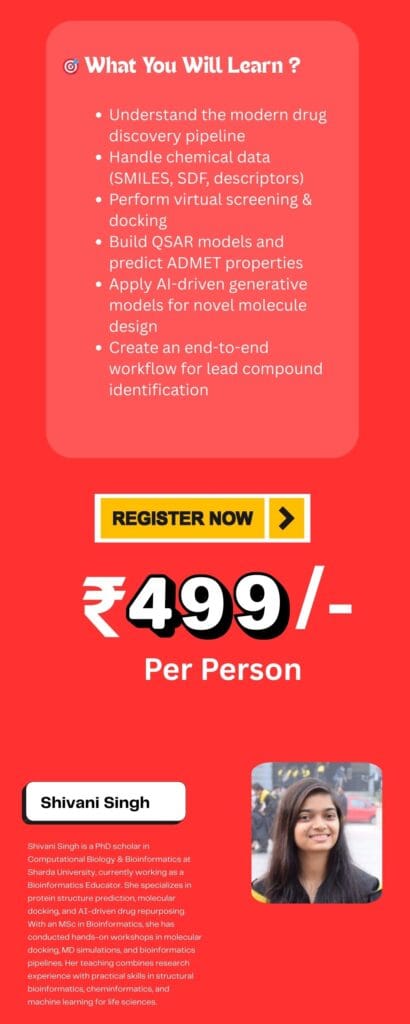
Overview of the modern drug discovery process, from target identification to lead optimization.
Introduction to chemical data and molecular representations (SMILES, SDF), and physicochemical descriptors.
Hands-on:
Install Python, Miniconda, and libraries (RDKit, Pandas, NumPy, Matplotlib, Jupyter Notebook).
Learn how to use Jupyter Notebook and standard Python data science libraries.
Read and write chemical files with RDKit.
Calculate molecular properties (molecular weight, logP, polar surface area).
Implement Lipinski’s Rule of Five to filter drug-like molecules.
Project Task: Select a target protein and download a relevant compound dataset from PubChem or ChEMBL.
Day 2
Virtual Screening and Compound Visualization
Topic 1: Exploring Chemical Space
Techniques for screening large chemical libraries (similarity searching, clustering).
Hands-on:
Generate molecular fingerprints (e.g., Morgan fingerprints).
Perform similarity searches to identify drug-like molecules.
Topic 2: Molecular Visualization
Visualizing small molecules and proteins to understand 3D structure and interactions.
Hands-on:
Install and use visualization tools (PyMOL or UCSF Chimera).
Generate 3D conformers for molecules using RDKit.
Visualize molecules from the Protein Data Bank (PDB) in PyMOL.
Project Task: Use RDKit to generate 3D conformers for compounds identified on Day 1.
Day 3
Molecular Docking with Open-Source Tools
Topic 1: Introduction to Protein-Ligand Docking
Principles of structure-based drug design and docking theory.
Hands-on:
Prepare a protein target and a ligand for docking.
Use AutoDock Vina to predict ligand binding poses.
Topic 2: Analyzing Docking Results & Workflows
Interpreting docking scores and binding poses.
Incorporating docking into automated workflows.
Hands-on:
Analyze docking poses and scores in PyMOL or UCSF Chimera.
Set up a basic cheminformatics pipeline in KNIME.
Project Task: Perform docking of selected compounds against the target protein.
Day 4
Machine Learning in Drug Design
Topic 1: QSAR Modeling with scikit-learn
Introduction to Quantitative Structure-Activity Relationships (QSAR).
Using ML models to predict molecular properties.
Hands-on:
Generate molecular descriptors with RDKit.
Train a machine learning model (Random Forest Regressor) in scikit-learn.
Topic 2: Predicting ADMET Properties
Importance of ADMET (Absorption, Distribution, Metabolism, Excretion, Toxicity) in drug discovery.
Hands-on:
Predict ADMET properties with ADMETLab.
Integrate ADMET prediction into QSAR workflow.
Project Task: Build a QSAR model and predict ADMET properties for docking hits to identify top candidates.
Day 5
AI-Driven Compound Generation & Wrap-Up
Topic 1: Generative AI for Molecules
Introduction to deep learning for drug-like molecule generation (SMILES-based models).
Hands-on:
Use a pre-trained generative model for molecule design.
Filter generated molecules for drug-likeness using RDKit.
Topic 2: Putting It All Together
Review of the full drug discovery workflow and future of AI in the field.
Hands-on:
Combine all steps into a comprehensive Jupyter Notebook.
Present project results: identified lead compounds and selection rationale.