

Introduction to Bioinformatics as a Global Career
Bioinformatics is at the absolute forefront of modern scientific discovery. By blending biology, computer science, mathematics, and statistics, bioinformatics empowers researchers to make sense of massive biological datasets. Whether it is sequencing a novel viral genome, developing personalized cancer therapies, or engineering climate-resilient crops, bioinformaticians are the computational architects driving these innovations. For biological science students and technology enthusiasts alike, choosing this path offers a highly rewarding, intellectually stimulating, and globally mobile career. If you are wondering where the best opportunities lie, this guide explores the top countries for a bioinformatics career, monthly salary expectations abroad, and the rapidly growing scope of bioinformatics in India.
Why the Demand for Bioinformatics is Surging Globally
The biological sciences have transitioned from a data-poor discipline to an incredibly data-rich science. The advent of Next-Generation Sequencing (NGS) technologies, single-cell genomics, and high-throughput proteomics has generated petabytes of molecular data. However, raw data is useless without analysis. This bottleneck has created a massive, high demand for bioinformatics professionals who can write algorithms, build pipelines, and interpret complex biological systems. Pharmaceutical companies, agricultural biotech firms, clinical research organizations, and academic institutions worldwide are actively competing for top-tier computational biology talent to accelerate drug discovery and clinical breakthroughs.
Top Countries for a Bioinformatics Career
When planning a global career in bioinformatics, several countries stand out due to their robust research infrastructure, high level of venture capital funding, and concentration of biotechnology hubs. Below are the top countries for a bioinformatics career:
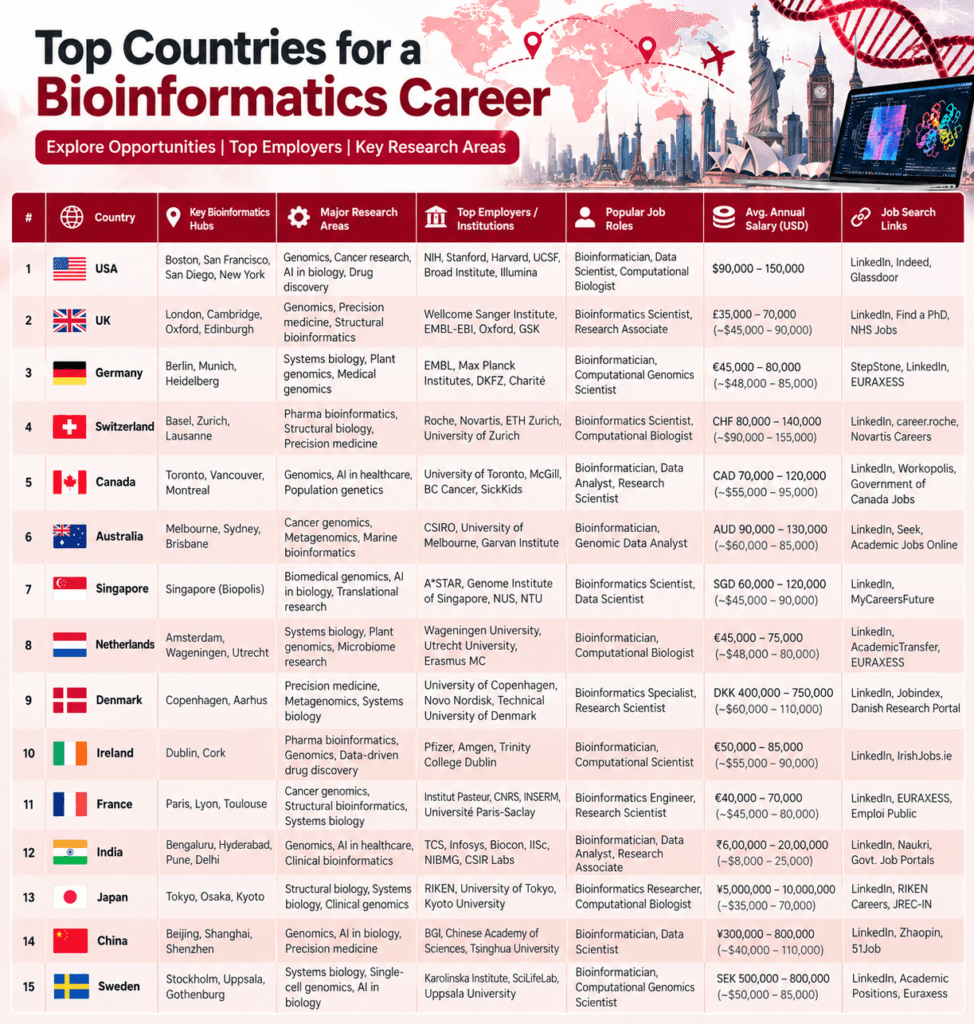
1. United States (USA)
The United States remains the global epicentre for bioinformatics and computational biology. The country boasts world-renowned biotechnology clusters in the San Francisco Bay Area, Boston-Cambridge, and San Diego. Academic giants like Harvard, MIT, Stanford, and the University of California work hand-in-hand with industry leaders such as Illumina, Genentech, and Thermo Fisher Scientific. The US is ideal for individuals looking to work in cutting-edge gene therapy, AI-driven drug discovery, and commercial genomics.
2. Germany
Germany is the powerhouse of European biotechnology. With a strong emphasis on research and development, Germany offers outstanding opportunities in both academic and industrial settings. Heidelberg (home to the European Molecular Biology Laboratory – EMBL), Munich, and Berlin are major hubs. The country’s public funding for scientific research is highly structured, and the presence of pharmaceutical giants like Bayer, Boehringer Ingelheim, and BioNTech ensures a steady demand for computational biologists.
3. United Kingdom (UK)
The UK has a rich history in genetics and bioinformatics, famously hosting the Wellcome Sanger Institute and the European Bioinformatics Institute (EMBL-EBI) in Cambridge. London, Oxford, and Cambridge (the Golden Triangle) represent a massive cluster for biotech startups and established pharma. The UK government’s Genomics England initiative has further solidified the country’s position as a leader in clinical genomics, making it one of the top countries for bioinformatics career development.
4. Switzerland
Switzerland offers an unparalleled quality of life coupled with world-class scientific research. Basel is a global pharmaceutical hub, housing the headquarters of multinational giants Roche and Novartis. Swiss universities, such as ETH Zurich and EPFL Lausanne, alongside the Swiss Institute of Bioinformatics (SIB), offer exceptional research facilities. The country is highly attractive for bioinformaticians seeking careers in translational medicine and pharma-bioinformatics.
5. Canada
Canada is rapidly expanding its digital health and biotechnology sectors. Hubs like Toronto, Vancouver, and Montreal are known for artificial intelligence and deep learning research, which are increasingly applied to biological data. Organizations like Canada’s Michael Smith Genome Sciences Centre and various provincial genomics enterprises offer excellent career pathways for international graduates.
6. Singapore
As Asia’s leading biomedical hub, Singapore has invested heavily in its Biopolis research complex. The Agency for Science, Technology and Research (A*STAR) drives major genomic initiatives. Singapore is an excellent gateway for professionals wanting to work in a highly advanced, multicultural, and technologically driven environment in Asia.
Bioinformatics Salary Abroad per Month
For professionals looking to move abroad, understanding compensation is crucial. Salaries vary significantly based on experience, location, and whether you work in academia or the private industry (pharma/biotech companies generally pay 30% to 50% more than academic institutions). Below is an approximate breakdown of the bioinformatics salary abroad per month across top-tier countries:
| Country | Average Entry-Level Salary (Per Month) | Average Mid-to-Senior Salary (Per Month) | Primary Biotech/Bioinformatics Hubs |
|---|---|---|---|
| United States (USD) | $5,800 – $7,500 | $9,500 – $14,000+ | Boston, San Francisco, San Diego, Seattle |
| Switzerland (CHF) | CHF 7,000 – CHF 8,500 | CHF 10,000 – CHF 15,000+ | Basel, Zurich, Geneva, Lausanne |
| Germany (EUR) | €4,000 – €5,200 | €6,500 – €9,000+ | Heidelberg, Munich, Berlin, Cologne |
| United Kingdom (GBP) | £3,200 – £4,200 | £5,500 – £8,500+ | Cambridge, Oxford, London |
| Canada (CAD) | CAD 4,800 – CAD 6,000 | CAD 7,500 – CAD 11,000+ | Toronto, Vancouver, Montreal |
| Singapore (SGD) | SGD 4,500 – SGD 6,000 | SGD 8,000 – SGD 12,000+ | Biopolis, One-North |
Note: The monthly salary figures mentioned above are gross amounts (before tax) and represent realistic industry standards. Actual pay may vary depending on the specific employer, educational credentials (M.Sc. vs. Ph.D.), and specialized skill sets (e.g., machine learning expertise).
Bioinformatics Career and Future Scope in India
While Western nations have historically dominated the field, India is experiencing a significant paradigm shift. The Indian biotechnology industry is growing at an exponential rate, driven by government support, a massive pool of skilled IT professionals, and an increasing focus on healthcare data.
Is Bioinformatics a Good Career in India?
Yes, bioinformatics is increasingly becoming an excellent career choice in India. Historically, biological sciences in India were focused primarily on traditional wet-lab research. However, with the rising costs of wet-lab reagents and the efficiency of computational drug design, Indian pharmaceutical companies and research institutes have heavily transitioned toward dry-lab (computational) approaches. If you enjoy coding, data analysis, and solving complex biological puzzles without being confined to a wet-lab bench, bioinformatics offers a highly viable and lucrative career path in India.
Entry-Level Bioinformatics Salary per Month in India
The salary for freshers in India depends heavily on their educational qualifications (B.Tech, M.Sc., or Ph.D.) and their technical skillset. Candidates with strong programming skills (Python/R) and hands-on experience with NGS pipelines command much higher salaries than those with purely theoretical knowledge.
- M.Sc. / B.Tech Freshers: The entry-level bioinformatics salary per month in India typically ranges from ₹25,000 to ₹45,000 per month (approximately ₹3,00,000 to ₹5,40,000 per annum).
- M.Tech / MS (with strong coding skills): Freshers with advanced computational training can expect ₹40,000 to ₹60,000 per month.
- Ph.D. Holders: Candidates entering the industry or academic research institutes (like CSIR, DBT, or IISERs) as postdoctoral fellows or scientists can start at ₹65,000 to ₹95,000 per month.
With 3 to 5 years of experience, mid-level bioinformatics professionals in Indian biotech companies easily earn between ₹80,000 to ₹1,500,000 per month, making it one of the highest-paying domains within the life sciences sector in India.
Bioinformatics Future Scope in India
The bioinformatics future scope in India is exceptionally bright, backed by several key drivers:
- National Genomic Initiatives: Projects like the “Genome India Project,” which aims to sequence 10,000 genetic samples from representative Indian populations, are creating immense opportunities for local bioinformaticians to analyze complex genomic data.
- Pharma and CRO Expansion: India is known as the “pharmacy of the world.” Major Indian pharmaceutical companies like Dr. Reddy’s Laboratories, Biocon, Lupine, and Sun Pharma are actively integrating computational chemistry and bioinformatics to shorten drug discovery cycles. Contract Research Organizations (CROs) are also outsourcing bioinformatics workflows from Western countries to India.
- Thriving Genomic Startups: Homegrown companies such as Strand Life Sciences, MedGenome, Mapmygenome, and Xcode Life are leading the clinical genomics revolution in India. These companies offer direct-to-consumer genetic testing, personalized medicine, and oncology diagnostics, all of which rely entirely on robust bioinformatics pipelines.
- Agricultural Biotechnology: With a massive agricultural economy, India utilizes bioinformatics to develop climate-resilient, pest-resistant, and nutritionally enhanced crop varieties. Organizations like ICRISAT and various agricultural universities are at the forefront of this research.
Key Skills Needed to Succeed Globally
To secure a high-paying job in the top countries for a bioinformatics career, you must build a competitive skill set. Simply understanding basic biological concepts is no longer sufficient. Aspiring bioinformaticians should focus on mastering:
- Programming Languages: Proficiency in Python and R is non-negotiable. Bash/Linux scripting is also essential for navigating command-line genomics tools.
- Data Analysis and Statistics: Understanding statistical models, machine learning algorithms, and data visualization libraries (like ggplot2 or Seaborn).
- Next-Generation Sequencing (NGS): Hands-on experience with DNA-seq, RNA-seq, ChIP-seq, and single-cell RNA-seq data analysis pipelines (using tools like GATK, Bowtie, and Seurat).
- Database Management: Familiarity with SQL and biological databases (NCBI, Ensembl, UniProt, TCGA).
- Cloud Computing: Knowledge of AWS, Google Cloud, or Microsoft Azure, as modern genomic analysis is increasingly hosted on cloud platforms.
Conclusion
Bioinformatics is a highly dynamic and globally mobile career path. For those looking to work abroad, countries like the USA, Germany, Switzerland, and the UK offer unparalleled research ecosystems and high monthly salaries. Simultaneously, the bioinformatics future scope in India is expanding rapidly, offering a stable and rewarding career path closer to home for those with strong computational skills. By combining a passion for biology with robust coding capabilities, you can position yourself at the cutting edge of global scientific innovation.
Frequently Asked Questions (FAQs)
1. Which country has the highest demand for bioinformatics?
The United States currently has the highest demand for bioinformatics professionals, driven by its massive pharmaceutical industry, venture-capital-backed biotech startups, and world-class research universities. Germany, the UK, and Switzerland also experience high demand due to their strong clinical and academic research frameworks.
2. Can I get a bioinformatics job abroad after completing my degree in India?
Yes, absolutely. Many Indian students transition to careers abroad by first pursuing a Master’s or Ph.D. in a top destination country, which provides local networking opportunities. Alternatively, experienced professionals with strong programming skills, published papers, or contributions to open-source bioinformatics tools can secure direct employment abroad.
3. Is bioinformatics a good career option for biology students who do not know how to code?
While a biology background is incredibly valuable, coding is an essential component of bioinformatics. If you do not know how to code, you can start learning foundational languages like Python or R through online courses. Having basic programming skills is necessary to transition from traditional biology to bioinformatics.
4. What is the difference between Bioinformatics and Computational Biology?
While the terms are often used interchangeably, bioinformatics generally focuses on creating tools, databases, and pipelines to store and analyze biological data. Computational biology focuses more on using those mathematical and computational models to study the theoretical principles of biological systems.
5. Which sectors in India hire the most bioinformaticians?
In India, the primary employers are clinical genomic companies (e.g., MedGenome, Strand Life Sciences), major pharmaceutical firms (e.g., Biocon, Dr. Reddy’s), agricultural biotechnology companies, and premier government research institutes (such as CSIR, DBT, and NCBS).
References and Further Reading
- Department of Biotechnology (DBT), Government of India: Information on national genomic initiatives and the Genome India Project. dbtindia.gov.in
- European Bioinformatics Institute (EMBL-EBI): Global resources, training, and career frameworks in bioinformatics. ebi.ac.uk
- National Center for Biotechnology Information (NCBI): Access to biomedical literature and genomic databases. ncbi.nlm.nih.gov
- Nature Biotechnology: Market reports and academic papers highlighting the growth of computational biology and drug discovery. nature.com/nbt