Recorded Access Plan
Learn at your own pace with recordings
- Complete course access (Live classes)
- Hands-on training (Live)
- Live class recordings access
- Project guidance (Q&A support)
- Certificate of completion
Everything you need to know before enrolling.
Choose the registration option that matches your needs.
Learn at your own pace with recordings
Python applications in biology, bioinformatics, genomics, and data analysis · 60 mins — practical lessons, demonstrations and guided work included in this module.
Python, Anaconda, Jupyter, VS Code, syntax, variables, and data types · 60 mins — practical lessons, demonstrations and guided work included in this module.
String manipulation, DNA/RNA sequences, GC content, and basic operations · 60 mins — practical lessons, demonstrations and guided work included in this module.
Lists, tuples, gene lists, codon tables, and biological data structures · 60 mins — practical lessons, demonstrations and guided work included in this module.
Gene annotations, codon mappings, sets, and biological data handling · 60 mins — practical lessons, demonstrations and guided work included in this module.
Conditions, loops, and sequence filtering for biological data · 60 mins — practical lessons, demonstrations and guided work included in this module.
Functions, biological calculations, sequence processing, and basic classes · 60 mins — practical lessons, demonstrations and guided work included in this module.
FASTA, CSV files, Pandas, and gene expression data · 60 mins — practical lessons, demonstrations and guided work included in this module.
Arrays, numerical operations, matrices, and biological applications · 60 mins — practical lessons, demonstrations and guided work included in this module.
DNA/RNA/protein sequences, sequence manipulation, transcription, and translation · 60 mins — practical lessons, demonstrations and guided work included in this module.
ML fundamentals, scikit-learn, protein classification, and biological datasets · 60 mins — practical lessons, demonstrations and guided work included in this module.
ProteinAnalysis, molecular weight, aromaticity, and ML features · 60 mins — practical lessons, demonstrations and guided work included in this module.
Train/test splitting, feature scaling, labels, and visualization · 60 mins — practical lessons, demonstrations and guided work included in this module.
Logistic regression, protein classification, model training, and evaluation · 60 mins — practical lessons, demonstrations and guided work included in this module.
Protein prediction, model interpretation, saving models, and real-world applications · 60 mins — practical lessons, demonstrations and guided work included in this module.

Shivani Singh is a PhD scholar in Computational Biology & Bioinformatics at Sharda University, currently working as a Bioinformatics Educator. She specializes in protein structure prediction, molecular docking, and AI-driven drug repurposing. With an MSc in Bioinformatics, she has conducted hands-on workshops in molecular docking, MD simulations, and bioinformatics pipelines. Her teaching combines research experience with practical skills in structural bioinformatics, cheminformatics, and machine learning for life sciences.
“Excellent course! The content is practical and the projects made the concepts much easier to apply.”
Ananya VermaPhD Scholar, India★★★★★“Hands-on projects made all the difference. The guided workflow made the analysis easier to follow.”
Rahul MehtaResearch Associate, Germany★★★★★“Very detailed and practical content. I feel much more confident now.”
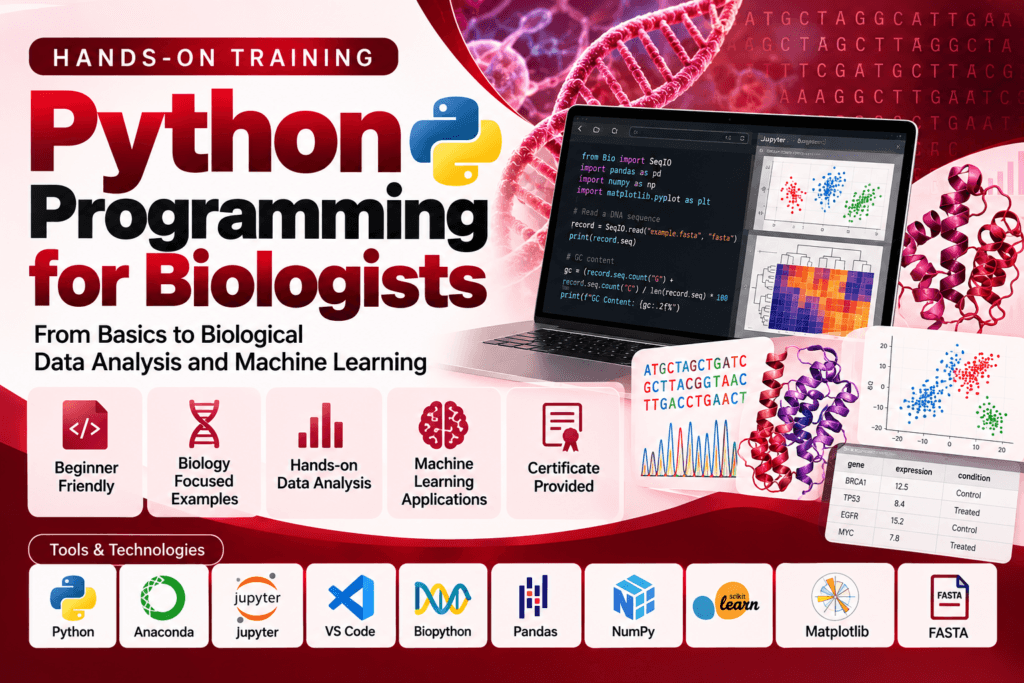
Sneha PatelBioinformatics Analyst, India★★★★★The course is designed for biologists, biotechnology and life science students, researchers, bioinformatics learners, and anyone interested in applying Python to biological data.
No. The course is beginner-friendly and starts with Python fundamentals.
No. The course introduces programming through biology-focused examples and gradually progresses toward bioinformatics applications.
The course consists of 15 hours delivered across 15 days with one 1-hour session each day.
The course is conducted through live interactive sessions.
The course page lists the session timing as 7:00–8:00 PM IST.
The course is conducted in English.
Yes. The curriculum starts with Python fundamentals including variables, data types, strings, lists, dictionaries, sets, control flow, and functions.
Yes. Biological examples include DNA/RNA sequence manipulation, GC-content calculation, gene lists, codon tables, protein analysis, and biological datasets.
Yes. The course includes installation and use of Python with Anaconda for package management.
Yes. Both Jupyter Notebook and VS Code are introduced as Python development environments.
Yes. Pandas is introduced for biological data analysis, while NumPy is covered for numerical and scientific computing.
Yes. The course includes sequence objects, sequence manipulation, reverse complements, transcription, translation, and protein analysis using Biopython.
Yes. File handling includes reading and writing biological files such as FASTA files.
Yes. The final portion of the course introduces machine learning for biological applications using scikit-learn.
Logistic regression is used to build a simple binary classification model for protein classification.
Yes. The course includes an end-to-end machine learning workflow involving protein features, training/testing data, model development, evaluation, and prediction.
Protein classification, such as distinguishing enzyme and non-enzyme classes, is used as an example application.
Yes. Biopython's ProteinAnalysis is used to calculate features such as molecular weight and aromaticity.
Yes. The course covers training/testing splits, feature scaling using StandardScaler, feature preparation, and biological labels.
Yes. Basic visualization using Matplotlib or Pandas plots is included during the machine learning data preparation stage.
Yes. The course page states that a certificate is provided.
You will be able to write Python programs, manipulate biological sequences, work with biological datasets, use Pandas and NumPy, perform sequence analysis with Biopython, prepare biological data for machine learning, and build a basic protein classification model.
Yes. The curriculum focuses on practical Python skills applicable to genomics, proteomics, sequence analysis, biological data processing, and machine learning.
Join thousands of learners and build the skills for tomorrow.