About This Course
Most bioinformatics code runs on one laptop or one cluster and breaks when someone else tries to use it. Biotech companies, sequencing providers and large research groups now expect bioinformaticians to ship software the way engineering teams do: tested, containerised, deployed to the cloud and able to scale from 10 samples to 10,000.
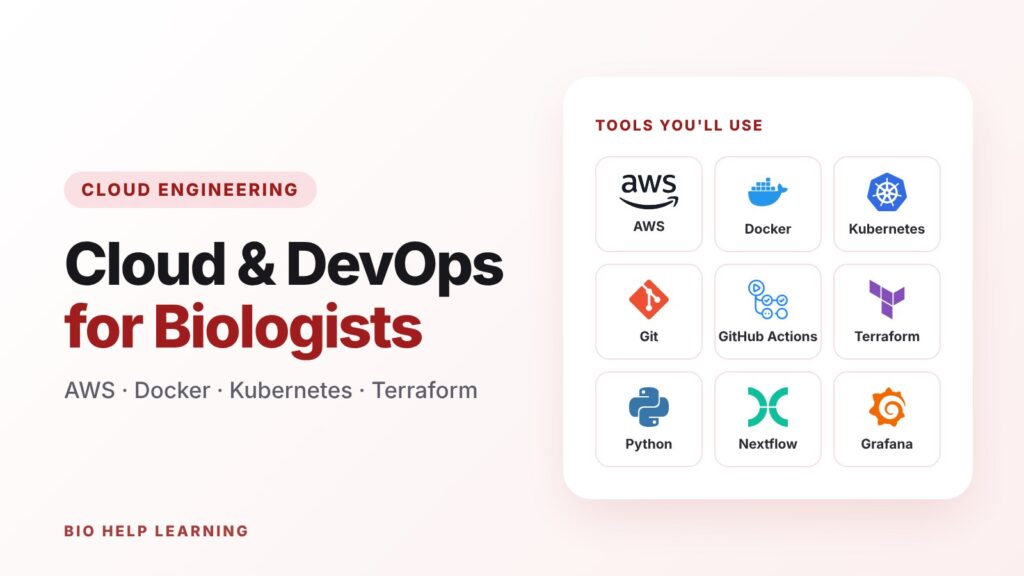
This course teaches that skill set using biological data throughout. You turn analysis scripts into a tested Python package, automate testing and image builds with GitHub Actions, write production-quality Docker images for tools like samtools and STAR, and provision AWS infrastructure with Terraform. You then run Nextflow pipelines on AWS Batch and Kubernetes, store results as Parquet on S3 and query them with Athena and DuckDB, serve results through an API and dashboard, track ML models with MLflow, and add monitoring, cost controls and data-protection safeguards for genomic and patient data.
Who this course is for
- Bioinformaticians moving into industry roles such as Bioinformatics Engineer, Research Software Engineer or Cloud Bioinformatician
- PhD students, postdocs and core-facility staff who need to scale analyses beyond a single server or HPC cluster
- Computational biologists who build tools or pipelines that other people use
- Software and DevOps engineers moving into biotech who want to learn the domain’s data and tools
Prerequisites
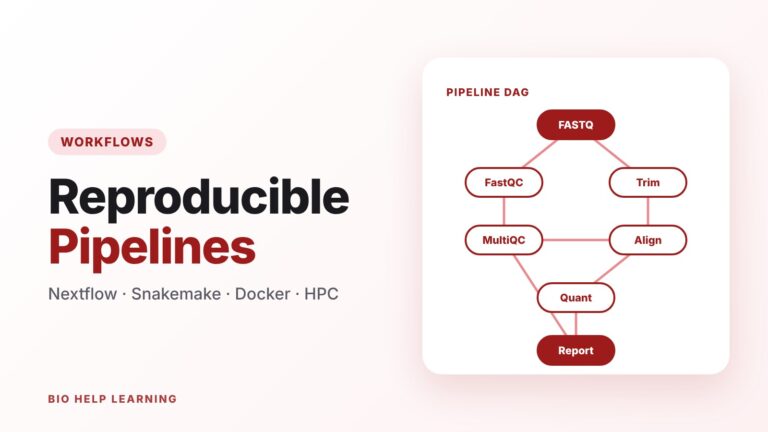
- Reproducible Pipelines with Nextflow, Snakemake, Docker and HPC (or equivalent experience)
- Comfortable with the Linux command line, basic Git, and Python
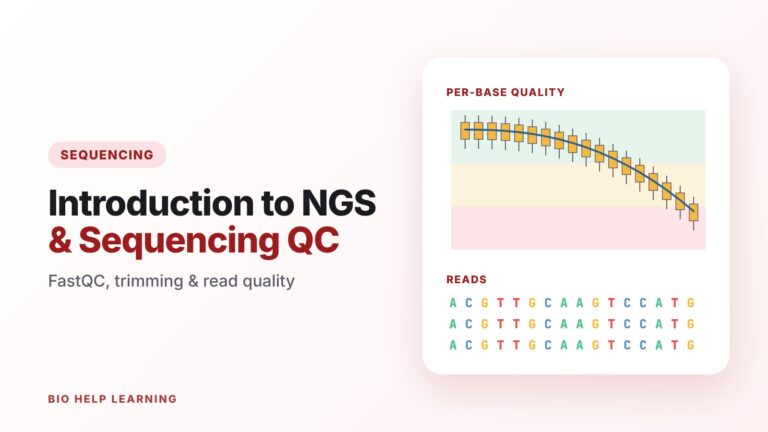
- Has run at least one complete NGS workflow (for example RNA-seq or WGS)
- A laptop with 16 GB RAM recommended; Docker Desktop or Linux with Docker
- An AWS account (free tier). Budget alerts are set up on Day 6 so cloud costs stay small, and every lab ends with a clean-up step.
Final project
Build and deploy a small genomics platform end to end. A raw-FASTQ QC and alignment pipeline is packaged in containers and tested in CI. The infrastructure is defined in Terraform, the pipeline runs on AWS Batch or Kubernetes, results land on S3 as Parquet, and an API and dashboard serve them, with monitoring and a cost report. You present the architecture and a live demo.