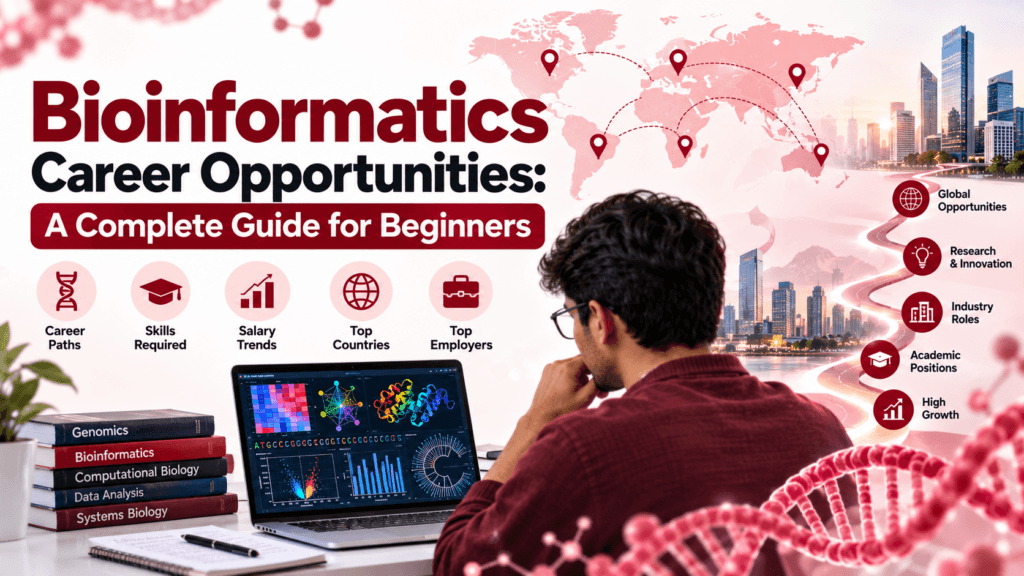
Biology has entered its digital age. Traditionally an observational, wet-lab science, modern biology has transformed into a data-driven discipline. With the advent of Next-Generation Sequencing (NGS), single-cell genomics, and high-throughput proteomics, biological laboratories are generating petabytes of data daily. This massive influx of biological data has created a critical bottleneck: we can generate data much faster than we can analyze and interpret it. This bottleneck is where bioinformatics comes in, making bioinformatics career opportunities some of the most dynamic, lucrative, and impactful pathways in modern science.
For beginners looking to bridge the gap between computer science and life sciences, bioinformatics offers a unique space to solve real-world problems. Whether your interest lies in developing life-saving cancer therapeutics, designing climate-resilient crops, or building computational tools that model complex biological systems, this field has a place for you. In this comprehensive guide, we will explore the diverse bioinformatics career opportunities, the essential skills you need to develop, the industries hiring computational biologists, and practical steps to launch your career.
Why Choose a Career in Bioinformatics?
Choosing a career in bioinformatics means positioning yourself at the intersection of three highly influential fields: molecular biology, computer science, and statistics. There are several compelling reasons why professionals and students are transitioning into this domain:
- High Demand and Job Security: The global bioinformatics market is expanding rapidly, driven by personalized medicine, agricultural biotechnology, and pharmaceutical research. The demand for skilled professionals far outpaces the supply.
- Diverse Career Paths: Bioinformatics is not a monolithic field. You can work as a software developer building genomic tools, a research scientist analyzing clinical trial data, or an academic exploring basic biological mechanisms.
- Tangible Real-World Impact: Bioinformaticians play a direct role in major scientific breakthroughs, such as tracking viral mutations during pandemics, identifying genetic markers for rare diseases, and optimizing metabolic pathways for biofuel production.
- Competitive Salaries: Because the role requires a highly specialized, interdisciplinary skill set, bioinformatics professionals command competitive salaries that often surpass traditional wet-lab biology roles.
Key Bioinformatics Job Roles and Career Paths
Because bioinformatics is highly interdisciplinary, job titles and responsibilities can vary significantly across organizations. To help you navigate the landscape, here are the most common bioinformatics career opportunities explained in detail.
1. Bioinformatics Analyst
A Bioinformatics Analyst is typically an entry-to-mid-level role. The primary focus of an analyst is to run established computational pipelines, perform quality control on raw sequence data, and generate standardized reports for wet-lab scientists or clinicians.
Key Responsibilities:
- Receiving raw sequencing data (such as FASTQ files) and performing quality checks using tools like FastQC.
- Aligning sequences to reference genomes using aligners like BWA, Bowtie, or STAR.
- Running variant calling pipelines (e.g., GATK) or differential gene expression analyses (e.g., DESeq2).
- Creating clear data visualizations (heatmaps, PCA plots, volcano plots) for research teams.
2. Bioinformatics Scientist
A Bioinformatics Scientist is a mid-to-senior-level position that usually requires an advanced degree (Master’s or Ph.D.). Unlike analysts, scientists are responsible for designing the experimental computational frameworks, developing novel analytical methodologies, and interpreting the biological meaning of the results.
Key Responsibilities:
- Formulating biological hypotheses and designing computational experiments to test them.
- Integrating multi-omics datasets (genomics, transcriptomics, epigenomics, and proteomics) to discover biomarkers or drug targets.
- Writing customized scripts to solve non-standard biological problems.
- Collaborating with wet-lab scientists to guide experimental design and sample size calculations.
3. Bioinformatics Software Engineer / Developer
If your passion leans heavily toward computer science and software development, this is the ideal role. Bioinformatics Software Engineers focus on building, optimizing, and maintaining the software tools, databases, and infrastructure that other bioinformaticians and biologists use.
Key Responsibilities:
- Writing high-performance, scalable code in languages like Python, C++, or Rust to process massive datasets.
- Developing and maintaining robust workflow pipelines using systems like Nextflow, Snakemake, or Cromwell.
- Containerizing software applications using Docker or Singularity to ensure reproducibility.
- Designing and managing biological databases (SQL, NoSQL) and building user-friendly APIs or web interfaces.
4. Computational Biologist
While the terms “bioinformatician” and “computational biologist” are often used interchangeably, computational biology frequently leans more toward mathematical modeling, biophysical simulations, and theoretical biology. Computational biologists model complex biological systems, such as protein folding dynamics, metabolic networks, or ecological systems.
Key Responsibilities:
- Developing mathematical models to simulate cellular processes or drug-target interactions.
- Applying structural biology tools and molecular dynamics simulations (e.g., PyMOL, GROMACS).
- Utilizing machine learning and deep learning architectures (like AlphaFold) to predict protein structures and functions.
To help you compare these diverse bioinformatics career opportunities, the table below summarizes the key differences in education requirements and core responsibilities.
| Job Title | Typical Education | Primary Focus | Key Technical Stack |
|---|---|---|---|
| Bioinformatics Analyst | Bachelor’s or Master’s | Running existing pipelines & basic data visualization | R, Python, Bash, Git, Command-line tools (GATK, samtools) |
| Bioinformatics Scientist | Ph.D. or Master’s with experience | Hypothesis generation, biological interpretation, & custom analysis | R, Python, Bioconductor, Advanced Statistics, Machine Learning |
| Bioinformatics Software Engineer | Bachelor’s or Master’s in CS/Bioinformatics | Building tools, software optimization, and pipeline development | Python, C++, Rust, Nextflow, Docker, AWS/Cloud Computing |
| Computational Biologist | Ph.D. in quantitative field | Mathematical modeling, structural biology, & system simulations | Python, MATLAB, C++, Deep Learning libraries (PyTorch, TensorFlow) |
Major Industries Hiring Bioinformatics Professionals
Bioinformatics career opportunities are not limited to academic research labs. A wide variety of sectors rely heavily on computational biology expertise:
Pharmaceuticals and Drug Discovery
The pharmaceutical industry is one of the largest employers of bioinformaticians. Developing a new drug traditionally takes over a decade and costs billions of dollars. Bioinformatics accelerates this process through computer-aided drug design (CADD), target identification, pharmacogenomics (understanding how genetics affect drug response), and analyzing clinical trial data to predict patient outcomes.
Clinical Diagnostics and Healthcare
With the rise of precision medicine, hospitals and clinical diagnostic labs employ bioinformaticians to analyze patient genomes. This is particularly crucial in oncology, where sequencing a tumor’s DNA can reveal specific mutations that guide targeted therapies, and in rare disease diagnostics, where genomic analysis can end years of diagnostic uncertainty for families.
Agricultural Biotechnology (AgTech)
AgTech companies utilize bioinformatics to improve crop yields, enhance nutritional value, and engineer resistance to pests, diseases, and climate change. Bioinformaticians in this sector analyze plant genomes, study soil microbiomes, and assist in marker-assisted breeding programs.
Consumer Genomics and Biotechnology Startups
Companies like 23andMe and Ancestry have popularized direct-to-consumer genetic testing. These organizations require large teams of bioinformaticians to process genetic data, build ancestry algorithms, and conduct large-scale genome-wide association studies (GWAS). Additionally, a thriving ecosystem of biotech startups is constantly seeking talent to innovate in areas like synthetic biology, gene editing (CRISPR), and microbiome therapeutics.
Essential Skills to Build for a Bioinformatics Career
If you are a beginner looking to capitalize on bioinformatics career opportunities, you need to build a balanced, interdisciplinary skill set. The table below outlines the core competencies required to succeed in the field.
| Skill Category | Essential Competencies | Why It Matters |
|---|---|---|
| Programming & Scripting | Python, R, Linux/Bash | Python is crucial for general scripting and machine learning. R is the gold standard for statistical analysis and visualization. Bash is essential for navigating server environments. |
| Biological Domain Knowledge | Genetics, Molecular Biology, Biochemistry | You cannot analyze biological data effectively without understanding the underlying biology, experimental design, and potential sources of biological noise. |
| Data Analysis & Statistics | Hypothesis testing, regression, machine learning, high-dimensional data analysis | Biological data is highly complex and noisy. Strong statistical foundations prevent false-positive discoveries and ensure scientific rigor. |
| Workflow & DevOps Tools | Git/GitHub, Nextflow/Snakemake, Docker | Ensures your analysis pipelines are reproducible, shareable, and scalable across different computational environments (local, HPC, or Cloud). |
Educational Pathways: How to Get Started
There is no single “correct” path to entering bioinformatics. Because the field is so diverse, individuals come from various academic backgrounds. Here are the primary pathways:
1. The Undergraduate Pathway
Many universities now offer dedicated Bachelor of Science (B.Sc.) degrees in Bioinformatics or Computational Biology. Alternatively, pursuing a double major or a minor in Computer Science alongside a Biology major (or vice versa) is an excellent way to build a strong foundation.
2. The Graduate Pathway (Master’s and Ph.D.)
For individuals who already hold a bachelor’s degree in a single discipline (e.g., pure Biology or pure Computer Science), a Master’s degree in Bioinformatics is a highly effective way to transition. A Master’s degree is often considered the terminal professional degree for many industry positions, providing practical computational skills. For those interested in leading R&D teams, designing novel algorithms, or working in academia, a Ph.D. is highly recommended.
3. The Self-Taught / Transition Pathway
If you are already working or studying in a related field, you can transition into bioinformatics through self-directed learning. There are excellent online platforms offering specialized courses, such as Coursera, edX, and Rosalind (a platform dedicated to learning bioinformatics through problem-solving). Building a strong portfolio of personal projects on GitHub is crucial for self-taught individuals to demonstrate their practical capabilities to employers.
How to Land Your First Bioinformatics Job
To successfully stand out in the job market and secure bioinformatics career opportunities, consider the following strategy:
- Build a Public Portfolio: Create a GitHub repository showcasing your code. Include projects where you have analyzed publicly available datasets (such as RNA-Seq data from the Gene Expression Omnibus) or implemented a biological algorithm from scratch.
- Gain Practical Experience: Look for internships, co-ops, or volunteer research opportunities in academic labs. Practical, hands-on experience working with messy, real-world biological data is highly valued by employers.
- Network within the Community: Join professional organizations like the International Society for Computational Biology (ISCB). Attend local meetups, bioinformatics hackathons, and conferences to connect with industry professionals and discover unadvertised job openings.
- Tailor Your Resume: Highlight both your computational skills and your biological understanding. For industry roles, emphasize your experience with version control, reproducibility, and workflow managers, as these are highly sought-after in production environments.
Conclusion
The landscape of bioinformatics career opportunities is vast, intellectually stimulating, and expanding rapidly. As biology continues to evolve into a digital, quantitative science, the need for professionals who can translate complex data into biological insights will only grow. By building a solid foundation in programming, statistics, and molecular biology, and by actively demonstrating your skills through practical projects, you can position yourself at the forefront of this scientific revolution and build a highly rewarding career.
Frequently Asked Questions
1. Can I get a bioinformatics job with a pure biology background?
Yes, but you must actively develop computational skills. Many successful bioinformaticians started in the wet-lab. To make the transition, focus on learning Linux command line, Python, R, and basic statistics. Contributing to open-source projects or completing specialized certificate programs can also help bridge the gap.
2. Do I need a Ph.D. to work in bioinformatics?
No. While a Ph.D. is highly advantageous for senior research roles and academic positions, there are abundant opportunities for Bachelor’s and Master’s graduates as Bioinformatics Analysts, Software Developers, and Data Engineers in both biotech companies and clinical laboratories.
3. Which programming language should I learn first for bioinformatics?
Python and R are the two most important languages in bioinformatics. For beginners, Python is highly recommended for its clean syntax and versatility in handling text processing, file manipulation, and machine learning. R is essential to learn next for its powerful statistical packages and data visualization libraries like ggplot2.
4. What is the average salary for bioinformatics professionals?
Salaries vary depending on geography, education, and sector. In the United States, entry-level Bioinformatics Analysts typically earn between $70,000 and $90,000 annually, while mid-to-senior Bioinformatics Scientists and Software Engineers in the biotechnology industry can command salaries ranging from $110,000 to over $160,000.
5. Are there remote work opportunities in bioinformatics?
Yes. Because bioinformatics is primarily a computational field, it is highly suited for remote and hybrid work environments. Many pharmaceutical companies, biotech startups, and academic institutions offer flexible remote working arrangements for computational staff.
References and Further Reading
- International Society for Computational Biology (ISCB): https://www.iscb.org/ – A global scholarly society dedicated to advancing the scientific understanding of living systems through computation.
- Rosalind: http://rosalind.info/ – An interactive platform for learning bioinformatics through problem-solving.
- National Center for Biotechnology Information (NCBI): https://www.ncbi.nlm.nih.gov/ – Access to biomedical and genomic information, databases, and tools.
- Nature Biotechnology: https://www.nature.com/nbt/ – A leading journal publishing high-impact research in biotechnology and computational biology trends.