Complete Access Plan
Live classes + Recordings + Full support
- Complete course access (Live + Recordings)
- Hands-on training
- Course resources
- Practical datasets
- Certificate of completion
- Project guidance (Q&A support)

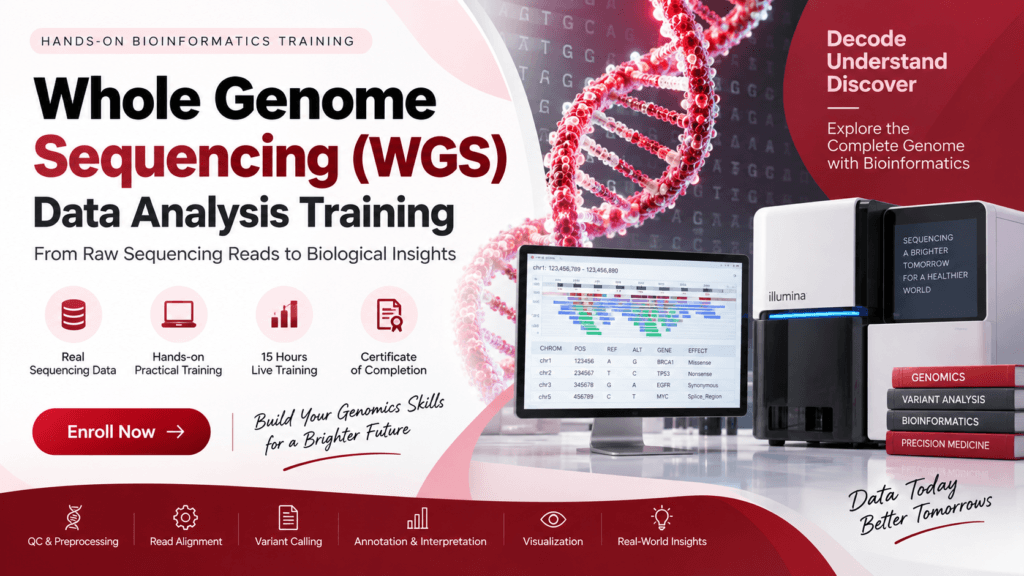
Learn the fundamentals of Whole Genome Sequencing (WGS), from genome organization and sequencing technologies to quality control, read alignment, genome coverage, and basic variant discovery. This 15-day beginner-friendly course provides a practical understanding of the complete WGS analysis workflow.
Everything you need to know before enrolling.
Choose the registration option that matches your needs.
Live classes + Recordings + Full support
Learn at your own pace with recordings
Genome organization, chromosomes, genes, coding/non-coding DNA
Purpose of WGS, applications, advantages and limitations
DNA preparation, fragmentation, library preparation and sequencing
NGS concept, sequencing cycles, reads and paired-end sequencing
Reads, genome size, sequencing depth and data volume
FASTQ structure, read identifiers, bases and quality information
Base quality, Phred scores, Q20/Q30 and sequencing errors
FastQC, MultiQC and basic quality assessment
Adapter removal, quality filtering and cleaned reads
Reference genome, mapping and alignment concept
SAM/BAM, sorting, indexing and alignment statistics
Depth, coverage, genome-wide coverage and coverage gaps
SNPs, SNVs, Indels and basic variant discovery
VCF structure, variant information and basic filtering
Complete workflow + beginner mini-project

Learn from experienced educators and practitioners through practical, career-focused bioinformatics training.
12 answers about this course
Yes. The course starts with the fundamentals of Whole Genome Sequencing and progressively introduces practical WGS data analysis.
No. Prior WGS experience is not required. Basic knowledge of biology and genetics is helpful.
No advanced programming knowledge is required. Basic Linux command-line concepts will be introduced during the training.
The training is 15 hours delivered over 15 days, with 1 hour of live training each day.
The course focuses on hands-on bioinformatics analysis using sequencing datasets and industry-relevant WGS tools.
You will work with GATK, BWA-MEM2, SAMtools, FastQC, MultiQC, SnpEff and IGV.
Yes. The course covers SNP and INDEL variant calling, filtering and downstream interpretation.
Yes. You will learn how to annotate genetic variants and understand their potential functional consequences using SnpEff.
The training includes practical WGS datasets so that you can practice the complete analysis workflow.
Yes. The final sessions include a hands-on WGS mini project covering the workflow from raw sequencing reads to variant interpretation.
Yes. Participants who successfully complete the training requirements will receive a Certificate of Completion.
Yes. Course materials, practical resources and relevant analysis files will be provided as part of the training.
No matching questions. Try another word or ask us directly.
Hear from learners building practical skills with Bio Help Learning.
The workshop provided me an understanding of the principles and techniques involved in bioinformatics, molecular docking, protein-ligand interactions, homology modeling, and drug design.
Ridam BhowmickMaulana Abul Kalam Azad University of Technology, West Bengal.Molecular Docking and Drug DiscoveryAs i am from biotechnology background this workshop, actually very helpfull for me
Anushka ChavanDeogiri college AurangabadBioinformatics TrainingLearn about different molecular docking tools.
Shovan NaskarIndian Institute of Technology (Banaras Hindu University), VaranasiBioinformatics WorkshopThis workshop helped me to learn working with various softwares and also to develop an interest over drug designing
Subhodeep SahaUniversity of CalcuttaBioinformatics TrainingFrom this workshop I learned many new things such as docking, about new websites,how to use Swiss software,basic bioinformatics etc, it's very helpful for me.
Sayan DuttaUniversity of CalcuttaBioinformatics TrainingThe workshop was informative and provided valuable insights into bioinformatics tools and techniques.
Santhosh M EReva University BangaloreBioinformatics Tools and TechniquesThe Drug Discovery Workshop was highly informative and helped me gain valuable knowledge about the drug discovery process, including molecular docking, drug–target interactions, and computational tools used in drug design.
ANUSHA P VCSIR-CCMB, Hyderabad IndiaDrug Discovery WorkshopI learned various bioinformatics techniques and databases and how to use them to explore biological data. The training helped me understand the practical applications of bioinformatics in research.
Prabhavi Praveenkumar kambleSmt. C. H. M. College, MumbaiBioinformatics WorkshopA growing community learning bioinformatics and life-science skills across borders.
Build practical bioinformatics skills with hands-on, project-based courses.