Skip to content
Home›Courses›Whole Exome Sequencing (WES) Data Analysis
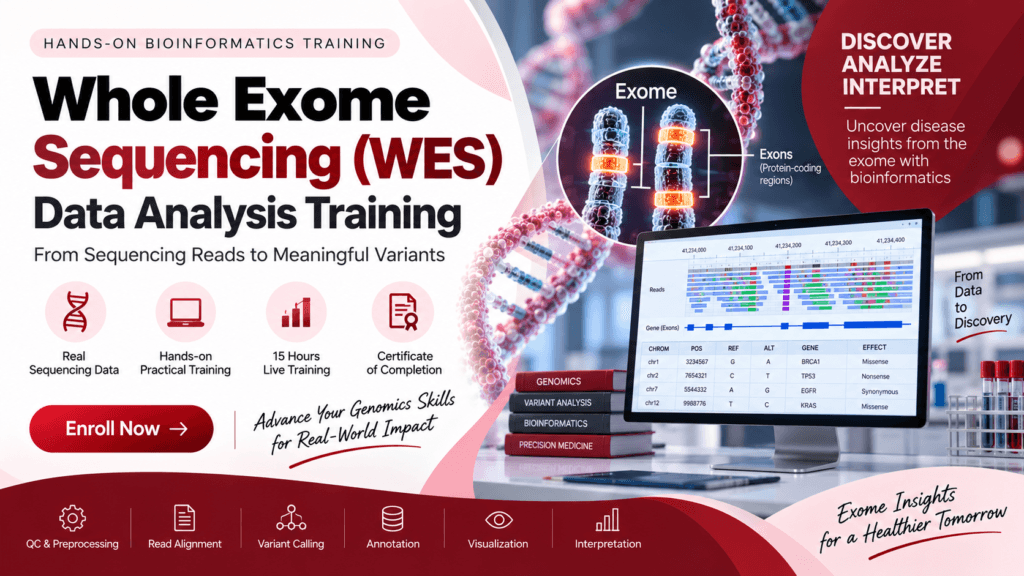
Whole Exome Sequencing (WES) Data Analysis
MOST POPULAR

Whole Exome Sequencing (WES) Data Analysis

Learn whole exome sequencing analysis with GATK best practices: alignment, variant calling, filtering, VEP annotation and clinical interpretation.

Genomics
★★★★★4.8/5(100+ reviews)
◉ Beginner to Intermediate◷ 15 Hours / Live▣ Yes — Certificate of Completion

Course Information

Everything you need to know before enrolling.

START DATE08 November 2026
END DATE22 November 2026
TIMINGS7:00 PM - 8:00 PM IST
PLATFORMGoogle Meet
MODE OF LEARNINGLive Classes
LANGUAGEEnglish

Choose Your Registration Plan

Pick the plan that suits you and register from India or internationally.

Recorded Access Plan

Learn at your own pace with recordings

India₹999
International$20
  • Live class recordings access
  • Project guidance (Q&A support)
  • Complete course access (Live classes)
  • Hands-on training (Live)
  • Certificate of completion
Prefer live classes?Pre-register for the next live batch and get the dates first.
Pre-register →
▤

About This Course

Whole exome sequencing is one of the most widely used tests for finding disease-causing variants. This 15-day training teaches the complete WES workflow used in research and clinical genomics labs.

You go from raw FASTQ files to a clinical diagnosis: read QC with FastQC and fastp, BWA-MEM alignment, duplicate marking and base recalibration, exome coverage QC, GATK HaplotypeCaller with trio joint genotyping, variant filtering, annotation with Ensembl VEP, gnomAD and ClinVar, inheritance-based prioritisation, ACMG/AMP interpretation, IGV review and a clinical report. You practise on a family trio exome built on the real human chromosome 22 reference, ending with a mini project where you solve a rare disease case.

Who this course is for

  • Students interested in human genetics and clinical genomics
  • Researchers analysing exome or gene-panel data
  • Learners preparing for genomics and diagnostics roles

◎

What You’ll Learn

✓Explain how whole exome sequencing works and when to choose it
✓Assess raw read quality and trim reads with FastQC, fastp and MultiQC
✓Align reads to GRCh38 with BWA-MEM and prepare analysis-ready BAM files
✓Measure exome coverage and find poorly covered regions
✓Call germline variants with GATK HaplotypeCaller and joint genotyping
✓Filter variants and check VCF quality, including Mendelian consistency in trios
✓Annotate variants with Ensembl VEP, gnomAD, ClinVar and in-silico predictors
✓Prioritise candidate variants using inheritance models and the patient's phenotype (HPO)
✓Classify variants with the ACMG/AMP guidelines
✓Write a clinical exome report with methods and limitations
⌘

Tools & Technologies

FastQCMultiQCfastpBWA-MEMSamtoolsGATKmosdepthBCFtoolsEnsembl VEPIGV
Course Curriculum

What you will learn, day by day

15 days 15 hours of training 60 topics Certificate on completion
♙

Your Instructor

Bio Help Learning Educator

Bio Help Learning Educator

Educator | Mentor

Learn from experienced educators and practitioners through practical, career-focused bioinformatics training.

in▶
?

Frequently Asked Questions

12 answers about this course

What is Whole Exome Sequencing?

Whole Exome Sequencing is a sequencing approach that focuses primarily on protein-coding regions of the genome, known as exons.

Who can join this WES training?

The training is suitable for biotechnology, bioinformatics, life science, genetics, genomics and related students, researchers and professionals.

Do I need prior WES experience?

No. The course starts with WES fundamentals and progressively moves toward practical data analysis.

Will this course include hands-on analysis?

Yes. Every class has a live hands-on part. You analyse a family trio exome on the real human chromosome 22 reference, using the same steps as a real clinical exome.

What computer do I need?

A laptop with 8 GB RAM and 5 GB free disk, running Linux, Mac, or Windows with WSL2. All software is free and is set up in the first classes.

Which tools will I learn?

FastQC, MultiQC, fastp, BWA-MEM, Samtools, GATK, mosdepth, BCFtools, Ensembl VEP and IGV, plus databases such as gnomAD, ClinVar and ClinGen.

Will I learn variant calling?

Yes. The course covers SNP and indel calling with GATK HaplotypeCaller, joint genotyping of a trio, quality control and filtering.

Will I learn variant annotation and interpretation?

Yes. You annotate variants with Ensembl VEP, gnomAD, ClinVar and prediction tools, then classify them with the ACMG/AMP guidelines.

How am I assessed?

Two assignments (a QC report and a variant QC report) and a mini project. A short practice quiz after each class helps you check your understanding; quiz scores do not count toward the certificate.

Will I receive a certificate?

Yes. You receive a certificate when both assignments are approved and you submit the mini project.

Will I get course materials?

Yes. You get the slides, practice data, ready-made scripts, a cheat sheet, an ACMG worksheet and a clinical report template.

Is there a project at the end of the course?

Yes. You solve a rare disease case: filter the trio's variants, classify the top candidate with ACMG/AMP, write a clinical report and present it on Day 15.

Still have a question?Our team usually replies within one working day.
Ask on WhatsApp →
WHAT OUR LEARNERS SAY

Real Stories. Real Growth.

Hear from learners building practical skills with Bio Help Learning.

View More Reviews →

OUR GLOBAL LEARNERS

Our Learners Are From Different Countries

A growing community learning bioinformatics and life-science skills across borders.

GlobalLearners worldwide
InternationalCountries represented
Learning togetherLearner satisfaction

Ready to Start Your Bioinformatics Journey?

Build practical bioinformatics skills with hands-on, project-based courses.

Explore More Courses →
DNA
Learn.
Apply.
Grow.