Recorded Access Plan
Learn at your own pace with recordings
- Live class recordings access
- Project guidance (Q&A support)
- Certificate of completion
- Complete course access (Live classes)
- Hands-on training (Live)
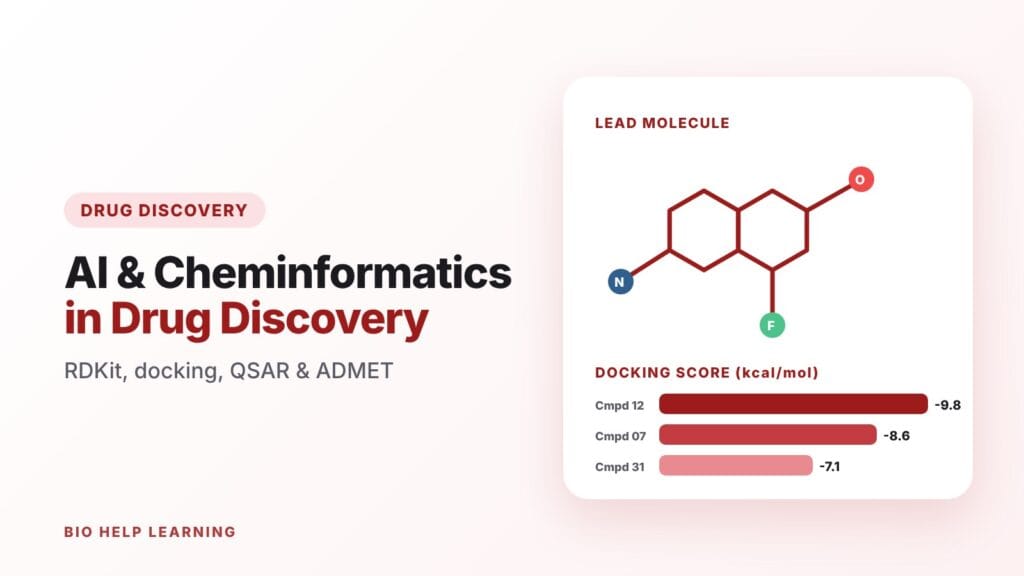
Learn how cheminformatics and AI speed up drug discovery: RDKit, virtual screening, AutoDock Vina docking, QSAR models and generative molecule design.
Everything you need to know before enrolling.
Pick the plan that suits you and register from India or internationally.
Learn at your own pace with recordings
Modern drug discovery relies on computers long before a compound reaches the lab. In this course you learn the cheminformatics and AI workflow that research teams use to find, test and improve drug candidates on screen.
You start by representing molecules as SMILES and calculating their properties with RDKit, then screen chemical libraries, dock ligands into protein targets with AutoDock Vina, build QSAR and ADMET prediction models with scikit-learn, and finish by generating and filtering new molecules with AI.

Learn from experienced educators and practitioners through practical, career-focused bioinformatics training.
18 answers about this course
Students, researchers, PhD scholars, biotechnology, pharmacy, chemistry, bioinformatics, computational biology, and life science learners can join.
No specific prerequisite knowledge is required.
The course is organised into 5 recorded modules that you can complete at your own pace.
Anytime. All sessions are recorded, so you can learn on your own schedule.
The course is delivered through recorded sessions.
Yes. RDKit is used for chemical data handling, molecular properties, fingerprints, conformer generation, and drug-likeness analysis.
Yes. The course includes protein–ligand preparation, AutoDock Vina docking, docking scores, binding poses, and result analysis.
AutoDock Vina is used for docking, with PyMOL or UCSF Chimera for visualization and analysis.
Yes. The course covers chemical-space exploration, molecular fingerprints, similarity searching, and virtual screening concepts.
Yes. The course introduces QSAR modeling and machine learning using scikit-learn.
A Random Forest Regressor is used for molecular property prediction.
Yes. ADMET concepts and practical prediction using ADMETLab are included.
Yes. The final session introduces AI-driven molecular generation using pre-trained generative models.
Yes. Each module includes project tasks that build toward a complete mini drug discovery project.

The project integrates compound selection, screening, docking, QSAR/ML, ADMET prediction, and selection of potential lead compounds.
Yes. A certificate of completion is provided.
Access details are shared after registration. If you need help, message us on WhatsApp at +91 78280 25951.
You get full access to all course materials for 3 months from the date of enrollment.
No matching questions. Try another word or ask us directly.
Hear from learners building practical skills with Bio Help Learning.
This training helped me develop practical skills in whole-genome sequencing analysis, from read quality control using FastQC and MultiQC to read trimming, genome alignment, coverage assessment, and variant calling. Working with a real public dataset helped me understand how different bioinformatics tools fit together in a complete analytical workflow. The hands-on activities strengthened my confidence in using command-line tools and interpreting genomic data. I particularly appreciated the practical approach and the opportunity to apply the concepts through a real project.
Yao Apélété Roland TOGLOUniversity of Lomé TogoWhole Genome Sequencing (WGS) Data Analysis TrainingI really enjoyed the course and found it very useful: it gave a clear and practical overview of the whole WGS workflow, from raw reads to a VCF, and the hands-on sessions helped a lot.
Marc Peralta SerranoUniversity of Barcelona SpainWhole Genome Sequencing (WGS) Data Analysis TrainingThe workshop provided me an understanding of the principles and techniques involved in bioinformatics, molecular docking, protein-ligand interactions, homology modeling, and drug design.
Ridam BhowmickMaulana Abul Kalam Azad University of Technology, West Bengal.Molecular Docking and Drug DiscoveryAs i am from biotechnology background this workshop, actually very helpfull for me
Anushka ChavanDeogiri college AurangabadBioinformatics TrainingLearn about different molecular docking tools.
Shovan NaskarIndian Institute of Technology (Banaras Hindu University), VaranasiBioinformatics WorkshopThis workshop helped me to learn working with various softwares and also to develop an interest over drug designing
Subhodeep SahaUniversity of CalcuttaBioinformatics TrainingFrom this workshop I learned many new things such as docking, about new websites,how to use Swiss software,basic bioinformatics etc, it's very helpful for me.
Sayan DuttaUniversity of CalcuttaBioinformatics TrainingThe workshop was informative and provided valuable insights into bioinformatics tools and techniques.
Santhosh M EReva University BangaloreBioinformatics Tools and TechniquesA growing community learning bioinformatics and life-science skills across borders.
Build practical bioinformatics skills with hands-on, project-based courses.