Skip to content
Home›Courses›Metagenomics data Analysis Course
▶Watch Course Preview
Preview this course and see what you will learn.
BIO HELP LEARNING COURSE

Metagenomics data Analysis Course

Genomics
◉ Beginner to Advanced◷ Self-Paced▣ Certificate Included

Course Information

Everything you need to know before enrolling.

Course schedule and delivery details will be announced soon.

Register for This Course

Choose the registration option that matches your needs.

Recorded Access Plan

Learn at your own pace with recordings

For Learners in India₹999
For International Learners$15
  • Complete course access (Live classes)
  • Hands-on training (Live)
  • Live class recordings access
  • Project guidance (Q&A support)
  • Certificate of completion
▤

About This Course

◎

What You’ll Learn

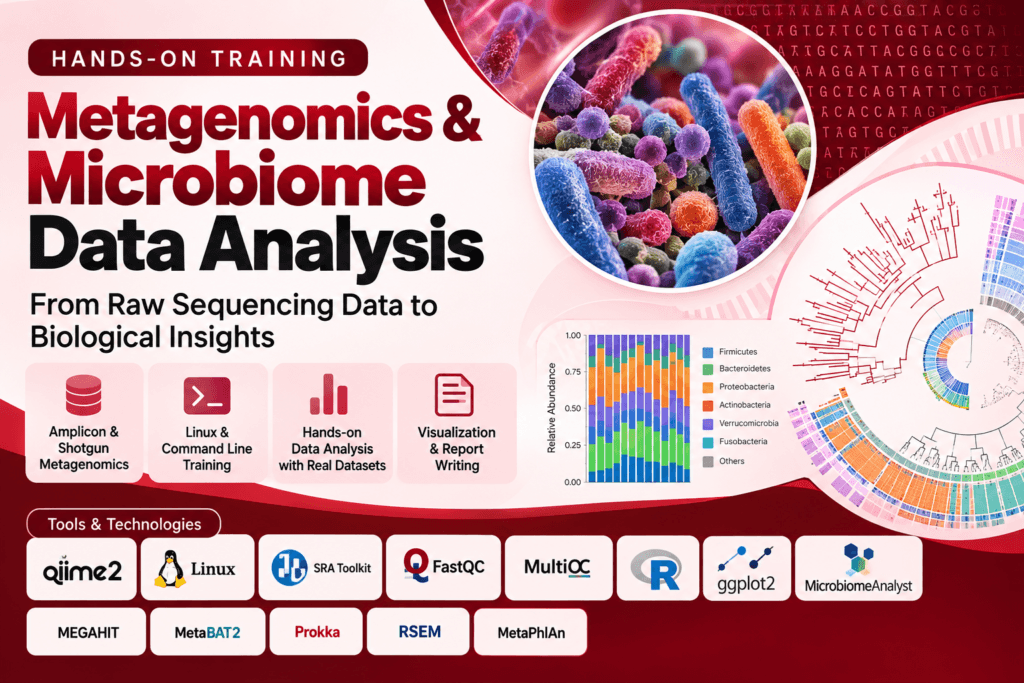
✓Understand the fundamentals, applications, and approaches of metagenomics and microbiome research.
✓Design and understand amplicon and shotgun metagenomics workflows.
✓Perform quality control of sequencing data using FastQC and MultiQC.
✓Work confidently with Linux command-line tools and WSL environments.
✓Download and manage metagenomic datasets from the SRA database.
✓Understand and execute core QIIME2 workflow steps.
✓Perform alpha and beta diversity analysis and interpret PCoA results.
✓Understand phylogenetic analysis and differential abundance testing.
✓Interpret microbiome visualization outputs and biological results.
✓Understand shotgun metagenomics workflows and functional profiling.
✓Explore metagenomic analysis using web-based platforms such as MicrobiomeAnalyst.
✓Create publication-oriented microbiome visualizations using R and ggplot2.
✓Interpret metagenomics results and communicate scientific findings effectively.
✓Prepare a structured scientific report based on a metagenomics case study.

⌘

Tools & Technologies

QIIME2Linux / WSLSRA ToolkitFastQCMultiQCCutadaptTrimmomaticAnacondaR & ggplot2MicrobiomeAnalystMEGAHITMetaBAT2ProkkaRSEMMetaPhlAn
☷

Course Curriculum

15 Modules
♙

Your Instructor

Ananya Ghosh

Ananya Ghosh

Bioinformatics Expert in Metagenomics Data Analysis

Ananya is a Bioinformatics professional with a strong foundation in multi-omics and computational biology. Holding a Master’s in Systems Biology, she specializes in microbiome analysis and has worked on diverse projects spanning phylogenomics, network biology, and transcriptomics. With a strong research background and a passion for integrating theory with hands-on research, Ananya is dedicated to engaging students in genomics, microbiome research, and data-driven biological insights. She is committed to advancing bioinformatics education and fostering a deeper understanding of computational approaches across various domains of life sciences.

in▶
★

Student Reviews

★★★★★ 4.8/5
AV

“Excellent course! The content is practical and the projects made the concepts much easier to apply.”

Ananya VermaPhD Scholar, India★★★★★
RM

“Hands-on projects made all the difference. The guided workflow made the analysis easier to follow.”

Rahul MehtaResearch Associate, Germany★★★★★
SM

“Very detailed and practical content. I feel much more confident now.”

Sneha PatelBioinformatics Analyst, India★★★★★
?

Frequently Asked Questions

Need help? →
Who can join this metagenomics training?⌄

Students, researchers, PhD scholars, biotechnology and life science graduates, bioinformaticians, and anyone interested in microbiome data analysis.

Do I need prior bioinformatics experience?⌄

No. The course covers Linux, command-line tools, and metagenomics workflows from the fundamentals.

Will this course cover both amplicon and shotgun metagenomics?⌄

Yes. The course covers amplicon-based microbiome analysis using QIIME2 and the workflow and tools used in shotgun metagenomics.

Will there be hands-on sessions?⌄

Yes. Hands-on sessions include Linux commands, sequencing data QC, SRA data handling, QIIME2 analysis, and microbiome data exploration.

Will I learn QIIME2?⌄

Yes. QIIME2 is covered in detail, including data formats, metadata, manifest files, demultiplexing, denoising, diversity analysis, phylogeny, visualization, and interpretation.

Will Linux be covered?⌄

Yes. The course includes WSL, Linux file systems, navigation, command-line usage, and practical bioinformatics commands.

Will I learn how to download datasets from SRA?⌄

Yes. The training covers SRA Run Selector and SRA Toolkit for downloading sequencing datasets and working with FASTQ files.

Will shotgun metagenomics be taught?⌄

Yes. The course covers the complete shotgun metagenomics workflow, major tools, functional profiling, and expected results.

Which shotgun metagenomics tools will be discussed?⌄

MEGAHIT, MetaBAT2, Prokka, RSEM, MetaPhlAn, and other tools used across the shotgun metagenomics workflow.

Will I learn R for microbiome visualization?⌄

Yes. The course introduces R and ggplot2 for visualization of microbiome datasets.

Will diversity analysis be covered?⌄

Yes. The course covers alpha diversity, beta diversity, PCoA, phylogenetic analysis, and interpretation of microbiome diversity results.

Will differential abundance analysis be covered?⌄

Yes. The course introduces statistical concepts and differential abundance approaches used in microbiome research.

Will MicrobiomeAnalyst be included?⌄

Yes. MicrobiomeAnalyst is covered as a web-based platform for microbiome data analysis and visualization.

Will report writing be covered?⌄

Yes. A dedicated session covers scientific report writing, results interpretation, and presentation of metagenomics findings.

Is this course suitable for beginners?⌄

Yes. The course progresses from fundamental metagenomics concepts and Linux basics to practical analysis and interpretation.

What will I learn after completing the course?⌄

You will learn to understand metagenomics workflows, perform sequencing QC, work with QIIME2, analyze microbiome diversity, explore metagenomic datasets, visualize results, and interpret scientific findings.

Ready to Start Your Bioinformatics Journey?

Join thousands of learners and build the skills for tomorrow.

Explore More Courses →
DNA
Learn.
Apply.
Grow.