India sequences genomes, runs clinical trials, manufactures a large share of the world’s generic medicines, and writes software for much of the global pharmaceutical industry. Sitting between all of those is a quieter industry: the companies that turn biological data into something a scientist or a doctor can act on.
If you are a biotechnology or life-science student in India, the top bioinformatics companies in India are probably where your first real job will come from. But “bioinformatics company” covers at least five very different kinds of business. They hire for different skills, pay differently, and want different things in an interview. Applying to all of them with the same CV is the most common mistake students make.
This article maps the industry: who the main players are, what each one actually does, where they are located, what they test you on, what the work pays, and what is genuinely difficult about building a career here.
How the Indian bioinformatics industry is organised
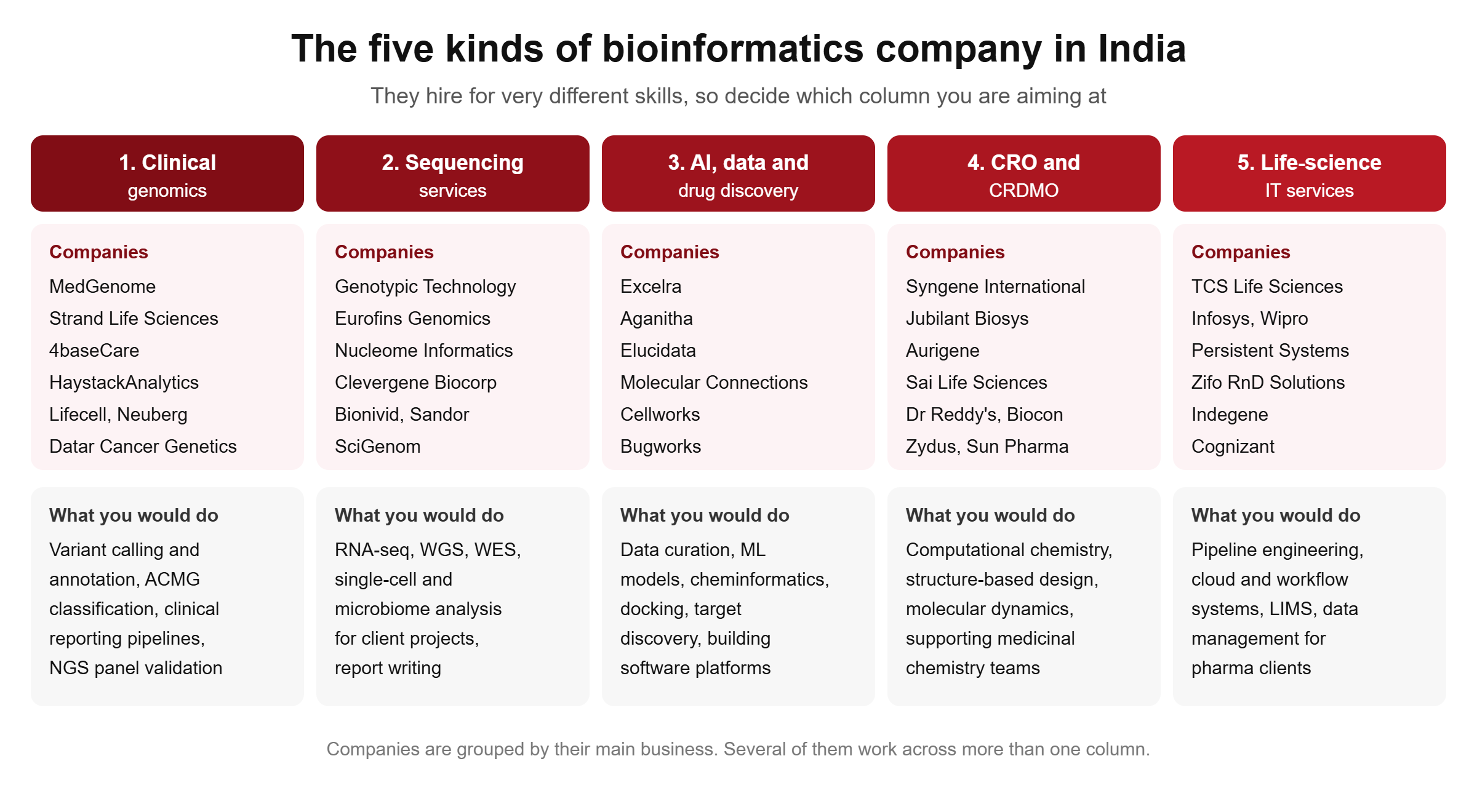
Before the company names, it helps to understand the five business models, because the job you would do is completely different in each.
- Clinical genomics and diagnostics. These companies sequence patient samples and return a medical report. The bioinformatics is regulated, validated and repeatable. Accuracy matters more than novelty.
- Sequencing and omics services. Research customers send samples; the company returns processed data and analysis. The work is varied, project-based and closest to what you did in your MSc dissertation.
- AI, data and computational drug discovery. These companies sell software, curated data or discovery services to pharmaceutical clients. The most technical segment, and the fastest growing.
- CRO and CRDMO. Contract research organisations that run discovery and development programmes for global pharma. Their computational chemistry teams sit alongside synthetic chemists and biologists.
- Life-science IT services. The large Indian IT firms with dedicated life-science divisions. Here bioinformatics is a software engineering job with biology attached.
One number for context: MarketsandMarkets projects India’s bioinformatics market to grow from about USD 568 million in 2026 to roughly USD 1,177 million by 2031, around 15.7 percent a year. Treat that as a ballpark. Different research firms count very different things and their figures vary widely.
Clinical genomics: the biggest employers
MedGenome
MedGenome is probably the single largest genomics employer in India and the name most students recognise. Headquartered in Bengaluru, it combines a diagnostics business with a research arm, and it has built one of the largest South Asian genomic datasets. That dataset is scientifically valuable because global reference databases heavily under-represent Indian populations.
It has kept expanding through 2026: launching OncoTrack MRD, a tumour-informed minimal residual disease test for monitoring cancer patients; extending its diagnostics network across the Mumbai suburbs; and taking a majority investment in Mumbai-based Medcare Diagnostics. It has also raised a Series E round to widen access to its genomics and integrated diagnostics services.
What you would do there: variant calling and annotation, clinical interpretation, pipeline validation, and research collaborations on population genomics.
Strand Life Sciences
Strand Life Sciences is the elder statesman of Indian bioinformatics. It began in Bengaluru as a pure bioinformatics software company built out of IISc, spent years selling analysis platforms, and later moved into clinical genomic diagnostics. In 2021 Reliance Industries acquired it, and Strand is now a Reliance subsidiary, which changed the scale of what it can attempt.
Recent work includes the StrandOmics portal for rare disease diagnosis, launched on Rare Disease Day alongside discounted genetic testing for underprivileged patients, and high-throughput proteomics using the Olink Explore HT platform, among the first such capability available in India. CEO Ramesh Hariharan has said the company’s aim is to make genomics as routine as a blood pressure check.
Strand matters to students for one specific reason: it is among the few Indian companies with a long history of building real bioinformatics software, not just running pipelines.
4baseCare
4baseCare, founded in Bengaluru and an Illumina Accelerator alumnus, is a precision oncology company. Its argument is that global cancer genomics data is heavily skewed towards Western populations, which limits how well it predicts outcomes for Asian patients, so it builds genomics infrastructure in under-represented regions.
It raised about USD 6 million in Series A in 2024 and extended a Series B through 2026, taking total funding to roughly USD 18 to 21 million depending on which tracker you consult. Its OncoTwin platform combines genomic, pathology, radiology and clinical data to build digital twins of cancer patients and match them to similar treatment journeys. It has also been setting up in-hospital genomics labs with partners including Max Healthcare and AIIMS Jammu.
HaystackAnalytics
HaystackAnalytics, founded in 2018 and incubated at IIT Bombay, took a different route. Rather than centralising sequencing, it built technology that lets an ordinary molecular diagnostic lab run genomic analysis on its own bench. Its best-known application is genomic tuberculosis testing, which identifies drug resistance far faster than culture-based methods. For a country with India’s TB burden, that is a genuinely significant use of bioinformatics.
Sequencing and omics service providers
These companies are the practical entry point for most bioinformatics graduates, because the work maps directly onto standard academic analysis.
- Genotypic Technology (Bengaluru) is one of India’s oldest genomics service providers, offering NGS, microarrays, single-cell and long-read sequencing with bioinformatics support.
- Eurofins Genomics India is the Indian arm of the global Eurofins group, covering sequencing, gene synthesis, genotyping and gene expression analysis.
- Nucleome Informatics (Hyderabad) works across genomics, metagenomics and transcriptomics for healthcare, agriculture and microbiology, with notable strength in plant and agricultural genomics, an under-rated area for Indian job seekers.
- Clevergene Biocorp (Bengaluru) handles sequencing, microbiome analysis, variant discovery and transcriptomics.
- Bionivid Technology, Sandor Lifesciences and SciGenom round out the segment.
The honest assessment: service companies give you enormous breadth very quickly. In one year you might touch RNA-seq, metagenomics, variant calling and single-cell data. The trade-off is that you rarely go deep on any single problem, and junior pay here is usually the lowest of the five segments.
AI, data and computational drug discovery
This is the most technical segment and, for students willing to learn to code properly, the most interesting.
Excelra
Excelra, based in Hyderabad, is a data and analytics company whose flagship product is GOSTAR, a structure-activity relationship database covering millions of small molecules linked to their biological, pharmacological and therapeutic activity. It is one of the few Indian-built scientific data products with genuine global standing.
Excelra has supplied GOSTAR to Lawrence Livermore National Laboratory as part of the ATOM consortium, which aims to compress drug discovery timelines, and partnered with X-Chem, whose analysis found that models trained on GOSTAR data outperformed equivalent models trained on public datasets. There is a lesson in that for students: in machine learning for chemistry, curated data is often worth more than a cleverer model.
Aganitha
Aganitha, also in Hyderabad, provides in-silico drug discovery services combining computational biology, computational chemistry, AI and cloud computing. Its job listings are an unusually honest syllabus for this field: QSAR, docking, virtual screening, structure-based design, pharmacophore modelling, molecular dynamics, free-energy perturbation, RDKit, KNIME, and the databases ChEMBL, PubChem, PDB, UniProt and AlphaFold DB. If you want to know what this segment expects, read their open roles.
Worth noting: Aganitha’s scientist positions in both cheminformatics and computational biology typically ask for a PhD or postdoctoral experience. This is not a segment with many pure-fresher openings.
Elucidata
Elucidata began in Delhi and now has its headquarters in the United States, with R and D hubs including India. Its platform, Polly, harmonises messy biomedical data into machine-learning-ready datasets, on the argument that AI keeps failing in life sciences because the data is not ready rather than because the models are weak. It raised a USD 16 million Series A led by Eight Roads Ventures, was ranked eighth in Biotech on Fast Company’s Most Innovative Companies list in 2024, and launched Elucidata AI Labs in January 2026.
Elucidata illustrates a pattern worth understanding: several of India’s strongest bioinformatics teams now sit inside companies that are legally headquartered abroad but do much of their scientific work here.
Others in this segment
Molecular Connections (Bengaluru) works in scientific data curation and text mining at large scale. Cellworks builds computational models of cancer biology to predict therapy response. Bugworks, also in Bengaluru, works on antibiotic discovery, one of the hardest and least commercially rewarding problems in the whole of drug development.
CRO and CRDMO: where computational chemistry lives
Syngene International, a Biocon subsidiary headquartered in Bengaluru with sites in Hyderabad and Mangaluru, is India’s best-known contract research organisation. Its services span chemistry, biology, safety assessment and toxicology, and it runs a dedicated Computational and Data Sciences function. Its clients include BMS, GSK, Zoetis and Merck KGaA.
Jubilant Biosys, part of Jubilant Pharmova, operates from Noida, Greater Noida, Bengaluru and Europe with around 1,700 employees. Its computational chemistry group covers virtual screening, ligand-based and structure-based design, fragment-based design and chemoinformatics, alongside protein crystallography. It opened a new discovery and preclinical facility in Noida in January 2026, doubling its early chemistry scale-up capacity.
Aurigene (Dr Reddy’s), Sai Life Sciences and the research arms of Biocon, Sun Pharma and Zydus Lifesciences also run computational teams.
There is a structural tailwind here. Global pharmaceutical companies are redirecting contract research away from China, and India is the obvious alternative. Jubilant’s leadership has said that global innovators increasingly treat India as a parallel execution base rather than a peripheral outsourcing destination, and that Indian CRDMOs are now trusted with mission-critical work rather than contingency assignments. For a student, that means this segment is likely to keep expanding.
Life-science IT services
TCS, Infosys, Wipro, Cognizant and Persistent Systems all run life-science divisions covering genomics pipelines, clinical data management, regulatory compliance and healthcare IT. Zifo RnD Solutions (Chennai) specialises in R and D informatics and laboratory systems, and Indegene focuses on commercial and medical operations for pharma.
Students often dismiss this segment as not being real bioinformatics. That is a mistake, for two reasons. Entry-level pay here is frequently the highest of the five segments. And the engineering discipline you learn, version control, testing, cloud infrastructure, code review, is exactly what the research-heavy companies complain that biology graduates lack.
Where these companies are
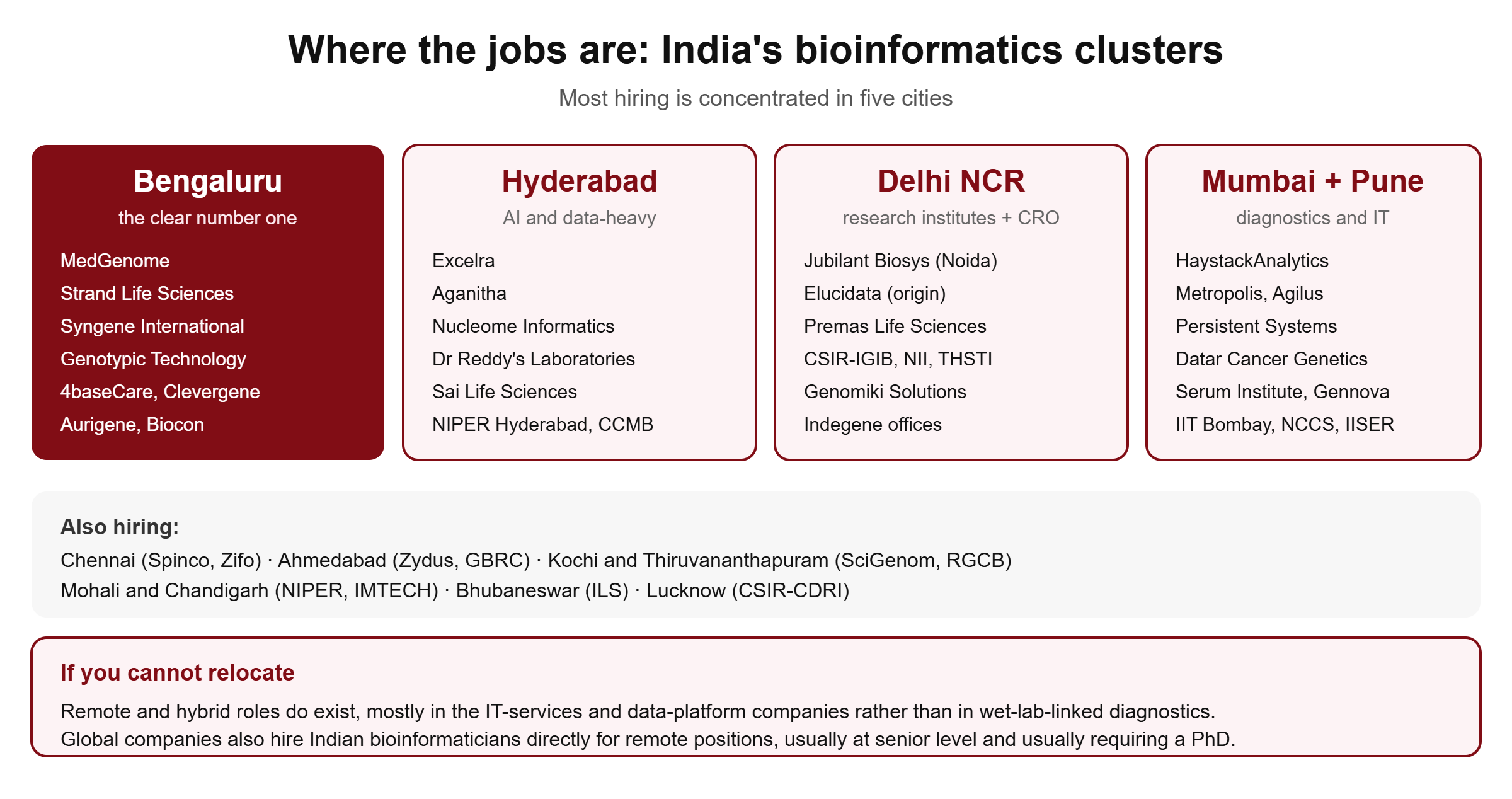
Bengaluru is the centre of gravity by a wide margin: MedGenome, Strand, Syngene, Genotypic, 4baseCare, Clevergene, Aurigene and Biocon are all there. If you are serious about this field and can relocate, Bengaluru roughly doubles the number of openings available to you.
Hyderabad is the second cluster and skews towards AI and data: Excelra, Aganitha, Nucleome, Dr Reddy’s and Sai Life Sciences, alongside CCMB and NIPER Hyderabad.
Delhi NCR combines CRO work, with Jubilant in Noida, and a dense concentration of public research institutes including CSIR-IGIB, NII and THSTI.
Mumbai and Pune host diagnostics and IT: HaystackAnalytics, Metropolis, Agilus, Persistent Systems and Datar Cancer Genetics, plus IIT Bombay and NCCS.
Beyond these, Chennai, Ahmedabad, Kochi, Thiruvananthapuram, Mohali and Bhubaneswar all have smaller clusters, usually built around a research institute.
The public sector you should not ignore
Students fixate on private companies and overlook that some of India’s most ambitious genomics work is government-funded.
The GenomeIndia Project, launched by the Department of Biotechnology in 2020 and involving around 20 institutions, completed whole genome sequencing of more than 10,000 individuals representing India’s major population groups. The resulting dataset and the Indian Biological Data Centre portals were launched in January 2025, and by 2026 the project had completed joint analysis across those genomes to build a catalogue of variation specific to Indian populations. It followed CSIR’s IndiGen programme, which sequenced about 1,000 genomes as a pilot from 2019.
This matters scientifically because global genetic studies remain heavily Euro-centric while India has enormous population diversity. It matters practically because CSIR labs, DBT institutes, the IITs, IISc, NIPER campuses and the Indian Biological Data Centre all employ bioinformaticians. Project positions are often advertised at lower salaries than industry, but they are a legitimate route into research and frequently the best preparation for a PhD.
What these companies actually test you on
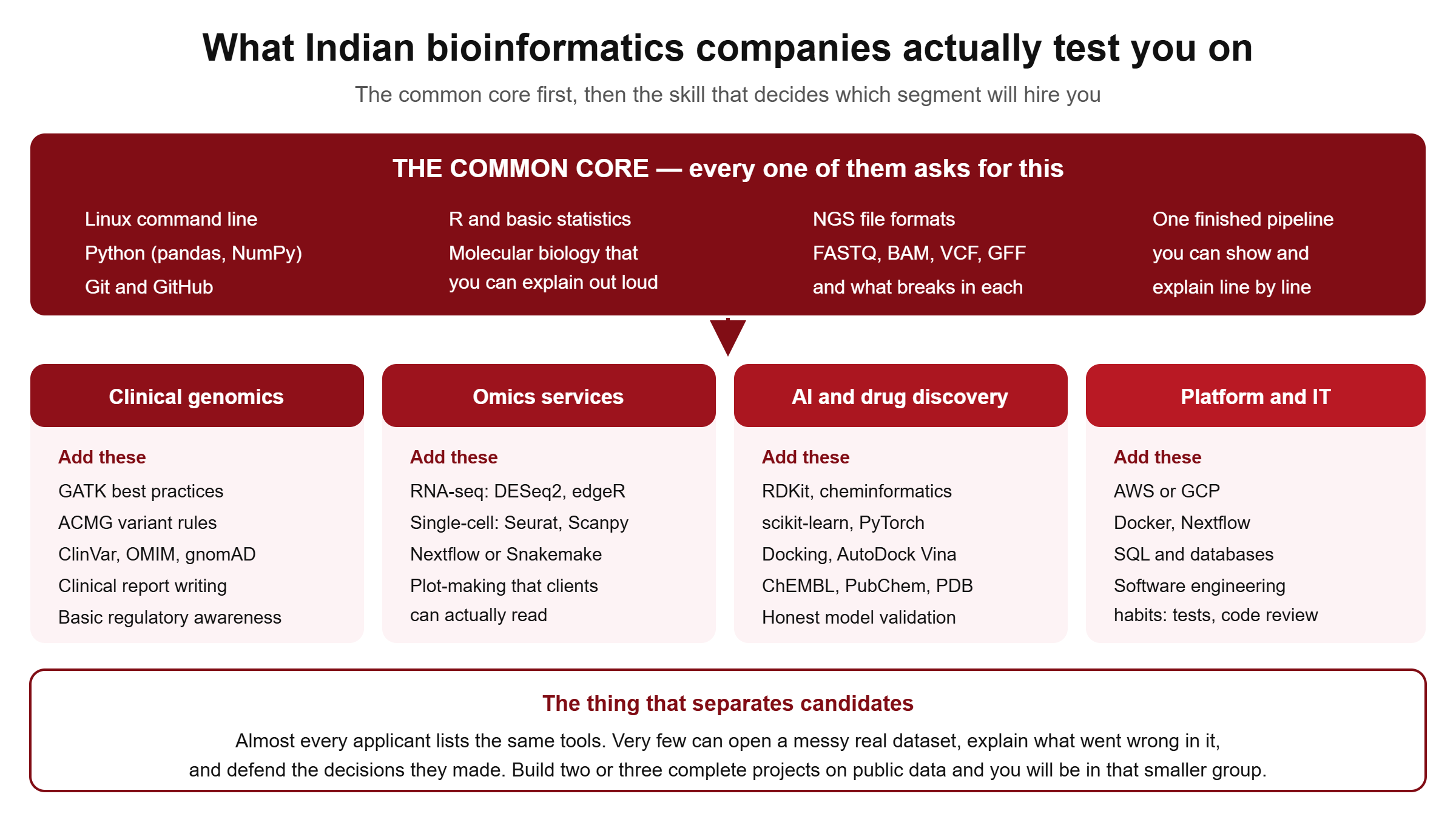
Across all five segments the common core is the same: Linux, Python with pandas and NumPy, Git, some R and statistics, molecular biology you can explain clearly out loud, and real familiarity with NGS file formats and what goes wrong inside them.
After that it splits by segment. Clinical genomics wants GATK, ACMG variant classification rules, ClinVar, gnomAD and clinical reporting. Omics services want DESeq2, Seurat or Scanpy, and a workflow manager such as Nextflow or Snakemake. AI and drug discovery want RDKit, scikit-learn, PyTorch, docking and honest model validation. Platform and IT want cloud, Docker, SQL and software engineering habits.
What actually separates candidates is not the tool list, because every applicant writes the same tool list. It is whether you can take a messy real dataset, explain what was wrong with it, and defend the decisions you made. Two or three complete projects on public data will put you in a much smaller group. Our guides on bioinformatics projects using Python and bioinformatics project ideas for students cover how to build those, and how to become a bioinformatician sets out the full roadmap.
If you are targeting the AI and drug discovery segment specifically, our AI and Cheminformatics in Drug Discovery and AI and Machine Learning for Bioinformatics courses are built around these exact skills, and the scientific background is covered in our article on AI-driven drug discovery.
What the work pays
Salary data for this field in India is genuinely unreliable, and you should be suspicious of any article that gives you one confident number.
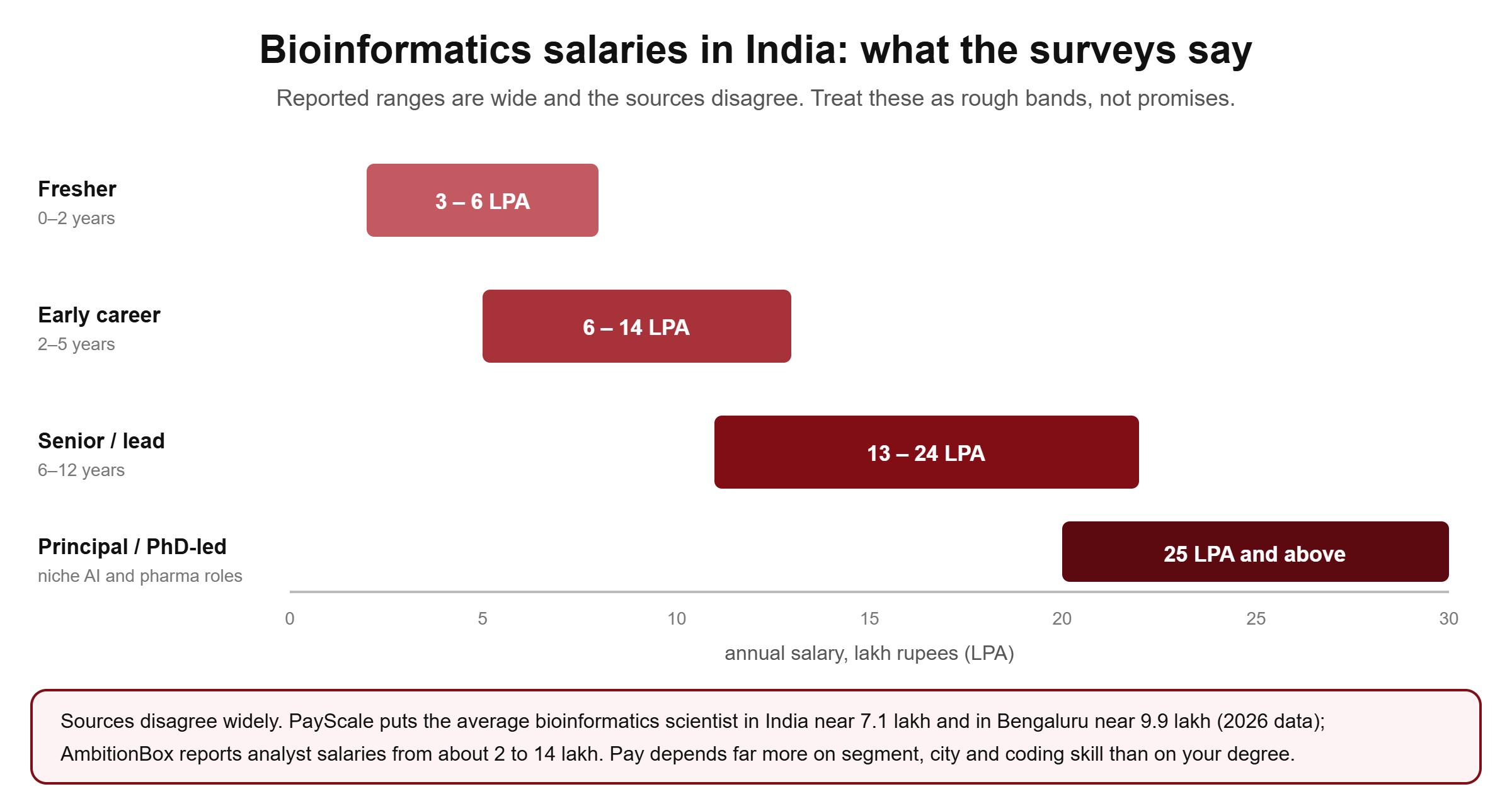
PayScale puts the average bioinformatics scientist salary in India at around 7.1 lakh rupees for 2026, with early career near 6.5 lakh and Bengaluru-based roles closer to 9.9 lakh. AmbitionBox, drawing on self-reported figures, reports bioinformatics analyst salaries ranging from roughly 2 lakh to 14 lakh. Those two pictures do not fully agree, and the sample sizes behind them are small.
As a working approximation: freshers typically land between 3 and 6 lakh, early-career professionals between 6 and 14 lakh, senior and lead roles between 13 and 24 lakh, and principal or PhD-led roles in AI-heavy companies above 25 lakh.
Three honest observations. Pay varies more by segment than by seniority, with IT services and AI drug discovery at the top and small service labs at the bottom. Coding ability moves your salary more than an additional biology degree does. And the gap between the best-paid and worst-paid bioinformatics jobs in India is wider than in almost any adjacent field, which means the company you join early matters a great deal.
The difficulties nobody advertises
An honest guide has to cover what makes this hard.
Entry-level competition is severe. India produces far more biotechnology and bioinformatics graduates each year than this industry creates junior positions. Many postings labelled bioinformatics quietly expect software-engineering competence that a standard MSc does not provide.
Companies do fail. Karkinos Healthcare, an oncology platform founded in 2020 that raised around USD 69 million and attracted investors including Tata Trusts entities, Ratan Tata and the Mayo Clinic, entered corporate insolvency in May 2024. Reliance Strategic Business Ventures acquired it through the NCLT resolution process with a plan of about 202 crore rupees, approved in December 2024. Well-funded and well-connected is not the same as safe.
Consolidation is reshaping the sector. Reliance acquired Strand and then Karkinos; Metropolis acquired Core Diagnostics; Manipal HealthMap bought iGenetic. Good for scale, but it means fewer independent employers.
Many roles are service work, not research. A large share of Indian bioinformatics jobs involve running established pipelines on client data to a deadline. That is valuable and it pays, but if you came for novel science, be clear-eyed about which jobs offer it.
PhDs dominate the most interesting roles. The AI drug discovery companies openly recruit PhD and postdoctoral candidates for scientist positions. You can enter the industry without one, usually through services, diagnostics or IT, but the research-leading roles mostly expect it. We discuss that trade-off in is a PhD in bioinformatics worth it in the AI era, and the wider question of automation in will AI replace bioinformaticians.
Frequently asked questions
Which is the best bioinformatics company in India?
There is no single best one, because it depends what you want. MedGenome and Strand Life Sciences are the largest and most established in clinical genomics. Excelra and Aganitha are the most technically demanding in AI and drug discovery. Syngene and Jubilant Biosys give the broadest exposure to real pharmaceutical programmes. TCS and Persistent pay well at entry level and teach engineering discipline.
Can I get a bioinformatics job in India as a fresher?
Yes, but target the right doors. Sequencing service companies, diagnostics labs and IT-services divisions hire freshers regularly. AI drug discovery companies mostly do not. A portfolio of two or three finished projects matters more than your marks.
Do I need a PhD to work in bioinformatics in India?
Not to enter. Analyst, associate and engineer roles are open to BSc and MSc graduates. For scientist-level and research-leading positions, particularly in computational drug discovery, a PhD is the normal expectation.
Which city is best for bioinformatics jobs in India?
Bengaluru, clearly, with Hyderabad second. If you cannot relocate, remote and hybrid roles exist mainly in IT-services and data-platform companies rather than in diagnostics, which is tied to physical laboratories.
Is bioinformatics a good career in India?
It is a good career for people who genuinely enjoy programming and data work. It is a frustrating one for people who chose it mainly to avoid the wet lab. The field is growing, the companies are real and the public genomics programmes are expanding, but the junior market is competitive and the work is more computational than most students expect.
What should I learn first if I want to join one of these companies?
Python and Linux, before anything else. Then one complete analysis workflow end to end, from raw reads to an interpreted result, done by yourself on public data, with the code on GitHub. That single project will teach you more, and impress an interviewer more, than four separate tool certificates.
Key takeaways
- Indian bioinformatics splits into five segments: clinical genomics, omics services, AI and drug discovery, CRO and CRDMO, and life-science IT. They hire differently.
- MedGenome and Strand Life Sciences lead clinical genomics; Excelra, Aganitha and Elucidata lead the data and AI segment; Syngene and Jubilant Biosys lead contract research.
- Bengaluru dominates hiring, with Hyderabad second, then Delhi NCR, Mumbai and Pune.
- Public programmes such as GenomeIndia, which has sequenced over 10,000 Indian genomes, are a real and under-used career route.
- Salary surveys disagree widely. Your segment, city and coding ability affect pay more than your degree does.
- Entry-level competition is severe and companies do fail. Build projects, pick a segment, and be realistic about which jobs are research and which are service.
References and further reading
- MarketsandMarkets, India Bioinformatics Market report (2026 to 2031)
- Department of Biotechnology, GenomeIndia Project updates, and the Indian Biological Data Centre (ibdc.rcb.res.in)
- BioSpectrum India and Indian Pharma Post, 2026 coverage of MedGenome, Strand Life Sciences and Jubilant Biosys
- Insolvency and Bankruptcy Board of India, Karkinos Healthcare corporate insolvency record (ibbi.gov.in)
- PayScale and AmbitionBox salary data for bioinformatics roles in India, 2026
- Company career and product pages: Aganitha, Excelra (GOSTAR), Syngene International, Jubilant Biosys, MedGenome, Strand Life Sciences