Skip to content
Home›Courses›Cloud and DevOps for Computational Biologists
Cloud and DevOps for Computational Biologists
BIO HELP LEARNING COURSE

Cloud and DevOps for Computational Biologists

Build, test, deploy and scale bioinformatics software like an engineering team: Git workflows, CI/CD, Docker, Terraform, AWS, Kubernetes and MLOps for omics data.

Programming
◉ Advanced◷ 30 Hours▣ Certificate Included

Course Information

Everything you need to know before enrolling.

MODE OF LEARNINGLive Classes
LANGUAGEEnglish

Pre-Register for Live Training

Registration for the next live batch opens soon. Pre-register and our team will contact you with the batch dates, fees and registration link as soon as it opens.

  • Live online classes
  • Group & college batches
  • Certificate on completion
▤

About This Course

Most bioinformatics code runs on one laptop or one cluster and breaks when someone else tries to use it. Biotech companies, sequencing providers and large research groups now expect bioinformaticians to ship software the way engineering teams do: tested, containerised, deployed to the cloud and able to scale from 10 samples to 10,000.

This course teaches that skill set using biological data throughout. You turn analysis scripts into a tested Python package, automate testing and image builds with GitHub Actions, write production-quality Docker images for tools like samtools and STAR, and provision AWS infrastructure with Terraform. You then run Nextflow pipelines on AWS Batch and Kubernetes, store results as Parquet on S3 and query them with Athena and DuckDB, serve results through an API and dashboard, track ML models with MLflow, and add monitoring, cost controls and data-protection safeguards for genomic and patient data.

Who this course is for

  • Bioinformaticians moving into industry roles such as Bioinformatics Engineer, Research Software Engineer or Cloud Bioinformatician
  • PhD students, postdocs and core-facility staff who need to scale analyses beyond a single server or HPC cluster
  • Computational biologists who build tools or pipelines that other people use
  • Software and DevOps engineers moving into biotech who want to learn the domain’s data and tools

Prerequisites

  • Reproducible Pipelines with Nextflow, Snakemake, Docker and HPC (or equivalent experience)
  • Comfortable with the Linux command line, basic Git, and Python
  • Has run at least one complete NGS workflow (for example RNA-seq or WGS)
  • A laptop with 16 GB RAM recommended; Docker Desktop or Linux with Docker
  • An AWS account (free tier). Budget alerts are set up on Day 6 so cloud costs stay small, and every lab ends with a clean-up step.

Final project

Build and deploy a small genomics platform end to end. A raw-FASTQ QC and alignment pipeline is packaged in containers and tested in CI. The infrastructure is defined in Terraform, the pipeline runs on AWS Batch or Kubernetes, results land on S3 as Parquet, and an API and dashboard serve them, with monitoring and a cost report. You present the architecture and a live demo.


◎

What You’ll Learn

✓Use professional Git workflows: branching, pull requests, code review and pre-commit hooks
✓Package bioinformatics code as an installable, tested Python command-line tool
✓Build CI/CD pipelines with GitHub Actions that test code and publish container images
✓Write small, secure, reproducible Docker images for bioinformatics tools
✓Run multi-service applications with Docker Compose (API, database, dashboard)
✓Work confidently with core AWS services: IAM, EC2, S3, VPC, Batch and CloudWatch
✓Define cloud infrastructure as code with Terraform
✓Scale Nextflow pipelines on AWS Batch with spot instances
✓Deploy and run workloads on Kubernetes, locally and on Amazon EKS
✓Store and query large omics results with Parquet, DuckDB and Athena
✓Track, version and serve ML models with MLflow, DVC and FastAPI
✓Monitor pipelines, control cloud costs and protect genomic and patient data
⌘

Tools & Technologies

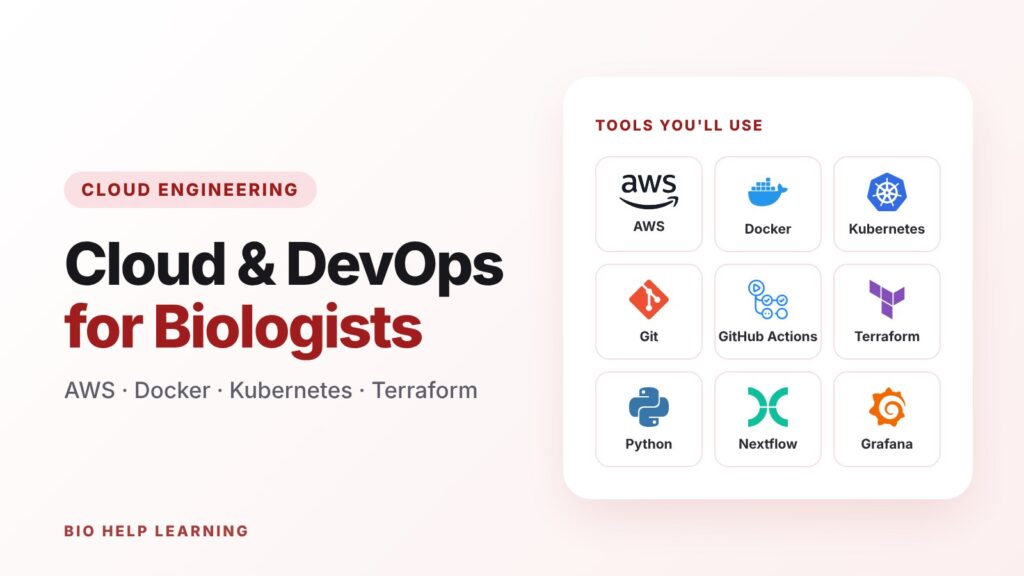
GitGitHub ActionsPythonpytestDockerDocker ComposeTrivyAWS EC2 & S3AWS IAMAWS BatchAmazon EKSAmazon AthenaTerraformKubernetesHelmArgo WorkflowsKarpenterNextflowSeqera PlatformParquetDuckDBPrefectFastAPIPostgreSQLStreamlitMLflowDVCPrometheus & Grafana
Course Curriculum

What you will learn, day by day

15 days 30 hours of training 63 topics Certificate on completion
♙

Your Instructor

Bio Help Learning educator

Bio Help Learning Educator

Bioinformatics Educator & Mentor

Learn from experienced educators and practitioners through practical, career-focused bioinformatics training.

in▶
?

Frequently Asked Questions

7 answers about this course

How is this different from the Reproducible Pipelines course?

Reproducible Pipelines teaches you to make an analysis rerunnable: Git, Conda, containers, Snakemake, Nextflow and HPC. This course teaches you to engineer and operate bioinformatics software in production: CI/CD, cloud infrastructure, Kubernetes, APIs, data engineering, MLOps, monitoring and security. Take Reproducible Pipelines first.

Will I have to pay for AWS?

Most labs fit within the AWS free tier or cost very little. On Day 6 you set up budget alerts, and every lab ends with a clean-up step so nothing keeps running. Exact costs depend on your usage.

Do I need to know Kubernetes or AWS already?

No. Both are taught from the basics, but the pace is fast because you are expected to be comfortable with Linux, Git, Python and Docker.

Does it cover Google Cloud or Azure?

The labs use AWS because it is the most common cloud in biotech job listings. Each cloud session also shows the equivalent Google Cloud and Azure services, so the skills carry over.

What jobs does this prepare me for?

Bioinformatics Engineer, Research Software Engineer, Cloud Bioinformatician, Data Engineer (life sciences) and MLOps roles at biotech, pharma and genomics companies.

Will I get a certificate?

Yes. You get a verifiable Bio Help Learning certificate after you complete the capstone.

How long will I have access to the course?

You get full access to all course materials for 3 months from the date of enrollment.

Still have a question?Our team usually replies within one working day.
Ask on WhatsApp →
WHAT OUR LEARNERS SAY

Real Stories. Real Growth.

Hear from learners building practical skills with Bio Help Learning.

View More Reviews →

OUR GLOBAL LEARNERS

Our Learners Are From Different Countries

A growing community learning bioinformatics and life-science skills across borders.

GlobalLearners worldwide
InternationalCountries represented
Learning togetherLearner satisfaction

Ready to Start Your Bioinformatics Journey?

Build practical bioinformatics skills with hands-on, project-based courses.

Explore More Courses →
DNA
Learn.
Apply.
Grow.