Cracking your first bioinformatics interview isn’t about memorising every tool. Interviewers want to see that you understand the basics clearly, have hands-on experience, and can explain your thinking. This guide covers 50+ of the most common bioinformatics interview questions for freshers, with short, clear answers you can build on in your own words.
The questions are grouped by topic — from biology fundamentals and sequence analysis to NGS, statistics, Linux, programming and HR questions — so you can revise section by section.
Tip: Don’t just memorise these answers. Connect each one to a project you’ve actually done. “I used FastQC on my RNA-seq project and found adapter contamination, so I trimmed with fastp” is far stronger than a textbook definition.
Section 1: Biology and bioinformatics basics
1. What is bioinformatics?
Bioinformatics is the use of computational methods, programming and statistics to store, analyse and interpret biological data such as DNA, RNA and protein sequences, gene expression and structures.
2. Explain the central dogma of molecular biology.
Genetic information flows from DNA to RNA (transcription) and from RNA to protein (translation). DNA also copies itself by replication. Exceptions include reverse transcription in retroviruses.
3. What is the difference between a genome, an exome and a transcriptome?
The genome is the complete DNA of an organism. The exome is the protein-coding part (exons) — about 1–2% of the human genome. The transcriptome is the full set of RNA transcripts expressed in a cell or tissue at a given time.
4. What are SNPs, indels and CNVs?
A SNP is a single-base change. An indel is a small insertion or deletion of bases. A CNV (copy number variation) is a larger region of DNA that is duplicated or deleted, changing the number of copies.
5. What are homologs, orthologs and paralogs?
Homologs share a common ancestor. Orthologs are homologs in different species separated by speciation (e.g. human and mouse insulin). Paralogs arise from gene duplication within the same genome (e.g. α- and β-globin).
6. What is a reference genome? Which human reference is commonly used?
A reference genome is a representative assembled sequence used to align reads and describe variants. For humans, GRCh38 (hg38) is the most widely used build, with GRCh37 (hg19) still found in older datasets. The newer T2T-CHM13 assembly is a complete telomere-to-telomere genome.
Section 2: Sequence analysis and databases
7. What is the difference between global and local alignment?
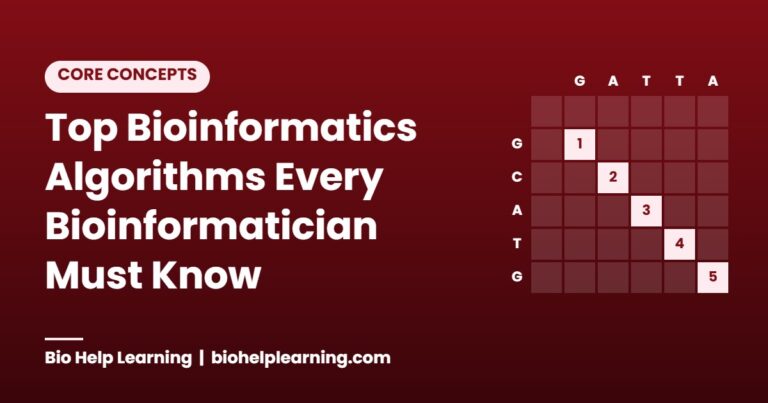
Global alignment (Needleman–Wunsch) aligns sequences end to end and suits sequences of similar length. Local alignment (Smith–Waterman) finds the best-matching region and suits sequences that share only a domain or partial similarity.
8. What is BLAST and what does the E-value mean?
BLAST (Basic Local Alignment Search Tool) finds sequences in a database that are similar to a query. The E-value is the number of hits with that score expected by chance — the lower the E-value, the more significant the match.
9. What are blastn, blastp, blastx, tblastn and tblastx?
blastn: nucleotide vs nucleotide. blastp: protein vs protein. blastx: translated nucleotide query vs protein database. tblastn: protein query vs translated nucleotide database. tblastx: translated nucleotide vs translated nucleotide.
10. What is the difference between PAM and BLOSUM matrices?
Both score amino-acid substitutions. PAM matrices are extrapolated from closely related sequences — higher numbers (e.g. PAM250) suit distant sequences. BLOSUM matrices come from conserved blocks — lower numbers (e.g. BLOSUM45) suit distant sequences. BLOSUM62 is the BLAST default for proteins.
11. Name some tools for multiple sequence alignment.
Clustal Omega, MUSCLE, MAFFT and T-Coffee. MSAs are used for finding conserved regions, building phylogenetic trees and designing primers.
12. What is the difference between primary and secondary databases?
Primary databases store raw experimental data such as sequences (GenBank, ENA, DDBJ, SRA). Secondary databases contain derived, curated information such as protein domains, families and pathways (Pfam, PROSITE, InterPro, KEGG).
13. Which databases would you use for genes, proteins, structures and variants?
Genes and genomes: NCBI Gene, Ensembl, UCSC. Proteins: UniProt. Structures: PDB (and AlphaFold DB for predicted structures). Variants: dbSNP, ClinVar, gnomAD, COSMIC (cancer). Expression data: GEO. Raw reads: SRA/ENA.
14. What is the FASTA format?
A text format for sequences. Each record starts with a header line beginning with >, followed by one or more lines of sequence.
Section 3: NGS concepts and file formats
15. What is next-generation sequencing (NGS)?
NGS refers to high-throughput technologies that sequence millions of DNA fragments in parallel, making whole-genome, exome and transcriptome sequencing fast and affordable. Illumina is the most widely used short-read platform.
16. What is the difference between short-read and long-read sequencing?
Short-read sequencing (Illumina) produces reads of roughly 100–300 bp with very high accuracy and low cost. Long-read sequencing (Oxford Nanopore, PacBio) produces reads of thousands to millions of bases, which helps with genome assembly, structural variants and repetitive regions.
17. What is the difference between single-end and paired-end sequencing?
Single-end reads sequence a fragment from one end only. Paired-end reads sequence both ends of the same fragment, which improves alignment accuracy and helps detect structural variants.
18. What does a FASTQ file contain?
Each read takes four lines: (1) a header starting with @, (2) the sequence, (3) a + line, and (4) the quality scores encoded as ASCII characters — one per base.
19. What does a Phred quality score of 30 mean?
Q = −10 log10(P), where P is the probability of an incorrect base call. Q30 means a 1 in 1,000 chance of error (99.9% accuracy). Q20 means 1 in 100 (99%).
20. Why do we perform quality control and adapter trimming?
Raw reads may contain low-quality bases, adapter sequences and contaminants that cause misalignment and false results. Tools like FastQC and MultiQC check quality; fastp, Trimmomatic or Cutadapt remove adapters and low-quality bases.
21. What is sequencing depth (coverage)?
The average number of reads covering each base. For example, 30× coverage means each base is covered by about 30 reads on average. Typical targets: ~30× for human WGS and ~100× or more for WES.
22. What is the difference between SAM, BAM and CRAM?
SAM is a human-readable text file of read alignments. BAM is its compressed binary version. CRAM compresses even further using the reference genome. SAMtools is used to convert, sort and index them.
23. What is mapping quality (MAPQ)?
MAPQ measures confidence that a read is aligned to the correct position. Low MAPQ often indicates reads in repetitive regions that could map to several places.
24. What are PCR duplicates and why are they removed?
PCR duplicates are identical reads created by amplification of the same original fragment. They can falsely inflate support for a variant, so they are marked or removed with tools like Picard MarkDuplicates or samtools markdup.
25. What is a VCF file?
The Variant Call Format stores genetic variants. Key columns include CHROM, POS, ID, REF, ALT, QUAL, FILTER, INFO, FORMAT and per-sample genotype information.
26. What is the difference between WGS, WES and targeted sequencing?
WGS sequences the entire genome, including non-coding regions. WES sequences only the exons — cheaper and widely used in clinical diagnosis. Targeted panels sequence selected genes at very high depth, often for cancer or specific inherited disorders.
Section 4: Analysis workflows
27. Explain the steps of a germline variant calling pipeline.
FASTQ → quality control (FastQC) → trimming (fastp) → alignment to reference (BWA-MEM) → sort and index (SAMtools) → mark duplicates (Picard) → base quality score recalibration (GATK BQSR) → variant calling (GATK HaplotypeCaller) → variant filtering → annotation (ANNOVAR, VEP or SnpEff).
28. What is the difference between germline and somatic variants?
Germline variants are inherited and present in every cell. Somatic variants arise during life in specific cells, such as tumour cells. Somatic calling usually compares tumour and matched normal samples using tools like GATK Mutect2.
29. What is variant annotation?
Adding biological meaning to variants — which gene they fall in, their effect on the protein (missense, nonsense, frameshift), population frequency (gnomAD), clinical significance (ClinVar) and predicted impact (SIFT, PolyPhen, CADD).
30. Explain the steps of an RNA-seq analysis.
QC and trimming → alignment with a splice-aware aligner (HISAT2 or STAR) or pseudo-alignment (Salmon, Kallisto) → read counting (featureCounts or HTSeq) → normalisation and differential expression (DESeq2 or edgeR) → visualisation (PCA, volcano plot, heatmap) → functional enrichment (GO, KEGG).
31. Why do RNA-seq aligners need to be splice-aware?
Mature mRNA has introns removed, so a single read can span two exons that are far apart in the genome. Splice-aware aligners like HISAT2 and STAR can split a read across exon–exon junctions; DNA aligners like BWA cannot.
32. What is the difference between raw counts, CPM, TPM and FPKM?
Raw counts are the number of reads per gene. CPM normalises for library size; FPKM/RPKM and TPM normalise for both gene length and sequencing depth, with TPM being more comparable across samples. For differential expression, tools like DESeq2 take raw counts and apply their own normalisation.
33. What is a batch effect and how do you handle it?
A batch effect is unwanted technical variation caused by processing samples at different times, places or with different reagents. Detect it using PCA; handle it by including batch in the statistical model (e.g. the DESeq2 design formula) or using methods like ComBat — and ideally by balanced experimental design.
Section 5: Statistics
34. What is a p-value?
The probability of seeing a result at least as extreme as the one observed, assuming the null hypothesis is true. A small p-value (e.g. < 0.05) suggests the result is unlikely to be due to chance alone. It is not the probability that the hypothesis is true.
35. Why do we need multiple-testing correction?
When testing thousands of genes, many will appear significant by chance — at p < 0.05, about 1,000 false positives for 20,000 genes. Corrections such as Benjamini–Hochberg (FDR) or Bonferroni control this. Results are then reported as adjusted p-values (padj or q-values).
36. What is log2 fold change?
The log2 ratio of expression between two conditions. A log2FC of 1 means a 2-fold increase; −1 means a 2-fold decrease; 0 means no change. The log scale makes up- and down-regulation symmetric.
37. What is PCA and why is it used?
Principal Component Analysis reduces high-dimensional data into a few components that capture most of the variation. In bioinformatics it is used to check sample clustering, detect outliers and spot batch effects.
38. When would you use a t-test vs a Wilcoxon test?
A t-test assumes approximately normally distributed data. The Wilcoxon (Mann–Whitney) test is non-parametric and is used when data are not normally distributed or sample sizes are small.
Section 6: Linux, programming and tools
39. How do you count the number of sequences in a FASTA file?
grep -c ">" sequences.fastaThis counts header lines, which equals the number of sequences.
40. How do you count the number of reads in a FASTQ file?
Each read takes four lines, so divide the line count by 4:
echo $(( $(wc -l < reads.fastq) / 4 ))
# for a gzipped file:
echo $(( $(zcat reads.fastq.gz | wc -l) / 4 ))
41. What is the difference between grep, awk and sed?
grep searches for lines matching a pattern. awk processes text by columns and is great for filtering and calculations on tables. sed edits text streams, typically for find-and-replace.
42. What does the pipe (|) do in Linux?
It sends the output of one command as input to the next, letting you chain simple tools together — for example, cut -f1 file.txt | sort | uniq -c counts unique values in the first column.
43. Write a Python function to get the reverse complement of a DNA sequence.
def reverse_complement(seq):
    comp = {"A": "T", "T": "A", "G": "C", "C": "G", "N": "N"}
    return "".join(comp[base] for base in reversed(seq.upper()))

print(reverse_complement("ATGCGT"))  # ACGCAT
44. Write Python code to calculate GC content.
def gc_content(seq):
    seq = seq.upper()
    return (seq.count("G") + seq.count("C")) / len(seq) * 100

print(gc_content("ATGCGC"))  # 66.67
45. Python or R — which is better for bioinformatics?
Both are widely used. Python is better for automation, pipelines and machine learning (Biopython, pandas, scikit-learn). R excels at statistics and expression analysis through Bioconductor (DESeq2, edgeR) and ggplot2. Most bioinformaticians use both.
46. What is Conda and why is it useful?
Conda is a package and environment manager. With the Bioconda channel, it installs thousands of bioinformatics tools and keeps separate environments for different projects, avoiding version conflicts.
47. What are Git and GitHub used for?
Git tracks changes to code over time (version control). GitHub hosts Git repositories online for sharing, collaboration and building a public portfolio of your projects.
48. What are Nextflow and Snakemake?
Workflow managers that connect many tools into automated, reproducible pipelines. They handle parallel execution, restart from failures, and run on laptops, clusters or the cloud. nf-core provides community-built Nextflow pipelines such as nf-core/rnaseq and nf-core/sarek.
Section 7: Project and HR questions
49. Tell us about yourself.
Give a 60–90 second summary: your education, the bioinformatics skills you have built, one or two key projects, and why you want this role. Keep it focused on what is relevant to the job.
50. Explain one of your projects.
Use a clear structure: the question, the data (and where it came from), the tools and steps, the key results, and what you learned or would improve. Be ready for follow-up questions on every tool you mention.
51. What would you do if a tool gave an error you had never seen before?
Read the full error message, check input formats and file paths, look at the tool’s documentation and GitHub issues, search forums like Biostars, test on a small subset of data, and ask a colleague if still stuck — while noting what you tried.
52. Why do you want to work in bioinformatics?
Be specific and honest — for example, your interest in genomics or disease research, a project that excited you, and how you enjoy combining biology with data. Link your answer to the company’s work.
53. Where do you see yourself in three to five years?
Show ambition and commitment: growing from analyst work to leading analyses, specialising in an area like clinical genomics or single-cell analysis, and contributing to the team’s projects.
How to prepare for your bioinformatics interview
- Revise your own projects first — most questions will come from your CV.
- Practise live coding — FASTA/FASTQ parsing, GC content, filtering tables, simple Linux one-liners.
- Know why, not just how — be ready to justify each tool and parameter you used.
- Research the company — diagnostics, pharma, research or bio-IT — and adapt your examples.
- Prepare a 5-minute project presentation with 3–4 clear figures.
- Be honest — if you don’t know something, say how you would find out.
Related reading
- Top 10 Skills Recruiters Look for in a Bioinformatics Fresher
- How to Become a Bioinformatician: A Step-by-Step Roadmap
- Bioinformatics Career Scope in India (2026)
Get interview-ready with Bio Help Learning
The best interview answers come from real hands-on experience. At Bio Help Learning, our practical courses help you build exactly that — with real datasets, assignments and projects you can discuss confidently in interviews:
- Linux and Command Line for Bioinformatics
- Python for Biologists
- Biological Databases, BLAST and Sequence Analysis
- Whole Genome Sequencing (WGS) Data Analysis and RNA-Seq Data Analysis
- Reproducible Pipelines with Nextflow, Snakemake, Docker and HPC
We also offer internships (3–12 months), customised learning paths and regular fresher job updates on jobsbiohelplearning.com.
👉 Explore all courses at www.biohelplearning.com
📩 Email: [email protected] | 📞 WhatsApp/Call: +91 78280 25951