Every week, students write to us with the same question. They have a BSc or MSc in biotechnology, microbiology or life sciences. They keep hearing that bioinformatics jobs are growing. But a full course feels expensive, and the free material online looks scattered and confusing. Where do you even start?
The good news is that you can genuinely learn bioinformatics online for free. Almost every major tool is open source, the world’s biggest biological databases are public, and several universities and institutes publish full lessons at no cost. What is missing is not content. What is missing is a plan: the right order, a weekly routine, and practice on real data.
This guide gives you that plan. We explain the five skill layers you need, a month-by-month roadmap, the best free platforms (and what each one is actually good at), how to use the free Bio Help Learning tutorials as your backbone, how to practise without a powerful computer, and an honest section on what free learning cannot do for you. Everything here was checked as of November 2026.
Can you really learn bioinformatics online for free?
Yes, with one condition: you must be willing to do the work that a paid course would normally organise for you. Bioinformatics is the use of computers, programming and statistics to store and analyse biological data, such as DNA sequences, gene expression measurements and protein structures. If you are new to the field itself, our article on what bioinformatics is, its branches and scope is a good five-minute primer.
Three things make free self-study possible in this field more than in most others:
- The tools are free. FastQC, BWA, samtools, GATK, DESeq2, Biopython and thousands more are open-source software. The Bioconductor project alone had 2,361 software packages for R in its 3.22 release in October 2025.
- The data is free. Archives such as NCBI’s Sequence Read Archive (SRA), the European Nucleotide Archive (ENA) and Gene Expression Omnibus (GEO) hold raw data from published studies. You can download the same files the authors used and repeat their analysis.
- The teaching is free. IIT professors on NPTEL, trainers at the European Bioinformatics Institute (EMBL-EBI), the global Galaxy community and independent platforms like Rosalind all publish lessons openly.
The catch is that nobody gives you a timetable, checks your code or tells you what to learn next. The rest of this article fills that gap.
The five skill layers you need, in order
Bioinformatics looks like one subject but is really a stack of five skills. Each one rests on the one below. Most beginners jump straight to running a pipeline, hit an error they cannot read, and give up. The error usually comes from a missing lower layer, such as not knowing what a FASTQ file contains or how a Linux path works.
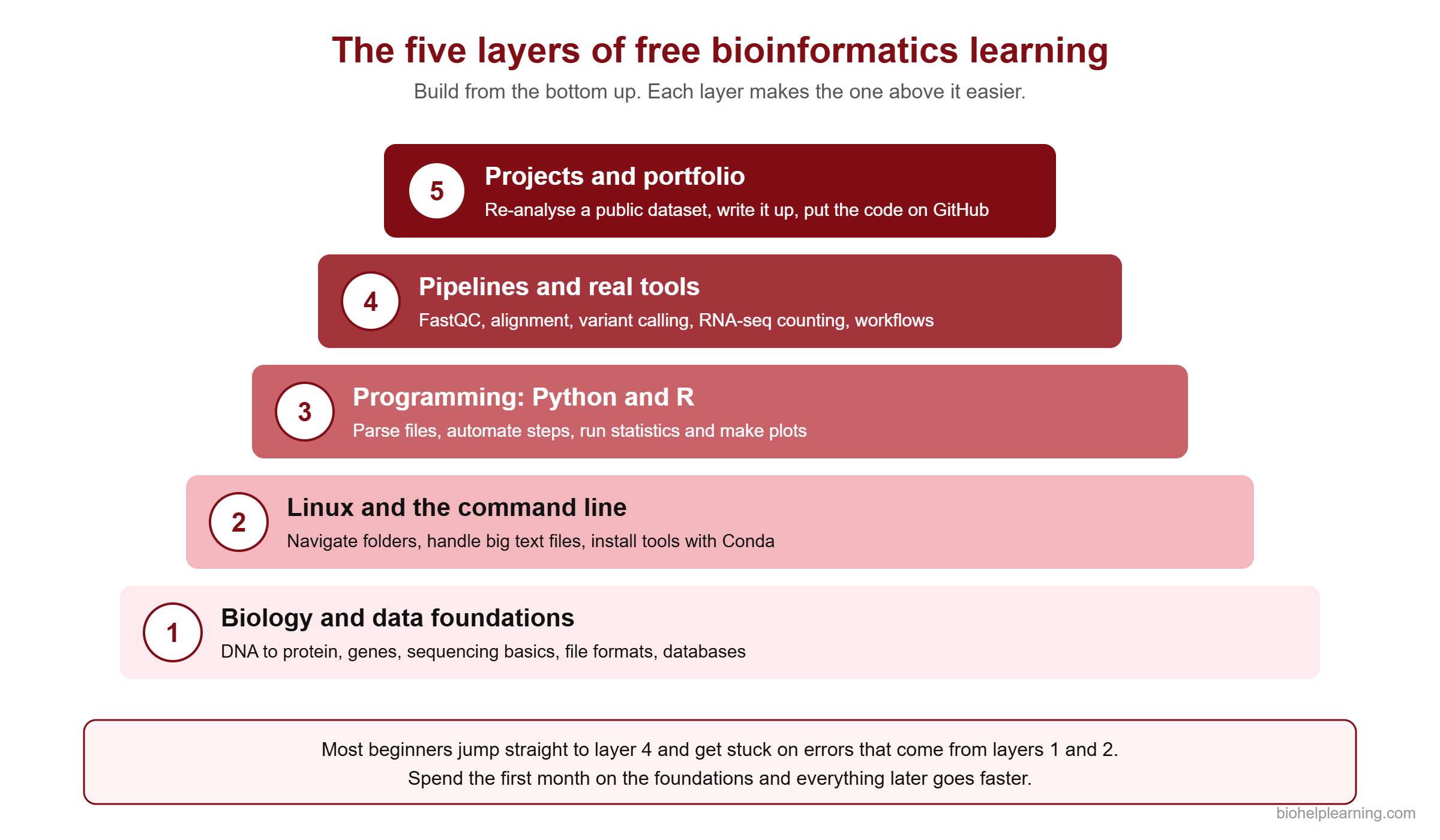
Layer 1: Biology and data foundations
You need the central dogma (DNA to RNA to protein), what a gene and a genome are, how sequencing machines produce reads, and the common file formats: FASTA for sequences, FASTQ for reads with quality scores, GFF/GTF for gene annotations, SAM/BAM for alignments and VCF for variants. You also need to be comfortable browsing NCBI and Ensembl. Life-science graduates already have most of the biology; the new part is thinking of it as data.
Layer 2: Linux and the command line
Nearly all serious bioinformatics tools run in a Linux terminal, not by clicking buttons. You need to move between folders, look inside huge text files without opening them, search them with grep, reshape them with awk and sort, chain commands with pipes, and install tools with Conda. This layer scares biologists the most and pays back the fastest.
Layer 3: Programming in Python and R
Python is used to parse files and automate steps; R dominates statistics and plotting for omics data. You do not need to master both at once. Pick one first (Python if you like automation, R if your interest is gene expression), learn loops, functions and reading files, then add the other later.
Layer 4: Pipelines and real tools
This is where you run actual analyses: quality control of reads, trimming, alignment to a reference genome, counting reads per gene for RNA-seq, or calling variants for whole-genome and whole-exome sequencing. Learn one pipeline end to end before touching a second.
Layer 5: Projects and portfolio
Employers and PhD supervisors want proof that you can take raw public data and produce a sensible result. Two or three well-documented projects on GitHub are worth more than ten course completion badges.
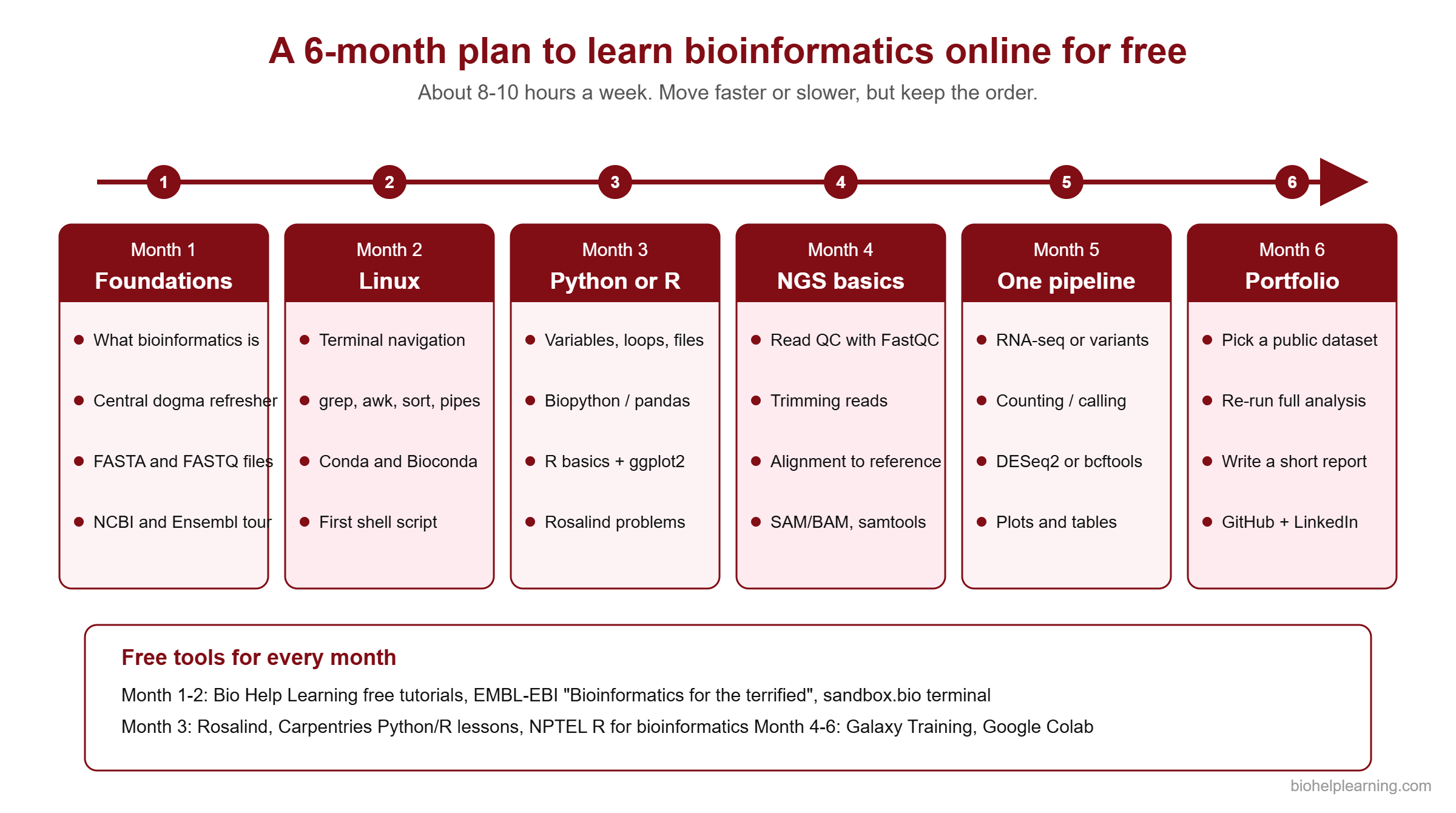
A 6-month roadmap to learn bioinformatics online for free
The plan below assumes about 8 to 10 hours a week, which suits a student or someone working full time. If you have more time, compress it; if you have less, stretch it. Just keep the order.
Month 1: Foundations
Understand what the field does, revise molecular biology with a data lens, and learn to recognise the main file formats by looking at real examples. Start with our free What is Bioinformatics? beginner tutorial, then the EMBL-EBI online course Bioinformatics for the terrified. Spend an evening exploring one gene of your choice on NCBI and Ensembl: its sequence, its transcripts, its known variants.
Month 2: Linux
Work through the free Linux Command Line for Bioinformatics tutorial, typing every command yourself. Then learn to install tools in isolated environments with the Conda and Bioconda tutorial. If you do not have Linux yet, sandbox.bio gives you a terminal inside the browser (more on practice setups below). End the month by writing your first small shell script that counts reads in a FASTQ file.
Month 3: Python or R
Learn the basics of one language through The Carpentries’ free lessons or an NPTEL course, then practise on Rosalind. Rosalind problems start with counting nucleotides and translating RNA, and slowly grow into real algorithms such as genome assembly and alignment. Aim to solve 15 to 20 problems this month. If you choose Python, our list of bioinformatics projects using Python gives you ideas to practise on.
Month 4: NGS basics
Next-generation sequencing (NGS) data is where most jobs are. Start with read quality control using our free FastQC and MultiQC tutorial. Then learn trimming, alignment to a reference genome, and handling SAM/BAM files with samtools. The Galaxy Training Network has step-by-step versions of all of these that run on free servers.
Month 5: One complete pipeline
Pick either RNA-seq (gene expression) or variant calling (mutations) and complete it from raw reads to final table and plots. For RNA-seq this usually means alignment or pseudo-alignment, counting, and differential expression with DESeq2 in R. For variants it means alignment, marking duplicates, calling with bcftools or GATK, and filtering. If transcriptomics interests you, read our explainer on how bioinformatics transformed transcriptomics first.
Month 6: Your portfolio project
Choose a published study with data on GEO or SRA, re-run the analysis, and write a short report: question, data, methods, results, limitations. Put the code and report on GitHub. Our list of bioinformatics project ideas for students will help you pick something the right size.
Start with the free Bio Help Learning tutorials
We built our free tutorial section for exactly the student this article is written for: someone who wants a clear, ordered path with real commands rather than a pile of links. Every tutorial is written to be readable by a beginner yet complete enough that a researcher does not need another source, and each topic explains the algorithm behind the tool, not just which button to press.
What is live right now
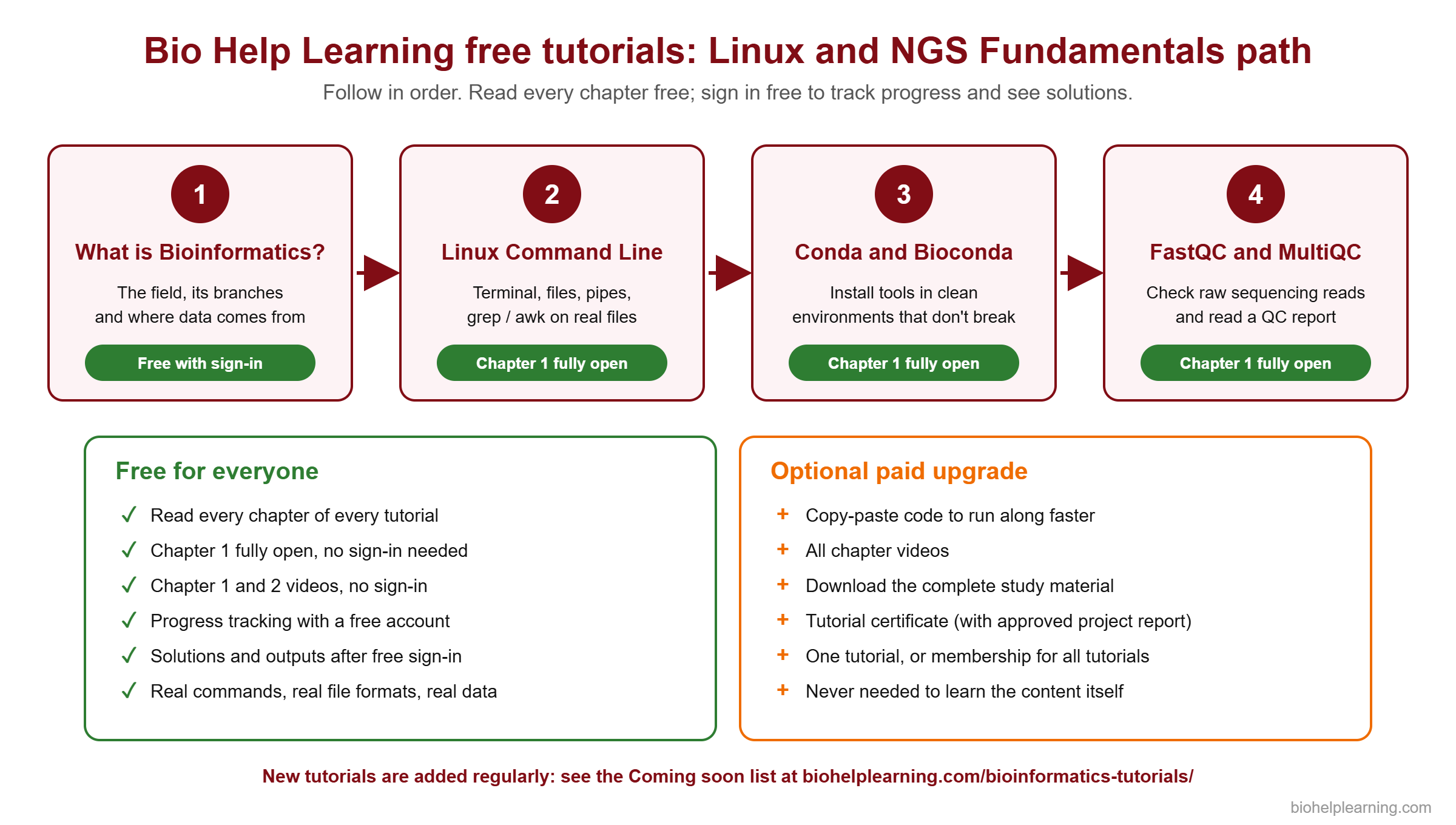
The first learning path, Linux and NGS Fundamentals, has four tutorials that map directly to months 1, 2 and 4 of the roadmap above:
- What is Bioinformatics? A Complete Beginner’s Guide: the field, its branches and where biological data comes from.
- Linux Command Line for Bioinformatics: the terminal skills every later tutorial depends on.
- Conda and Bioconda: installing tools in clean environments so that one update does not break everything else.
- Quality Control of NGS Reads with FastQC and MultiQC: your first real NGS analysis, and how to read a QC report like an analyst.
Each tutorial is split into short chapters with Next and Previous navigation, so you can finish one chapter in a single sitting. New tutorials are added regularly, and upcoming ones are listed in the Coming soon section of the free bioinformatics tutorials page.
What is free, and what is optional
You can read every chapter of every tutorial for free. Chapter 1 of each tutorial is fully open with no sign-in, and the chapter 1 and 2 videos play without an account. Creating a free account lets you track your progress and unlocks the solutions and expected outputs for the exercises, which matters because checking your result against a known answer is how you catch mistakes early.
There is an optional paid upgrade for learners who want to move faster or need proof of completion: copy-paste code, all chapter videos, downloadable study material and a tutorial certificate (issued after an approved project report). You can buy a single tutorial or a membership that covers all of them. To be clear, you never need to pay to learn the content itself. Many students read everything free, type the code by hand (which is better for learning anyway) and upgrade only when they need a certificate.
We also keep a broader roundup of our free videos and other free courses in Free Bioinformatics Courses and Tutorials: Learn Step by Step with Free Videos.
The best free platforms, and what each one is good for
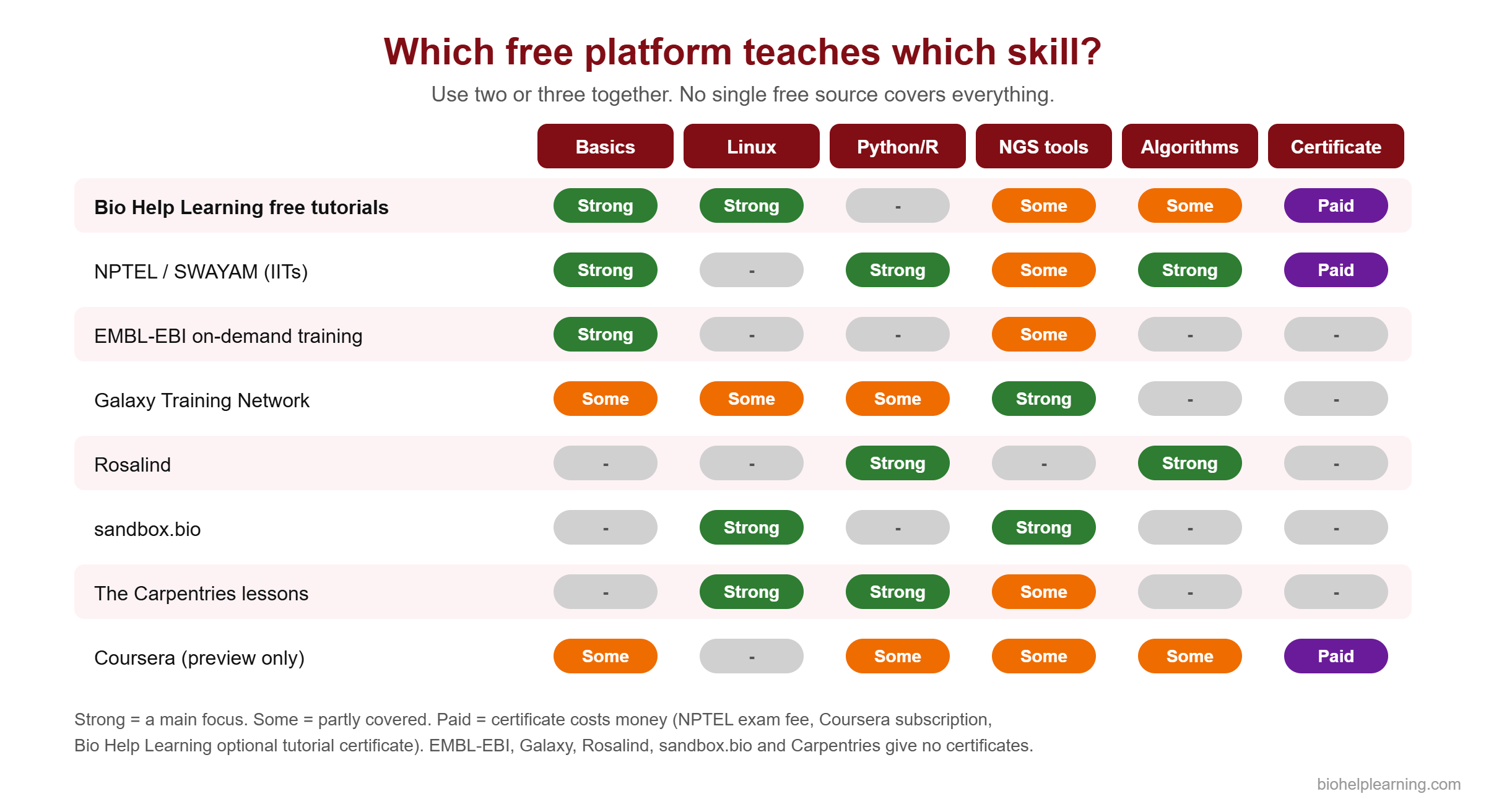
No single free source covers every layer. The smart approach is to pick a backbone (one structured series) and add two or three specialist platforms for the gaps. The chart below shows where each one is strong.
NPTEL and SWAYAM: university courses from the IITs
NPTEL runs full-semester online courses taught by IIT and IISc faculty, free to enrol. A long-running example is BioInformatics: Algorithms and Applications by Prof. M. Michael Gromiha of IIT Madras, a 12-week course whose January to April 2026 run covered databases, sequence analysis and protein bioinformatics. IIT Kharagpur also offers an 8-week course by Prof. Riddhiman Dhar built around R for biological data. Learning is free; the e-verifiable certificate requires a proctored exam with a fee (₹1,000 for the IIT Madras course in 2026). Courses run on fixed semesters, so check enrolment dates and note that recorded lectures stay on YouTube after the run ends.
EMBL-EBI on-demand training
The European Bioinformatics Institute publishes self-paced tutorials, recorded webinars and full course materials. On-demand content needs no registration, though a free account lets you track what you have finished. The Introductory bioinformatics pathway, which starts with Bioinformatics for the terrified, is excellent for month 1. The trade-off: EMBL-EBI does not issue certificates for on-demand courses, and much of the content teaches its own databases rather than command-line analysis.
Galaxy Training Network
The Galaxy Training Network (GTN) is a community collection of hands-on tutorials that passed its 400th tutorial in June 2024. Tutorials run on public Galaxy servers in your browser, so you can do a real RNA-seq or variant-calling analysis without installing anything. The University of Freiburg, which runs the European server, says a free account comes with 250 GB of storage and more than 3,500 tools. Galaxy is perfect for understanding what each pipeline step does; just remember that most jobs also expect you to run the same steps on the command line.
Rosalind: learn by solving problems
Rosalind is a free problem-solving platform from UC San Diego and Saint Petersburg collaborators. You download a dataset, write code in any language, and submit your answer for automatic checking. Its problem table lists 284 problems across beginner tracks (Python Village), algorithms (Bioinformatics Stronghold) and using existing tools (Bioinformatics Armory). It is the best free way to build programming confidence on biological problems. It does not teach NGS pipelines.
sandbox.bio: a terminal in your browser
sandbox.bio runs a real Linux environment inside your web browser using WebAssembly, so nothing is installed and nothing can break. It has guided tutorials for tools such as BLAST, SeqKit, fastp, samtools and bedtools, plus playgrounds for awk, grep and sed. Ideal for month 2 if you are on Windows or a borrowed computer.
The Carpentries
Software Carpentry and Data Carpentry publish their lessons under a CC-BY licence, free for anyone to use. The Data Carpentry Genomics lessons walk through project organisation, the shell, and a full variant-calling workflow. They were designed for live workshops, so self-learners need to set up the software themselves following the setup pages.
Coursera: useful only as a preview now
Many older guides tell you to “audit Coursera courses for free”. That is out of date. On 8 August 2025 Coursera replaced its audit option with a free preview of the first module of most courses; full access and certificates now need a subscription or course fee. Previews are still useful to judge whether a specialisation suits you, but Coursera is no longer a free learning route on its own.
How to practise without a powerful computer
A common worry is “I only have a basic laptop.” For learning, that is usually fine. Practice datasets are small, and several free options give you computing power:
- sandbox.bio for terminal practice with zero setup.
- Public Galaxy servers (usegalaxy.org, usegalaxy.eu and others) for full NGS pipelines on remote machines.
- Google Colab for Python and R notebooks in the cloud. The free tier usually provides a GPU, but Google does not publish fixed limits; sessions can disconnect when idle, so save your work to Google Drive. Kaggle Notebooks are a similar free option with a weekly GPU quota.
- WSL (Windows Subsystem for Linux) lets a Windows laptop run Ubuntu without dual-booting, which is enough for most tutorials that use small test data.
Free cloud resources also change and disappear. Coursera’s audit option ended in 2025, and Amazon SageMaker Studio Lab, once a popular free notebook service, has been reported as closing to new sign-ups in 2026. Do not build your whole learning plan around one free service; keep your code on GitHub so you can move it anywhere.
A weekly routine that turns free content into skill
Free learners rarely fail because of poor material. They fail because they watch videos passively and stop after two weeks. The fix is a simple loop: learn, run, break, write.
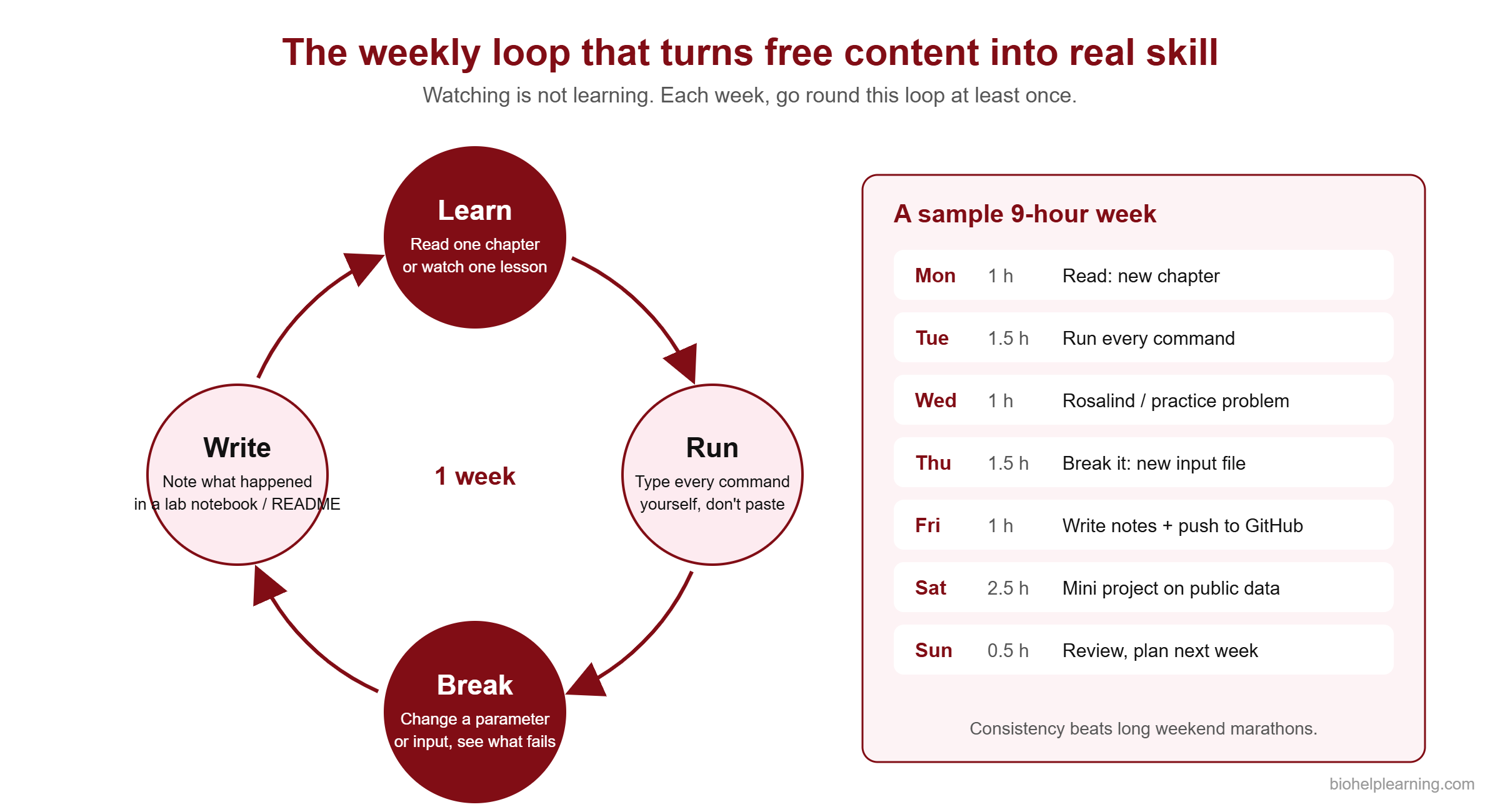
- Learn: read one chapter or watch one lesson. Not three. One.
- Run: type every command yourself. Pasting code teaches your clipboard, not you.
- Break: change one thing (a parameter, an input file, a threshold) and see what changes or fails. Reading error messages is half of real bioinformatics work.
- Write: keep notes in a README or lab notebook: what you ran, why, and what you saw. These notes become your portfolio later.
Two more habits help a lot. First, when you get stuck, search Biostars, the long-running bioinformatics question-and-answer forum, before asking a new question; most beginner errors have been answered there. For R and Bioconductor packages, the Bioconductor support site is the right place. Second, find one study partner or online group. Explaining a concept to someone else is the fastest test of whether you really understood it.
Build a portfolio from public data
A portfolio is what converts free learning into interviews. A good beginner project has four parts:
- A clear question, for example “Which genes change expression in this drug-treated cell line compared with controls?”
- Public data, usually a GEO series with raw reads in SRA, cited by its accession number.
- Reproducible code, with a README, a Conda environment file and every command in order.
- A short report with figures, a comparison with the original paper, and honest limitations.
Two or three such projects, each in a different area (for example RNA-seq, variant calling and a Python data-parsing tool), show breadth. If your result differs from the paper, that is not failure; explaining why is exactly the kind of thinking employers look for.
From free learning to a bioinformatics career
Free resources can take you to job-ready skill for entry-level roles. Common first job titles in India and abroad include Bioinformatics Analyst, NGS Data Analyst, Research Assistant or Project Associate in an institute lab, Clinical Genomics Analyst and, with more programming, Bioinformatics Software Developer. Our guide on how to become a bioinformatician covers the full skill stack, and bioinformatics career scope in India explains where the openings are. For employers, see our list of top bioinformatics companies in India.
Do you need a PhD? Not for analyst and industry roles, where a strong portfolio plus an MSc or BTech is often enough. A PhD matters for research scientist positions and for leading independent projects. We discuss the trade-off in detail in is a PhD in bioinformatics worth it in the AI era. And if you worry that AI tools will make these skills useless, read will AI replace bioinformaticians: in short, AI is making people who understand the biology and the pipelines more productive, not unnecessary.
What free online learning still cannot do
We run paid courses as well as free tutorials, so it is fair to be honest about where the line falls. Free learning is excellent, but it has real gaps.
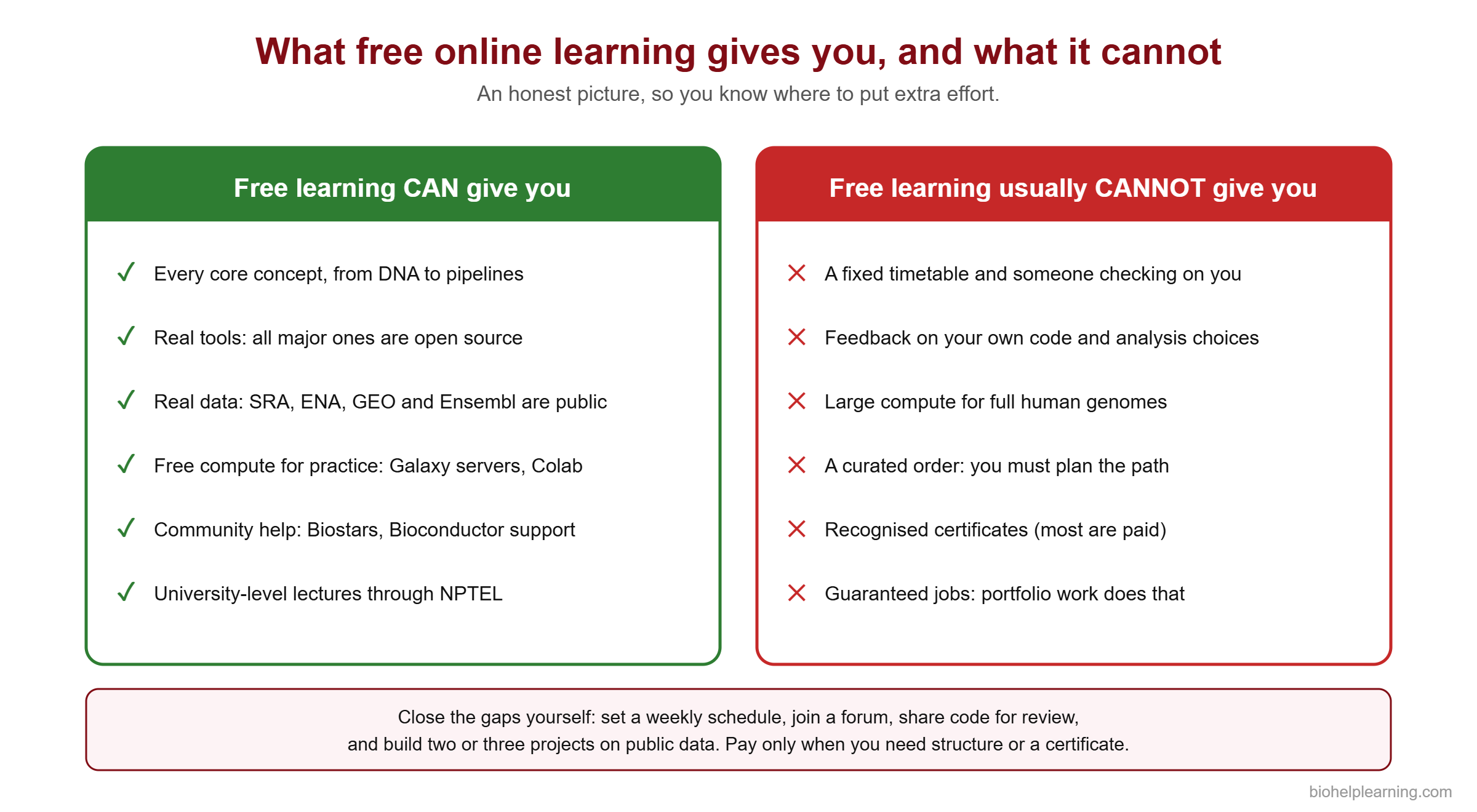
- No accountability. Nobody notices if you stop. Most self-learners who quit do so in the first month, usually at the Linux stage.
- No feedback on your own work. A forum can answer a specific error, but nobody reviews whether your overall analysis choices were sensible.
- Limited compute. Free servers handle practice data well. A full human whole-genome dataset needs far more memory and storage than free tiers provide.
- You design the path. Free platforms rarely link to each other, so you must decide the order yourself. The roadmap above is meant to solve this.
- Certificates usually cost money. NPTEL charges an exam fee, Coursera needs a subscription, and EMBL-EBI, Galaxy and Rosalind do not issue certificates at all.
- Free resources change. Policies and free tiers can be withdrawn, as Coursera’s audit option showed.
None of these gaps stops you learning. They simply mean you must create your own structure. If at some point you want a fixed schedule, live classes and a recognised certificate, a structured course such as our RNA-seq data analysis course is an option, but it is a choice, not a requirement.
Frequently asked questions
Can I learn bioinformatics online for free without a coding background?
Yes. Most life-science students start with no coding. Begin with biology foundations and Linux before programming, use Rosalind’s Python Village for your first lines of code, and type every command yourself. Expect the first month to feel slow; it speeds up quickly after that.
How long does it take to learn bioinformatics for free?
With 8 to 10 hours a week, about six months gets you through the basics, one complete pipeline and a portfolio project. Becoming confident across several data types takes a year or more of regular practice.
Which is better for bioinformatics, Python or R?
Both are used. Python is stronger for automation and file handling; R is stronger for statistics and gene expression analysis through Bioconductor. Learn one well first, then pick up the basics of the other.
Are the Bio Help Learning tutorials really free?
Yes. You can read every chapter of every tutorial free, chapter 1 and the first two chapter videos need no sign-in, and a free account adds progress tracking and solutions. Copy-paste code, full videos, downloads and certificates are an optional paid upgrade.
Do I need a powerful laptop to learn bioinformatics?
No. Practice datasets are small, and you can use sandbox.bio, public Galaxy servers and Google Colab in the browser. A basic laptop with WSL or Linux is enough for most beginner tutorials.
Can I get a job after learning bioinformatics for free?
You can get entry-level analyst and research roles if you can show real projects on public data. Employers care more about a clear GitHub portfolio and your ability to explain your analysis than about where you learned.
Is the NPTEL bioinformatics course free?
Enrolling and studying is free. The certificate requires registering for a proctored exam, which had a fee of ₹1,000 for the IIT Madras bioinformatics course in 2026.
Key takeaways
- You can learn bioinformatics online for free because the tools, data and many courses are open.
- Learn in layers: biology and file formats, then Linux, then Python or R, then pipelines, then projects.
- Use one structured backbone, such as the free Bio Help Learning tutorials, plus two or three specialist platforms.
- Practise with the learn, run, break, write loop every week; passive watching does not build skill.
- Free learning lacks feedback, structure and certificates, so create your own schedule and seek review.
- Two or three documented projects on public data matter more than any number of course badges.
References and further reading
- Bio Help Learning: Free Bioinformatics Tutorials.
- NPTEL: BioInformatics: Algorithms and Applications, IIT Madras (onlinecourses.nptel.ac.in, 2026 run).
- EMBL-EBI Training: Bioinformatics for the terrified and on-demand training.
- Galaxy Training Network: training.galaxyproject.org; Hiltemann S. et al. (2023) Galaxy Training: A powerful framework for teaching! PLoS Computational Biology. doi:10.1371/journal.pcbi.1010752.
- Rosalind: learning bioinformatics through problem solving.
- sandbox.bio: interactive bioinformatics tutorials in the browser.
- The Carpentries: Data Carpentry lessons, including the Genomics curriculum.
- Bioconductor 3.22 release announcement (October 2025), bioconductor.org.
- Coursera Blog (8 August 2025): Introducing Coursera’s new course preview experience.
- Parnell L.D. et al. (2011) BioStar: An Online Question and Answer Resource for the Bioinformatics Community. PLoS Computational Biology 7(10): e1002216. doi:10.1371/journal.pcbi.1002216.
- Compeau P. and Pevzner P. Bioinformatics Algorithms: An Active Learning Approach. Active Learning Publishers (companion to the Rosalind textbook track).