
What is Bioinformatics? A Complete Beginner’s Guide to Bioinformatics and Computational Biology
Chapter 1 of 5: What is bioinformatics and computational biology?
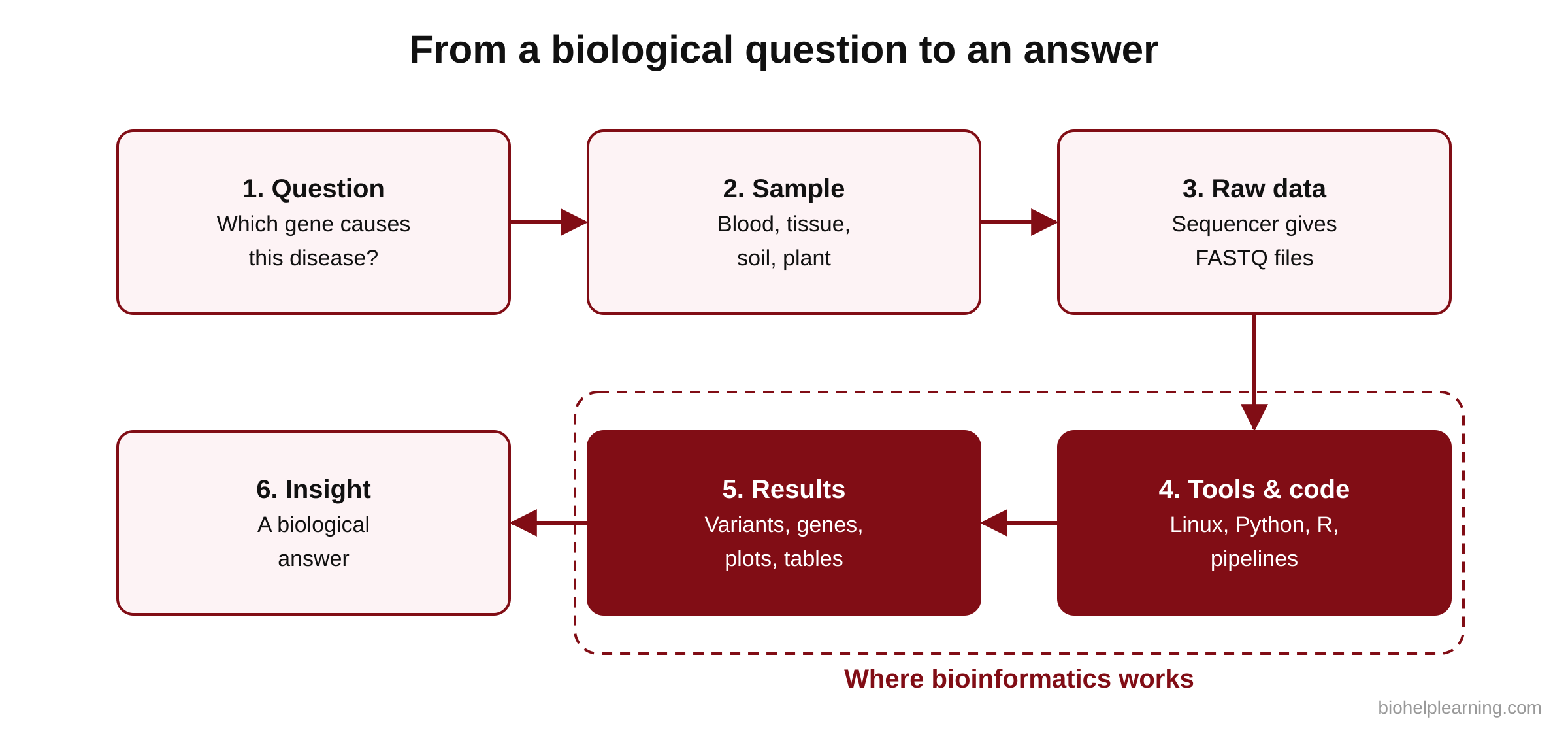
Biology today produces more data than any human can read. One run of a modern DNA sequencer can create hundreds of gigabytes of text made of four letters: A, T, G and C. Hospitals, farms, drug companies and research labs all hold this kind of data. Someone has to turn it into answers. That someone is a bioinformatician.
This what is bioinformatics guide is the starting point of the Bio Help Learning tutorial series. It is written for absolute beginners: biology students who have never written code, and computer students who have never studied DNA. You will learn what bioinformatics and computational biology are, where they are used, where the field is going, what jobs and salaries look like in different countries, how long it takes to learn, and how this free tutorial series will take you from zero to your first real analysis.
How do you want to read this tutorial?
You can switch at any time. Quick checks stay visible in both paths.
What you will learn in this tutorial
- What bioinformatics and computational biology mean, and how they differ.
- Why the field exists: the data explosion and the falling cost of DNA sequencing.
- Where bioinformatics is used: medicine, agriculture, drug discovery, microbiology, forensics and more.
- The future of bioinformatics: AI models, long-read sequencing, single-cell and spatial data.
- Job roles, indicative salaries in India, the USA, the UK, Germany and Canada, and the companies that hire.
- A realistic month-by-month roadmap to become a bioinformatician from scratch.
- How the Bio Help Learning tutorial series builds your skills, and how we keep it up to date.
- The story of how Bio Help Learning started, and why learning here stays free.
What is bioinformatics?
Bioinformatics is the use of computers, software and statistics to store, organise and analyse biological data. The data can be DNA sequences, RNA expression values, protein structures, microscope images or patient records. The goal is always the same: to answer a biological question.
Think of a library with three billion letters and no index. The human genome is roughly that size. A biologist can read a few genes by hand. A bioinformatician writes the index, the search tool and the reading machine, so that millions of letters can be compared in seconds.
In daily work, a bioinformatician does things like:
- checking the quality of sequencing data (our FastQC tutorial teaches this);
- aligning millions of short DNA reads to a reference genome;
- finding mutations (variants) that may cause a disease;
- measuring which genes are switched on or off in a tumour (RNA-seq);
- identifying bacteria in a soil or gut sample (metagenomics);
- building automated pipelines so the same analysis runs the same way every time.
▸ Go deeper: where the word came from
The term “bioinformatics” was used by Paulien Hogeweg and Ben Hesper in the early 1970s for “the study of informatic processes in biotic systems”. The meaning has since shifted towards the analysis of biological data, but the original idea, that living systems process information, is still at the heart of the field.
Early milestones you will meet again and again: protein sequence databases in the 1960s and 70s, sequence alignment algorithms such as Needleman–Wunsch (1970) and Smith–Waterman (1981), GenBank in 1982, BLAST in 1990, and the Human Genome Project from 1990 to 2003.
What is computational biology?
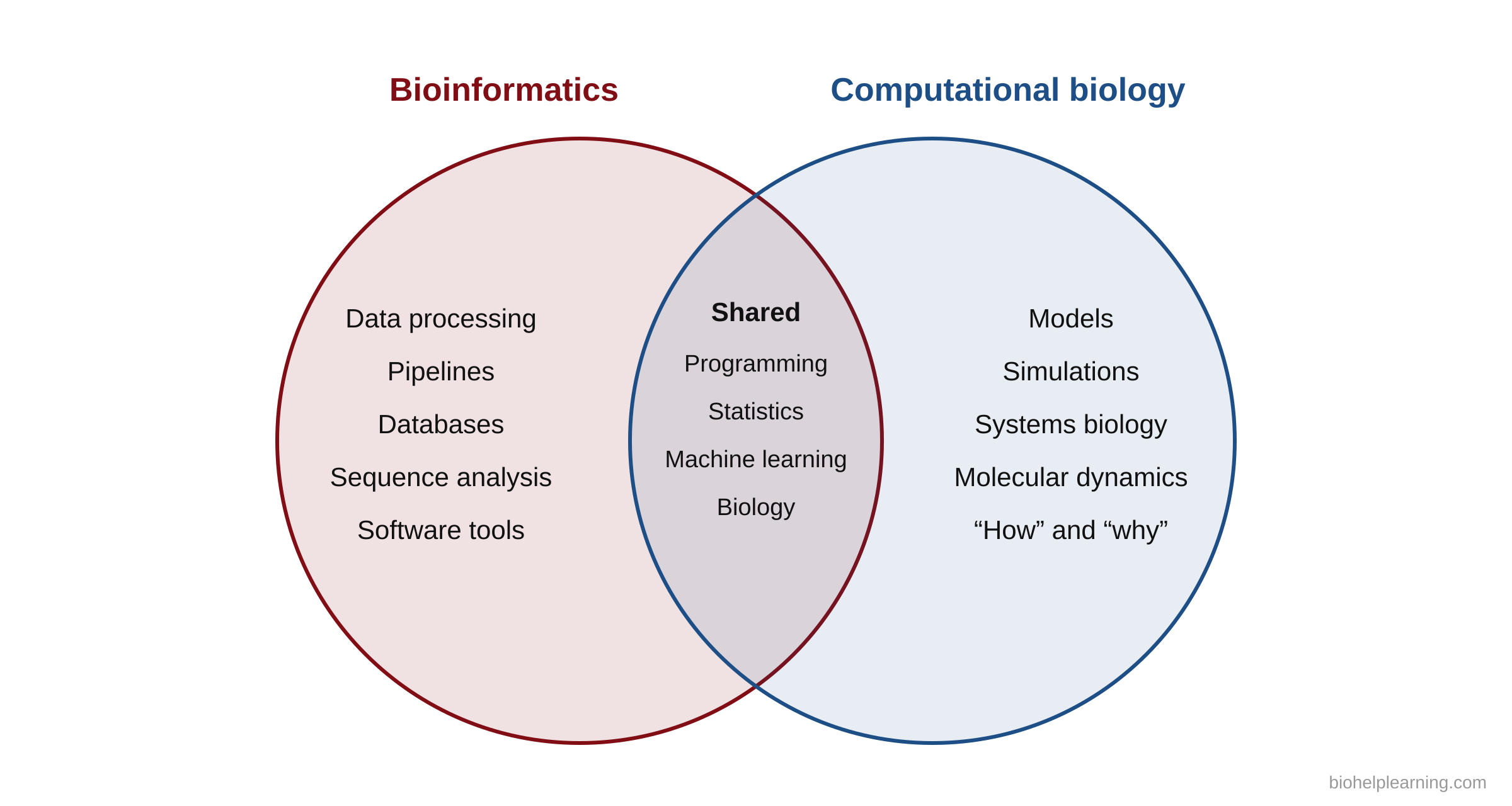
Computational biology uses mathematics, models and simulations to understand how living systems work. Instead of only analysing data that already exists, a computational biologist builds a model of a process, such as how a protein folds, how a virus spreads, or how a gene network switches a cell from healthy to cancerous, and then tests the model against real data.
A simple way to remember it: bioinformatics builds and uses the tools; computational biology uses tools and models to answer “how” and “why” questions. In real jobs the two overlap so much that many job posts list both names.
| Bioinformatics | Computational biology | |
|---|---|---|
| Main question | How do we store, process and analyse this data? | How does this biological system work? |
| Typical output | A pipeline, a database, a list of variants or genes | A model, a simulation, a prediction or a theory |
| Typical tools | Linux, Python, R, BWA, GATK, FastQC, databases | Python, R, statistics, machine learning, molecular dynamics |
| Example task | Find all mutations in 100 cancer exomes | Predict how one mutation changes protein shape and drug binding |
| Example job titles | Bioinformatics analyst, NGS analyst, pipeline engineer | Computational biologist, systems biologist, modelling scientist |
Researcher note: The US NIH’s Biomedical Information Science and Technology Initiative (BISTI) drew this same line in 2000: bioinformatics as research and development of tools to acquire, store, organise and analyse biological data; computational biology as the development of data-analytical and theoretical methods, modelling and simulation to study biological systems. In practice, journals such as Bioinformatics, PLOS Computational Biology and Nucleic Acids Research publish both kinds of work. For a history of the term, see Hogeweg (2011), PLoS Comput Biol 7(3): e1002021, doi:10.1371/journal.pcbi.1002021.
Why bioinformatics matters: the data explosion
The first human genome took 13 years (1990–2003) and billions of dollars of total project cost. Today a human genome can be sequenced in a day or two. The US National Human Genome Research Institute (NHGRI) tracked the cost: about US$95 million per genome in 2001 and about US$500 by 2022, a drop of roughly 190,000 times.
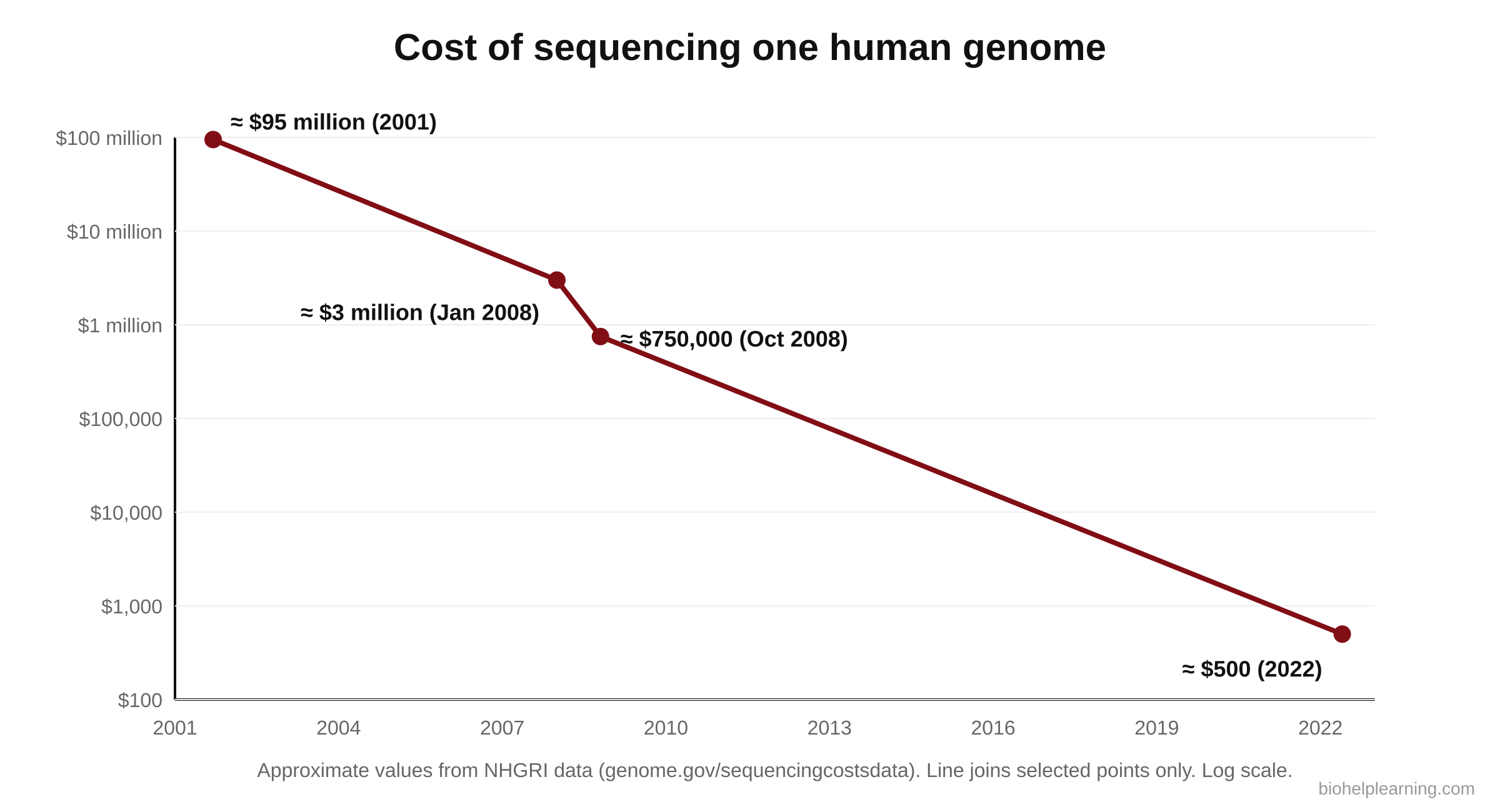
When data becomes cheap, analysis becomes the bottleneck. A lab can sequence 100 samples in a week, but it needs people who can check, clean, align, compare and interpret those samples. This is why bioinformatics skills are in demand in research, hospitals and industry.
The data is also growing in India. The Genome India Project, funded by the Department of Biotechnology, sequenced the whole genomes of 10,000 Indians from 83 population groups. The data was released in January 2025 through the Indian Biological Data Centre (IBDC) in Faridabad for approved researchers. Projects like this create work for Indian bioinformaticians for years.
▸ Go deeper: how big is genomic data, really?
A 30× human whole genome from short-read sequencing usually produces about 90–100 gigabases of sequence. As compressed FASTQ files this is often 50–100 GB per person, and an aligned BAM file adds a similar amount. Multiply by thousands of people and you reach petabytes. The Genome India Project data is often quoted at about 8 petabytes for 10,000 genomes, roughly 80 GB per genome.
Stephens and colleagues (2015, PLoS Biology 13(7): e1002195) compared genomics with astronomy, YouTube and Twitter and argued that genomics would be among the biggest data producers in the world by 2025. Whatever the exact numbers, the lesson for you is simple: you cannot open these files in Excel. You need the command line, scripts and pipelines.
Researcher note: NHGRI cost-per-genome figures include production costs (labour, reagents, consumables, instrument depreciation, informatics up to the first processing step) at NHGRI-funded centres. They exclude interpretation, storage beyond the first steps and research overheads, so do not quote them as the price a patient pays. The series is described at genome.gov/sequencingcostsdata (Wetterstrand KA, DNA Sequencing Costs: Data from the NHGRI Genome Sequencing Program). For a methods section, cite the page and the access date.
Your first taste: a tiny bioinformatics task
Here is the kind of thing bioinformaticians do every day, shrunk to one line of DNA. The GC content of a sequence is the percentage of letters that are G or C. It matters because GC-rich DNA is more stable, sequences differently on some machines, and varies between species.
The formula is simple:
GC% = (number of G + number of C) / (total number of bases) × 100For the sequence ATGCGTACGTTAGCGC there are 16 bases. Count the G and C letters: there are 9. So GC% = 9 / 16 × 100 = 56.25%.
Now the same task in Python. You don’t need to understand every word yet; the Python tutorials in this series will cover it.
seq = "ATGCGTACGTTAGCGC"
gc = seq.count("G") + seq.count("C")
print("Length:", len(seq))
print("GC count:", gc)
print("GC %:", round(100 * gc / len(seq), 2))And the same count in one line on the Linux command line, which our Linux tutorial teaches step by step:
echo "ATGCGTACGTTAGCGC" | grep -o "[GC]" | wc -lThis is the whole spirit of bioinformatics: a biology question (how GC-rich is this DNA?), a precise definition, and a few lines of code that work equally well on 16 letters or 3 billion.
▸ Go deeper: why a computer beats counting by hand
Counting 16 letters by hand takes a minute. Counting 3.1 billion letters at one letter per second would take nearly 100 years. Python’s count() scans memory at hundreds of millions of characters per second, so a whole chromosome takes seconds. Real tools go further: they read compressed files in streams, so even a 100 GB file never has to fit in memory.
# Pseudo-code: GC content of a very large FASTA file
gc = 0 ; total = 0
for each line in file:
    if line starts with ">": skip        # header line
    for each base in line:
        if base in {G, C}: gc = gc + 1
        if base in {A, C, G, T}: total = total + 1   # ignore N
report 100 * gc / total
Notice the detail “ignore N”: real genomes contain unknown bases written as N. Deciding how to treat them is a scientific choice, and good bioinformaticians always state it.
✅ Quick check: Chapter 1
- Bioinformatics vs computational biology: which one would you call “building a pipeline to find mutations in 500 samples”?
- What is the GC% of
GGCCAATT? - Why did bioinformatics become essential after about 2008?
Answers: 1. Bioinformatics (tool building and data processing). 2. 4 G/C out of 8 bases = 50%. 3. Next-generation sequencing made data very cheap and plentiful, so analysis became the bottleneck.