
What is Bioinformatics? A Complete Beginner’s Guide to Bioinformatics and Computational Biology
Chapter 2 of 5: Where bioinformatics is used, and where it is going
Bioinformatics is not one job in one lab. It is a set of skills used wherever biology produces data. This chapter shows the main fields, real examples, and the trends that will shape the next ten years.
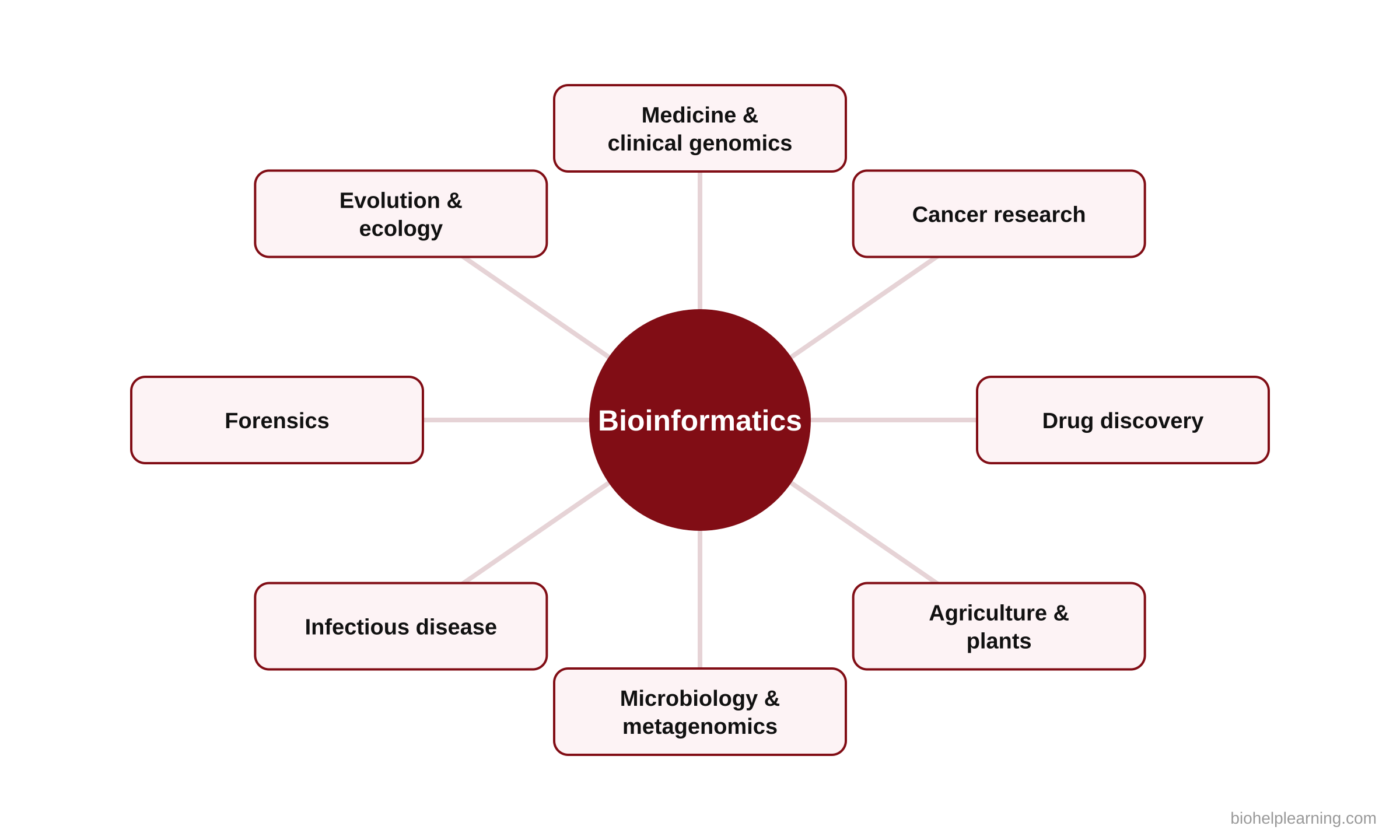
Bioinformatics used in various fields
1. Medicine and clinical genomics
Hospitals and diagnostic labs sequence patients’ genes to find the cause of rare genetic diseases, inherited cancer risk and drug-response differences. Whole exome sequencing (WES) reads the ~2% of the genome that codes for proteins; whole genome sequencing (WGS) reads everything. Bioinformaticians run the pipeline from raw reads to a short list of candidate variants that a clinical geneticist can review.
2. Cancer research
Tumours carry mutations that normal cells do not. By comparing tumour and normal DNA from the same patient, bioinformaticians find the driver mutations, measure gene expression with RNA-seq, and help match patients to targeted drugs.
3. Drug discovery
Pharmaceutical companies use bioinformatics to choose drug targets, predict protein structures, screen millions of molecules on the computer before testing a few in the lab, and analyse clinical trial data. Protein structure prediction with AI, such as AlphaFold, has changed this area dramatically.
4. Agriculture and plant science
Plant breeders use genome data to find genes for drought tolerance, disease resistance and yield. Marker-assisted selection and genomic selection let breeders choose the best seedlings before they grow, saving years. India’s crop research institutes use these methods for rice, wheat, pulses and cotton.
5. Microbiology and metagenomics
Metagenomics sequences all the DNA in a sample, such as gut, soil, sea water or sewage, and identifies which microbes are present and what they can do. It is used to study the gut microbiome, find new enzymes and track antibiotic resistance genes.
6. Infectious disease and public health
During COVID-19, labs around the world sequenced the virus and shared genomes so that new variants could be spotted within days. The same methods track tuberculosis drug resistance, influenza and foodborne outbreaks.
7. Forensics, evolution, ecology and more
DNA forensics identifies people from tiny samples. Evolutionary biologists build family trees of species. Ecologists use environmental DNA (eDNA) from water to count fish without catching them. Animal breeders, food-safety labs and even archaeologists use bioinformatics.
| Field | Typical data | Typical question | Common tools you will learn |
|---|---|---|---|
| Clinical genomics | WES/WGS of patients | Which variant explains this disease? | BWA, GATK, bcftools, VEP |
| Cancer | Tumour–normal DNA, RNA-seq | Which mutations drive this tumour? | Mutect2, STAR, DESeq2 |
| Drug discovery | Protein sequences and structures | Will this molecule bind the target? | AlphaFold, PyMOL, docking tools |
| Agriculture | Plant genomes, SNP panels | Which plants carry the useful gene? | GWAS tools, PLINK, R |
| Metagenomics | Mixed microbial DNA | Which microbes are here? | Kraken2, MetaPhlAn, QIIME 2 |
| Public health | Pathogen genomes | Is this a new variant or outbreak? | Nextclade, IQ-TREE, Nextstrain |
▸ Go deeper: what a variant-calling project actually looks like
A typical exome project: (1) receive FASTQ files from the sequencing provider; (2) run quality control with FastQC and MultiQC; (3) trim adapters; (4) align reads to the human reference (GRCh38) with BWA-MEM; (5) sort, mark duplicates and index the BAM file; (6) call variants with GATK HaplotypeCaller or a similar tool; (7) filter variants; (8) annotate them with gene names, population frequencies and predicted effects; (9) prioritise variants that fit the patient’s symptoms and inheritance pattern. Each step is one tutorial in this series.
Researcher note: Clinical use of variant calls requires validated pipelines and standard interpretation frameworks. The ACMG/AMP 2015 guidelines (Richards et al., Genetics in Medicine 17: 405–424, doi:10.1038/gim.2015.30) define the five classes pathogenic, likely pathogenic, uncertain significance, likely benign and benign. Research pipelines are not automatically clinical-grade; accreditation (for example NABL in India, CAP/CLIA in the USA) requires documented validation.
The future of bioinformatics
Bioinformatics is one of the fastest-moving areas of science. Here are the trends that will matter most for anyone starting today.
1. AI models that read and write DNA and proteins
AlphaFold changed protein structure prediction, and its creators Demis Hassabis and John Jumper shared the 2024 Nobel Prize in Chemistry with David Baker. AlphaFold 3, which also predicts how proteins interact with DNA, RNA and small molecules, had its code released for academic use in November 2024. In 2026 two large DNA models were published in Nature: Google DeepMind’s AlphaGenome, which reads up to one million DNA letters and predicts how a variant changes gene regulation, and the Arc Institute’s fully open Evo 2, trained on about 9.3 trillion nucleotides from across the tree of life.
What this means for you: AI will not replace bioinformaticians, but bioinformaticians who can use, test and question AI models will replace those who cannot. You still need biology to know whether a prediction makes sense, and statistics to know whether a result is real.
2. Long-read and cheaper sequencing
Oxford Nanopore and PacBio read DNA fragments thousands to millions of letters long. In 2022 the Telomere-to-Telomere (T2T) Consortium published the first truly complete human genome using long reads. Long reads reveal structural variants and repeats that short reads miss, and they need new tools and new skills.
3. Single-cell and spatial biology
Instead of measuring the average of millions of cells, single-cell RNA-seq measures each cell separately. Spatial transcriptomics also records where each cell sits in the tissue. These methods produce huge, complex datasets and are among the hottest areas for computational biologists.
4. Multi-omics and precision medicine
Combining genome, transcriptome, proteome, metabolome and clinical data from the same patient gives a fuller picture than any one layer. Integrating them is a core computational challenge.
5. Cloud, workflows and reproducibility
Analyses are moving to the cloud and to workflow managers such as Nextflow and Snakemake, so that a pipeline written in Bengaluru runs identically in Boston. Nextflow 26.04 (2026) added a module registry, so a tested community module such as nf-core FastQC can be installed with one command. Skills in Linux, containers (Docker, Apptainer) and workflows are now expected, not optional.
6. Growth in India
India is building its own genomic data (Genome India Project, IBDC), its own clinical genomics companies and a growing biotech sector. The government’s BioE3 policy (2024) also targets biomanufacturing and biotech growth. More data generated in India means more analysis jobs in India.
▸ Go deeper: how big is the bioinformatics market?
Market research firms publish different numbers because they define the market differently. BCC Research (2026) valued the global bioinformatics market at about US$23.5 billion in 2025 and projected about US$43.5 billion by 2030, a compound annual growth rate (CAGR) of 13.1%. Other firms give lower or higher figures, but almost all agree on double-digit yearly growth driven by sequencing, AI and precision medicine.
CAGR is easy to compute yourself:
CAGR = (end value / start value)^(1 / years) − 1
     = (43.5 / 23.5)^(1/5) − 1 ≈ 0.131  →  13.1% per year
Researcher note: Key 2024–2026 references for the AI shift: Abramson et al. 2024, “Accurate structure prediction of biomolecular interactions with AlphaFold 3”, Nature 630: 493–500, doi:10.1038/s41586-024-07487-w; Brixi et al. 2026, “Genome modeling and design across all domains of life with Evo 2”, Nature, doi:10.1038/s41586-026-10176-5; AlphaGenome (Google DeepMind; preview 2025, Nature 2026). Licences differ: AlphaFold 3 weights and AlphaGenome are for non-commercial use under their terms, while Evo 2 releases code, weights and training data openly. Always check the licence before using a model in a company project.
For complete genomes, cite Nurk et al. 2022, “The complete sequence of a human genome”, Science 376: 44–53, doi:10.1126/science.abj6987.
✅ Quick check: Chapter 2
- Which sequencing approach reads only the protein-coding part of the genome: WES or WGS?
- Name one reason long reads are useful.
- True or false: AI models mean you no longer need to learn biology.
Answers: 1. WES (whole exome sequencing). 2. They span repeats and detect large structural variants that short reads miss. 3. False: biology and statistics are what let you judge whether an AI prediction is believable.