
What is Bioinformatics? A Complete Beginner’s Guide to Bioinformatics and Computational Biology
Chapter 3 of 5: Bioinformatics careers, salaries and how long it takes
This chapter answers the questions every student asks: What jobs exist? What do they pay in different countries? Which companies hire? And how long does it really take to become a bioinformatician from scratch?
Common bioinformatics job roles
| Role | What you do | Usual entry level |
|---|---|---|
| Bioinformatics analyst / NGS analyst | Run pipelines on sequencing data, QC, alignment, variant calling, reports | MSc / MTech with practical NGS skills |
| Genome analyst / variant scientist | Interpret variants for clinical reports | MSc in genetics or biotech, sometimes PhD |
| Bioinformatics engineer / pipeline developer | Build and maintain Nextflow/Snakemake pipelines, cloud and HPC | Strong coding + Linux, any relevant degree |
| Computational biologist / scientist | Design analyses, models and new methods, publish research | Usually PhD |
| Data scientist (life sciences, ML) | Machine learning on omics and clinical data | MSc/PhD with statistics and ML |
| Research fellow (JRF/SRF) / project staff | Bioinformatics work on government-funded projects | MSc; JRF often needs NET/GATE-type qualification |
| Trainer / educator / field application scientist | Teach tools, support customers using software or instruments | MSc + communication skills |
Bioinformatics salary in different countries
Salaries depend on country, city, degree, experience, skills and employer. The figures below are indicative averages from public salary surveys, checked in November 2026. Treat them as a rough guide, not a promise. Starting salaries, especially in India, can be lower than averages, and senior or industry AI roles can be much higher.
| Country | Indicative annual salary | Source and notes |
|---|---|---|
| India | ₹3–8 lakh for freshers and analysts; about ₹7 lakh average for bioinformatics scientists; ₹10–20 lakh+ for experienced or senior roles | PayScale India 2026 (Bioinformatics Scientist average ≈ ₹7.1 L; early career ≈ ₹6.5 L; mid-career ≈ ₹8.4 L); AmbitionBox (Bioinformatics Analyst ₹2.1–13.8 L for 0–5 years) |
| USA | About US$93,000 median; often US$100,000+ in industry | O*NET/BLS May 2024 median for Biological Scientists, All Other (includes bioinformatics scientists) = $93,330; PayScale 2025 average ≈ $103,800 |
| United Kingdom | About £40,000–55,000; higher in pharma and AI companies | PayScale UK 2026 Bioinformatics Scientist average ≈ £44,700; Wellcome Sanger senior bioinformatician posting £46–55K |
| Germany | About €60,000–80,000 | PayScale Germany 2026 Bioinformatics Scientist average ≈ €68,300 |
| Canada | About C$65,000 average | PayScale Canada 2026 Bioinformatician average ≈ C$66,100 |
Why do Indian numbers look small next to US numbers? Living costs are very different, so compare salaries within a country, not across countries. Inside India, bioinformatics pays well compared with many wet-lab entry jobs, and remote work for international companies is becoming more common for experienced people.
▸ Go deeper: what increases your salary
- Real, shown skills: a GitHub portfolio with a complete NGS project beats a certificate list.
- Programming depth: Python or R plus Linux and a workflow manager (Nextflow/Snakemake).
- A domain: clinical genomics, single-cell, cancer, or drug discovery.
- Cloud and HPC: AWS/GCP, Slurm, Docker.
- Machine learning: especially for omics data.
- Communication: explaining results to doctors, biologists and managers.
Researcher note on the data: US federal statistics do not have a separate occupation code for bioinformatics scientists; O*NET maps them (19-1029.01) to “Biological Scientists, All Other”, so the BLS median mixes several jobs. Crowd-sourced sites (PayScale, AmbitionBox, Glassdoor) rely on self-reports with small samples for niche titles, so they move from month to month. When you negotiate, compare at least two sources for your city and level, and use job postings that state a salary range as the most direct evidence.
Top bioinformatics companies and what they do
Bioinformaticians work in four kinds of places: sequencing and instrument companies, software and data platforms, pharma and AI-driven biotech, and diagnostics and service companies. Universities and government institutes are a fifth, very important employer. Here are well-known examples (not a ranking).
Global companies
| Company | What they do (bioinformatics side) |
|---|---|
| Illumina | Leading short-read sequencer maker; develops DRAGEN secondary-analysis software and, from 2026, the BioInsight software and AI platform |
| Thermo Fisher Scientific | Ion Torrent sequencers, lab instruments and analysis software |
| Oxford Nanopore Technologies | Portable long-read nanopore sequencers and their basecalling and analysis software |
| PacBio | HiFi long-read sequencing and tools for complete genomes and structural variants |
| QIAGEN (QIAGEN Digital Insights) | Bioinformatics software for clinical interpretation and pathway analysis |
| Google DeepMind and Isomorphic Labs | AlphaFold, AlphaGenome and AI-driven drug design |
| NVIDIA (BioNeMo) | GPU computing and AI frameworks for biology; partner on Evo 2 |
| Seqera | Company behind Nextflow and the Seqera Platform for running pipelines |
| DNAnexus, Velsera | Cloud platforms for secure genomic data analysis (Velsera has a large team in Pune) |
| Schrödinger, Recursion | Computational drug discovery using physics-based modelling and AI |
| Big pharma (Novartis, AstraZeneca, Pfizer, Roche, Sanofi, GSK…) | In-house computational biology for targets, biomarkers and clinical trials; several run large data teams in India |
Companies and organisations in India
| Organisation | What they do |
|---|---|
| Strand Life Sciences (Bengaluru) | IISc spin-off; genomic diagnostics, bioinformatics software and services |
| MedGenome (Bengaluru) | Genetic testing, clinical genomics and research services; hires genome analysts |
| Elucidata (Delhi, Bengaluru) | AI-ready biological data platform and bioinformatics services for pharma |
| MapMyGenome (Hyderabad) | Consumer and clinical genomics tests |
| Velsera (Pune) | Genomic data platforms and analysis (formerly Seven Bridges and others) |
| Other startups | Bionivid, Clevergene, Xcode Life, Nucleome Informatics and many more service companies |
| Government and academic | IBDC, NCBS, CCMB, NIBMG, ICGEB, NABI, IISc, IITs, ICMR and CSIR institutes – project and research positions |
Our sister portal Jobs Bio Help Learning collects life-science, bioinformatics, PhD and postdoc openings in one place.
How much time does it take to become a bioinformatician from scratch?
Honest answer: about 9–12 months of steady part-time study (10–15 hours a week) to reach an entry-level, job-ready standard, if you already have a life-science or computer degree. It can be faster with full-time study, and slower if you are also learning basic biology or basic computing. Becoming an independent senior scientist takes several years of real projects, as in any profession.
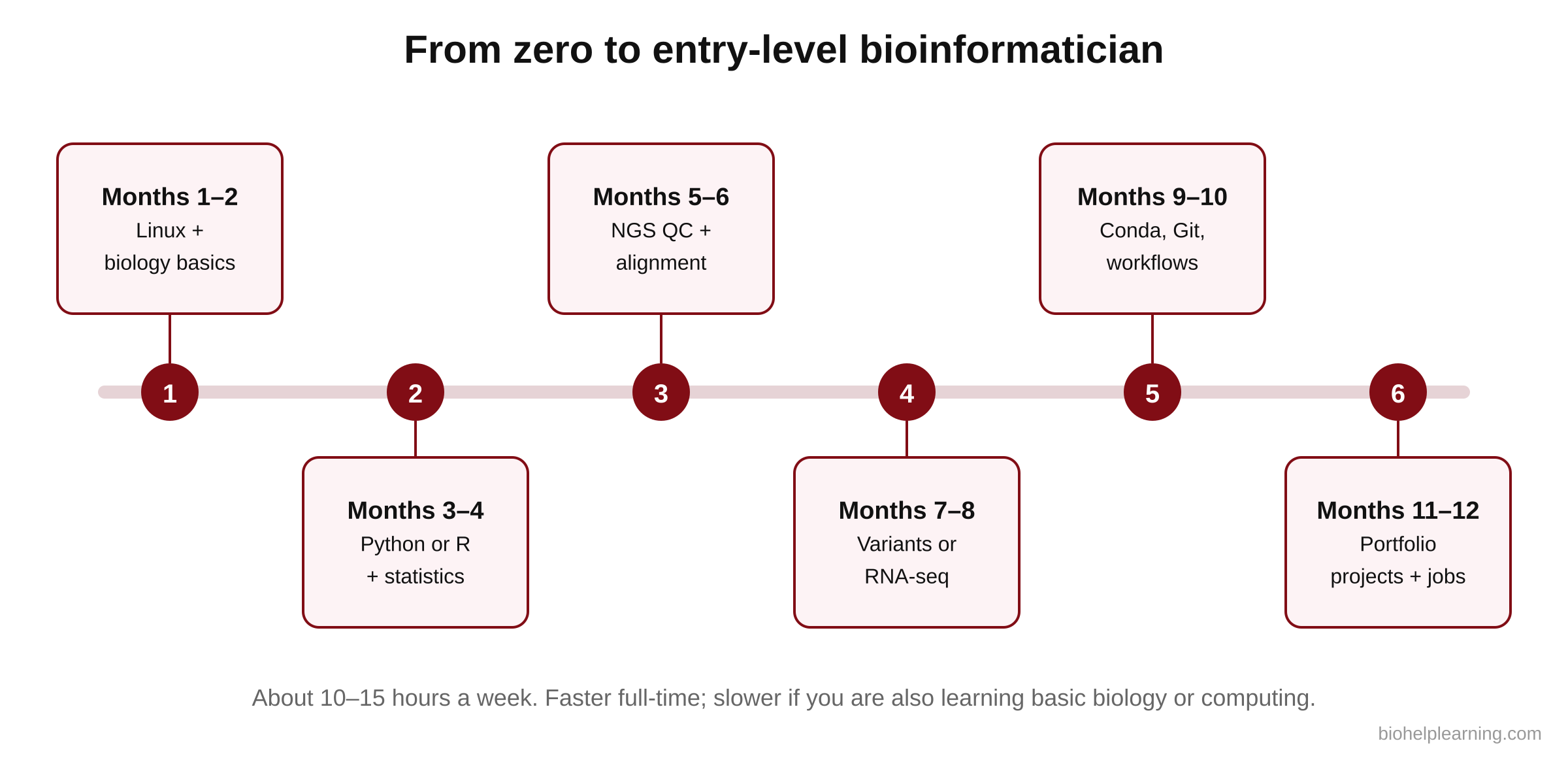
| Months | Focus | You can say you are ready when you can… |
|---|---|---|
| 1–2 | Linux command line; refresh molecular biology (DNA, genes, mutations, central dogma) | move around folders, read and count FASTQ/FASTA files with grep, wc, awk |
| 3–4 | Python or R basics; statistics (mean, variance, p-values, multiple testing) | write a script that reads a file, loops and makes a plot |
| 5–6 | NGS basics: FASTQ, quality control, trimming, alignment, SAM/BAM | take raw reads to a sorted, indexed BAM file and explain each step |
| 7–8 | Variant calling (WES/WGS) or RNA-seq differential expression | produce and explain a filtered VCF or a list of differentially expressed genes |
| 9–10 | Conda, Git/GitHub, Nextflow or Snakemake, Docker | rerun your whole analysis with one command on another computer |
| 11–12 | Two or three portfolio projects on public data; CV; interviews | show a GitHub repository with README, code, results and interpretation |
▸ Go deeper: a simple weekly study rhythm
- 3 days: learn one new concept and type every command yourself (never just watch).
- 2 days: practise on a different dataset than the tutorial.
- 1 day: write short notes in your own words, or a small blog post.
- 1 day: rest, or read one paper’s Methods section and try to understand which tools they used.
Consistency beats intensity. One hour every day for a year is about 365 hours of practice; that is more than most short courses provide.
How to learn bioinformatics and computational biology
You need four kinds of knowledge. You don’t need all of them on day one, but you will need all of them eventually.
- Biology: molecular biology, genetics, and the biology of your chosen area.
- Computing: Linux command line first, then Python and/or R, then Git and workflows.
- Statistics: distributions, hypothesis tests, multiple-testing correction, regression; later machine learning.
- Domain tools and data: the file formats (FASTA, FASTQ, SAM/BAM, VCF, GTF), databases (NCBI, Ensembl, UniProt, PDB) and standard tools.
Good free resources to use alongside our tutorials: NCBI and Ensembl tutorials, EMBL-EBI Training online courses, the Galaxy Training Network, Rosalind (bioinformatics programming puzzles), nf-core documentation, and Biostars for questions.
Practical rules that work:
- Learn by doing on real public data from NCBI SRA or ENA.
- Keep everything in a GitHub repository from day one.
- Read the official documentation of each tool, not only blog posts.
- When you get an error, read the error message slowly before searching; most errors say exactly what is wrong.
- Explain each step in your own words. If you can’t explain it, you haven’t learned it yet.
Researcher note: Good habits from day one save months later. Read Sandve et al. 2013, “Ten simple rules for reproducible computational research”, PLoS Comput Biol 9(10): e1003285, doi:10.1371/journal.pcbi.1003285, and the FAIR principles (Wilkinson et al. 2016, Scientific Data 3: 160018, doi:10.1038/sdata.2016.18). Record tool versions, parameters, reference genome builds and random seeds for every analysis.
✅ Quick check: Chapter 3
- Which source gives the official US median for the group that includes bioinformatics scientists?
- What should you build during months 11–12 of the roadmap?
- Name the four kinds of knowledge a bioinformatician needs.
Answers: 1. BLS/O*NET (Biological Scientists, All Other). 2. Two or three portfolio projects on public data, on GitHub. 3. Biology, computing, statistics, and domain tools and data.