A sequencing run that once took a week now finishes overnight, and the bottleneck has moved. The hard part of modern biology is no longer generating data. It is making sense of it: deciding which of the four million variants in a genome matters, what an uncharacterised protein does, which of ten thousand cells in a tumour sample is the one driving resistance. These are pattern problems on data too large for any person to read, which is exactly the kind of problem machine learning is good at.
That is why AI in bioinformatics stopped being a conference buzzword and became ordinary infrastructure. The variant caller in a clinical pipeline is a neural network. The structure of the protein you are docking against was almost certainly predicted by one. The basecaller that turned raw nanopore signal into sequence is a deep learning model too, and nobody calls it AI any more because it simply works. Meanwhile a second wave of much larger models, trained on genomes and proteins the way language models are trained on text, is pushing into harder territory: predicting what a non-coding mutation does to gene regulation, or designing a protein that has never existed.
This guide covers what these systems actually do, the AI tools used in bioinformatics task by task, the skills and job roles that follow from them, where to learn this for free in India, and, just as importantly, the things these models still get wrong. If you are new to the field, start with our primer on what bioinformatics is and its major branches and come back here.
What AI in bioinformatics actually means
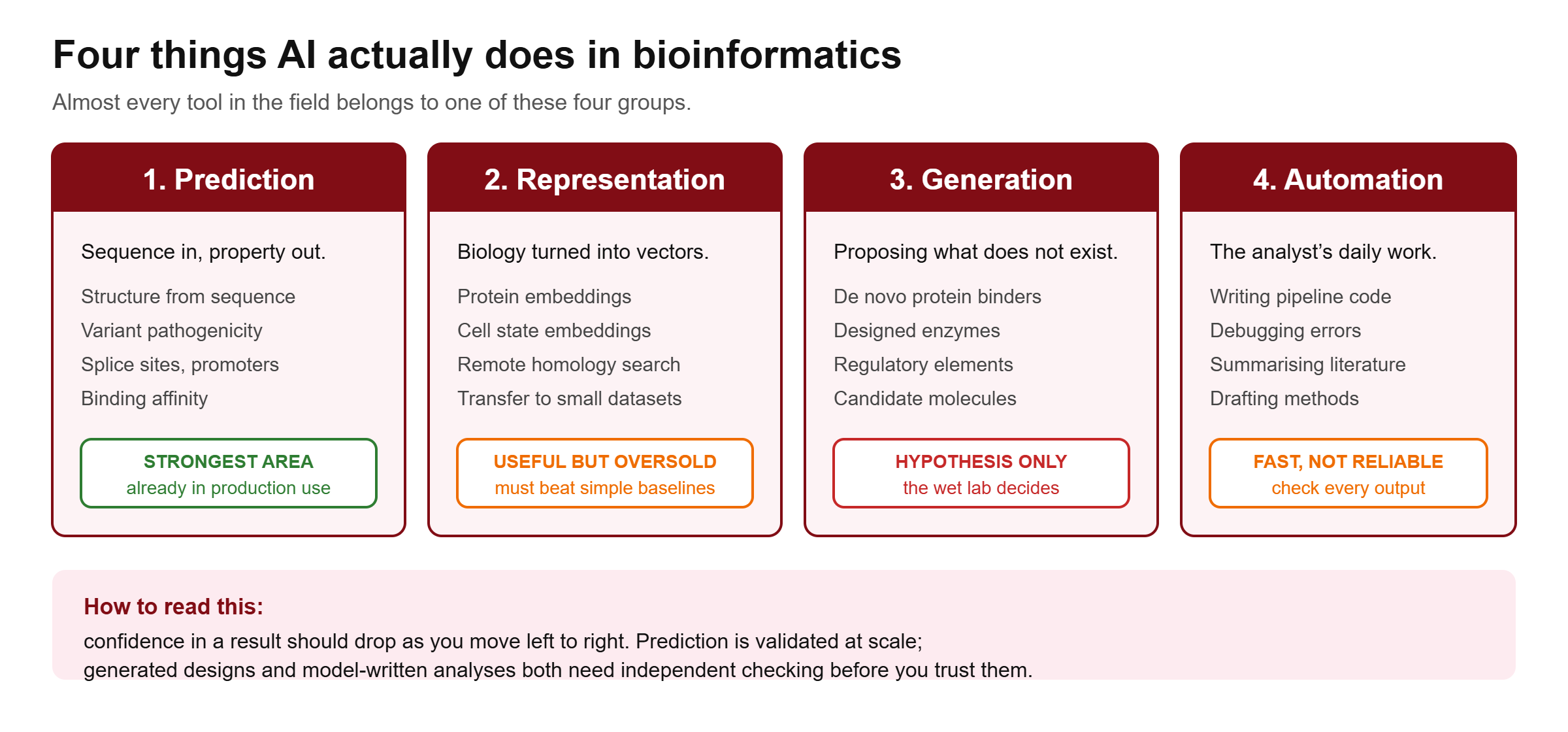
Strip away the marketing and almost everything in this field is one of four things.
Prediction. You have a sequence and you want a property: a structure, a pathogenicity score, a splice site, a promoter, a binding affinity. The model learns the mapping from labelled examples and then applies it to sequences nobody has ever studied. This is the bread and butter of the field and where it works best.
Representation. Before you can cluster, classify or compare, you need to turn messy biological data into numbers that preserve meaning. Protein language models learn embeddings in which evolutionarily related sequences sit close together even when their sequence identity is low. Single-cell models try to do the same for expression profiles. A good representation makes every downstream task easier.
Generation. Diffusion models and sequence generators do not just score what exists, they propose what does not: a new binder for a target, a regulatory element active only in liver cells, a candidate molecule with a wanted property profile. Generation is the most exciting and the least reliable of the four.
Automation of the analyst. Large language models write the Snakemake rule, explain the cryptic error, draft the methods section, summarise forty papers. This is not biology-specific intelligence. It is a productivity change in how bioinformatics work gets done, and it is the part that affects your day first.
Keep those four categories in mind, because the honest limits later in this article map onto them neatly. Prediction is strong. Representation is useful but oversold. Generation needs a wet lab to check it. Automation is real but unreliable in ways that are easy to miss.
Why biology became a machine learning problem
Three things had to line up, and they did, roughly in that order.
First, labelled data at scale. Decades of structural biology produced the Protein Data Bank. Clinical genetics produced curated variant databases. Consortia produced thousands of matched epigenomic and expression tracks across tissues. Deep learning needs examples, and biology had quietly accumulated them in public archives.
Second, the right architectures. Convolutional networks suited the local-motif structure of DNA. Attention mechanisms suited the long-range problem: an enhancer can act on a gene a hundred thousand bases away, and models that only look at a narrow window will never see it. The same transformer ideas that made language models work turned out to fit sequences written in four letters or twenty.
Third, the compute. Training the current generation of genome-scale models takes thousands of accelerators running for months. Most of us never train one. We download it, and that distinction matters for how you should plan a career: the field needs far more people who can apply, benchmark and interpret these models than people who can build them from scratch.
A useful way to see what changed is to compare how one question used to be answered with how it is answered now.
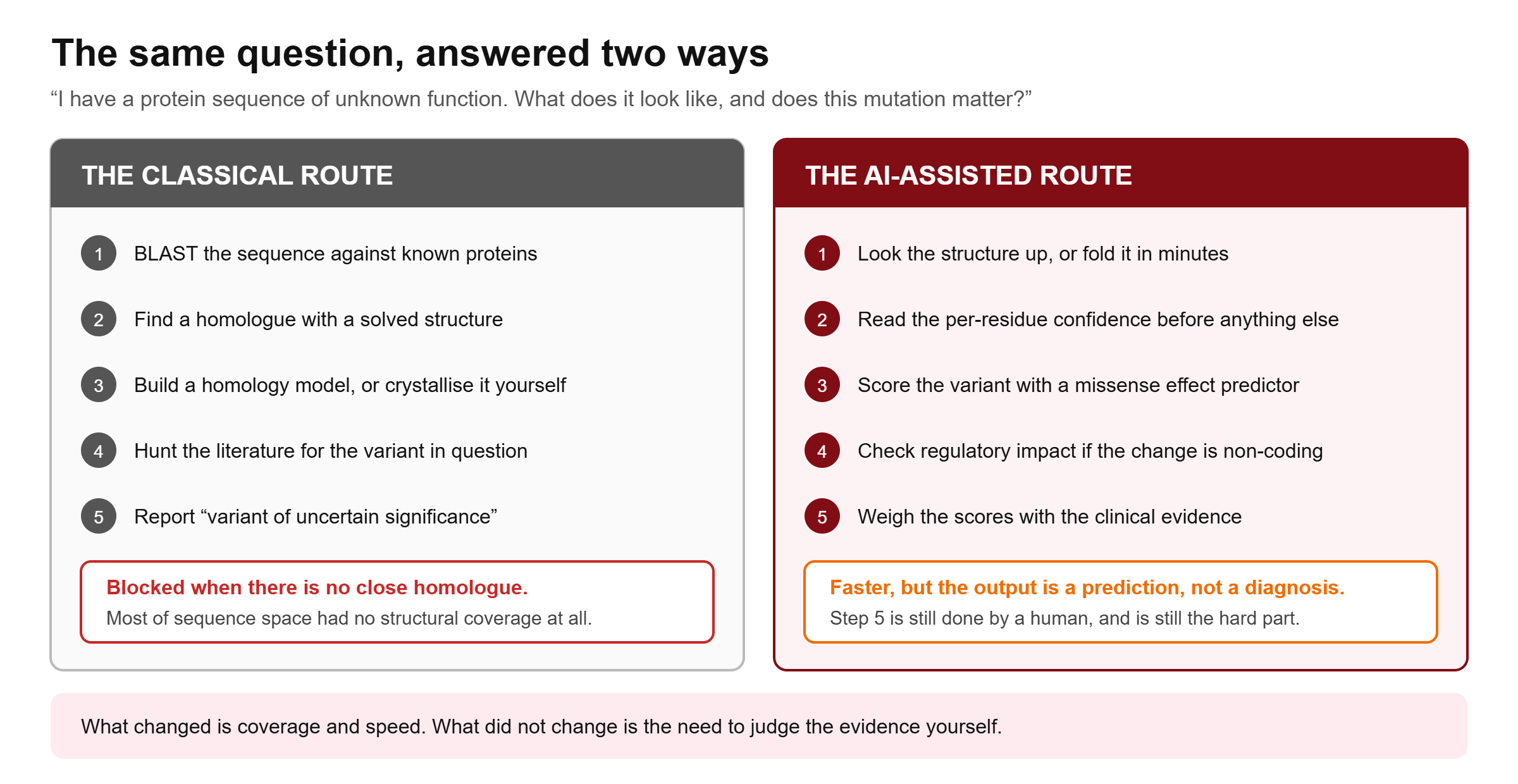
Where AI sits in a real bioinformatics pipeline
It is tempting to picture AI as a separate exotic stage bolted onto the end of an analysis. In practice it is distributed through the whole thing, and most of it is invisible.
Basecalling and raw signal
For nanopore sequencing, the conversion from electrical current to bases is a neural network, and it has been for years. Accuracy has climbed with successive model generations rather than with changes to the chemistry alone, and the same models are what make direct detection of base modifications such as methylation possible from the raw signal. Neural basecalling was benchmarked against earlier hidden-Markov approaches as far back as the first community comparisons, and nobody has gone back.
Alignment and quality control
This stage is still mostly classical algorithms, and that is fine. Burrows-Wheeler indexing and seed-and-extend are exact, fast and auditable. If you want to understand why this layer resisted replacement, our write-up of the core bioinformatics algorithms is a good companion read. Learn the Linux command line and read quality control with FastQC and MultiQC before you touch any of the models below, because a model trained on clean data will happily produce confident nonsense from a bad library.
Variant calling
This is where deep learning took over a mainstream production step. DeepVariant reframes variant calling as image classification: it renders the pileup of aligned reads around a candidate site as a tensor that looks like a picture, then uses a convolutional network to decide whether the site is a real variant and what genotype it is. Input is an aligned BAM or CRAM plus a reference; output is an ordinary VCF or gVCF, so it drops into an existing pipeline. It has models for Illumina and Element short reads, PacBio HiFi, Oxford Nanopore R10.4.1, Complete Genomics, Roche SBX, and RNA data, and it won the 2020 precisionFDA Truth Challenge V2 in the all-benchmark-regions category for nanopore, PacBio and multi-technology entries, having previously taken best SNP performance in the 2016 challenge. If you are building a clinical pipeline, see our guide to whole exome sequencing for where this step fits.
Interpretation
Calling a variant is easy compared with saying whether it matters. This is now the busiest area of applied AI in genomics, and it is covered in its own section below.
Reporting and write-up
Language models summarise, draft and explain. They also hallucinate citations, so everything they produce about a patient or a paper has to be checked against the source.
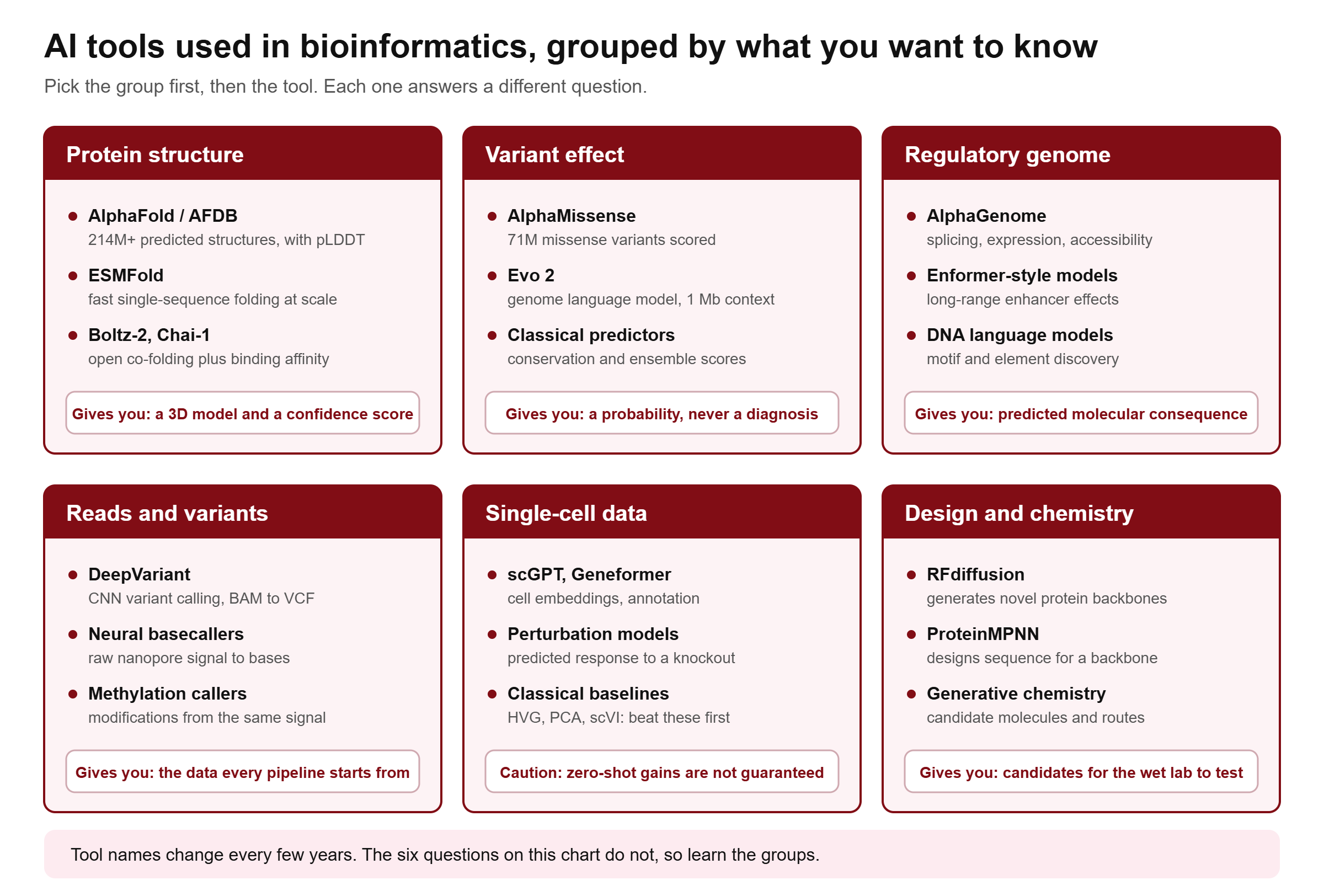
AI tools used in bioinformatics, task by task
What follows is organised by the question you are trying to answer, not by who built the tool. For each one, the useful thing to know is what it takes in, what it gives back, and what it cannot tell you.
Protein structure prediction
AlphaFold is the reason this field looks different from how it looked a decade ago. The AlphaFold Protein Structure Database, built with EMBL-EBI, now provides predicted structures for over 214 million protein sequences, which is effectively the whole of UniProt rather than the few hundred thousand entries in the experimental Protein Data Bank. The single most important habit when using it is to read the confidence score rather than the picture. Per-residue pLDDT above 90 is high accuracy and good enough for tasks such as characterising a binding site; 70 to 90 means the backbone is reliable; 50 to 70 should be used with caution; and below 50 the region is probably intrinsically disordered and the spaghetti you see on screen is not a conformation, it is the model telling you there is no single structure to predict. The database also excludes isoforms, very short sequences, sequences with non-standard amino acids, and viral proteins, which surprises people who assume every accession is covered.
AlphaFold 3 extended prediction from single chains to complexes, including protein interactions with nucleic acids, ligands and ions. Its code and weights were subsequently made available for academic, non-commercial use, with weights granted on request, so it is usable in a university lab but not freely redistributable.
ESMFold takes a different route. Instead of building a multiple sequence alignment for each query, it reads the single sequence through a protein language model and folds from that representation, which makes it dramatically faster and well suited to bulk work on sequences with few relatives. That speed is what made the ESM Metagenomic Atlas possible: an open atlas of 617 million predicted metagenomic protein structures, a region of sequence space that classical methods had largely left dark.
Boltz-2 and Chai-1 are the openly developed co-folding models that matter most for drug discovery work, because they predict structure and binding affinity together rather than leaving affinity to a separate scoring step. Boltz-2, developed at MIT with Recursion, is open source, which means a student with a modest GPU allocation can now run something close to the current state of the art.
Variant effect and clinical interpretation
AlphaMissense scored all 71 million possible single amino acid substitutions in the human proteome. It classified 89 per cent of them as either likely benign (57 per cent) or likely pathogenic (32 per cent), leaving 11 per cent uncertain. The context that makes this striking: before it, only about 0.1 per cent of those variants had been confirmed by human experts. The context that keeps it honest: DeepMind states plainly that the predictions are not designed to be used directly in the clinic, must be read alongside other evidence, and say nothing about how a mutation changes protein structure or stability.
AlphaGenome addresses the part of the genome that most tools ignore. It reads up to one million base pairs of DNA and predicts, at single-base resolution, where genes start and end across tissues, where RNA is spliced and which junctions are used, how much RNA is produced, which regions are accessible, which sit close together in three dimensions, and which proteins bind where. You score a variant by comparing predictions for the mutant and reference sequences. It is available in preview through an API for non-commercial research, and the published work notes two limits worth repeating: regulatory elements more than about a hundred thousand bases away remain an open challenge, and the model was neither designed nor validated for personal genome or clinical prediction.
Evo 2 is the most ambitious genome language model released so far, and the most open. It was trained on roughly 9.3 trillion nucleotides from more than 128,000 genomes spanning bacteria, archaea, phage and eukaryotes, on over two thousand H100 GPUs, with a context window of up to a million nucleotides. In BRCA1 variant tests it exceeded 90 per cent accuracy in separating benign from potentially pathogenic mutations, without having been trained on variant labels at all. Weights, code and training data were all released. Human pathogens were deliberately excluded from the base training data, which is a reminder that biosecurity is now part of model design rather than an afterthought.
Single-cell and spatial transcriptomics
This is the area where you should be most sceptical, and knowing why will make you look like a careful scientist in any interview. scGPT and Geneformer are transformer models pretrained on tens of millions of cells, offered for cell type annotation, batch integration, perturbation prediction and more. A zero-shot evaluation published in Genome Biology compared them against unglamorous baselines and found they did not reliably win: on cell type clustering both generally performed worse than simply selecting highly variable genes; on batch integration the highly variable gene baseline achieved the best scores across all datasets tested; scGPT’s gene expression predictions were beaten by a naive mean-expression baseline when not conditioned on cell embeddings; and tissue-matched pretraining did not guarantee better performance than random initialisation. The authors’ conclusion was a caution against using these models in zero-shot settings, and a separate study found parameter-free representations outperforming them on downstream benchmarks.
None of that means the approach is worthless. Fine-tuned on a specific task with enough labelled data, these models can be competitive. It means the burden of proof sits with the model, and the baseline you must beat is cheaper than you think. If you work with this data, build the boring pipeline first: our single-cell RNA-seq analysis training and RNA-seq data analysis course both cover the classical workflow that any model has to be measured against.
Protein design and engineering
RFdiffusion generates protein backbones by denoising from random noise, optionally conditioned on a target, a motif or a symmetry you specify, and ProteinMPNN then designs an amino acid sequence likely to fold into that backbone. Together they have produced genuinely novel binders and enzymes validated in the lab, and the work was published in Nature. They have also produced a lot of designs that do not work: one evaluation reported a low success rate for de novo design of functional binders intended for biochemical detection. The realistic workflow is to generate many candidates, filter hard in silico, and still expect the wet lab to reject most of them.
Drug discovery and cheminformatics
Property prediction, generative chemistry, retrosynthesis planning and AI-assisted docking are now standard parts of early discovery. The useful framing is that AI compresses the hit-finding and lead-optimisation stages, which were never where most programmes died. We go through the real molecules, the companies and the methods in detail in our article on AI-driven drug discovery, and the hands-on side is taught in our AI and cheminformatics in drug discovery course.
Literature, code and the daily grind
General-purpose language models are now part of most bioinformaticians’ working day: drafting scripts, debugging a confusing stack trace, converting a file format, explaining an unfamiliar tool’s flags, summarising a field. This is real time saved. It is also where the gap between feeling capable and being correct is widest. BixBench, a benchmark of 61 real bioinformatics analysis scenarios with 205 open-answer questions, found frontier models reaching only about 21 per cent accuracy in open-answer mode, and when a multiple-choice variant included an honest “insufficient information” option, performance fell to near random guessing. The authors described this as a fundamental shortcoming for conducting rigorous bioinformatics research. Use these tools as a fast, confident junior colleague whose work you always check, not as an analyst.
Careers: what AI in bioinformatics asks of you
The job market has not replaced bioinformaticians with prompt engineers. It has raised the floor. Employers now assume you can run a standard pipeline and want to know what you can do beyond that, which usually means: can you evaluate a model honestly, and can you build something that runs on more than your laptop.
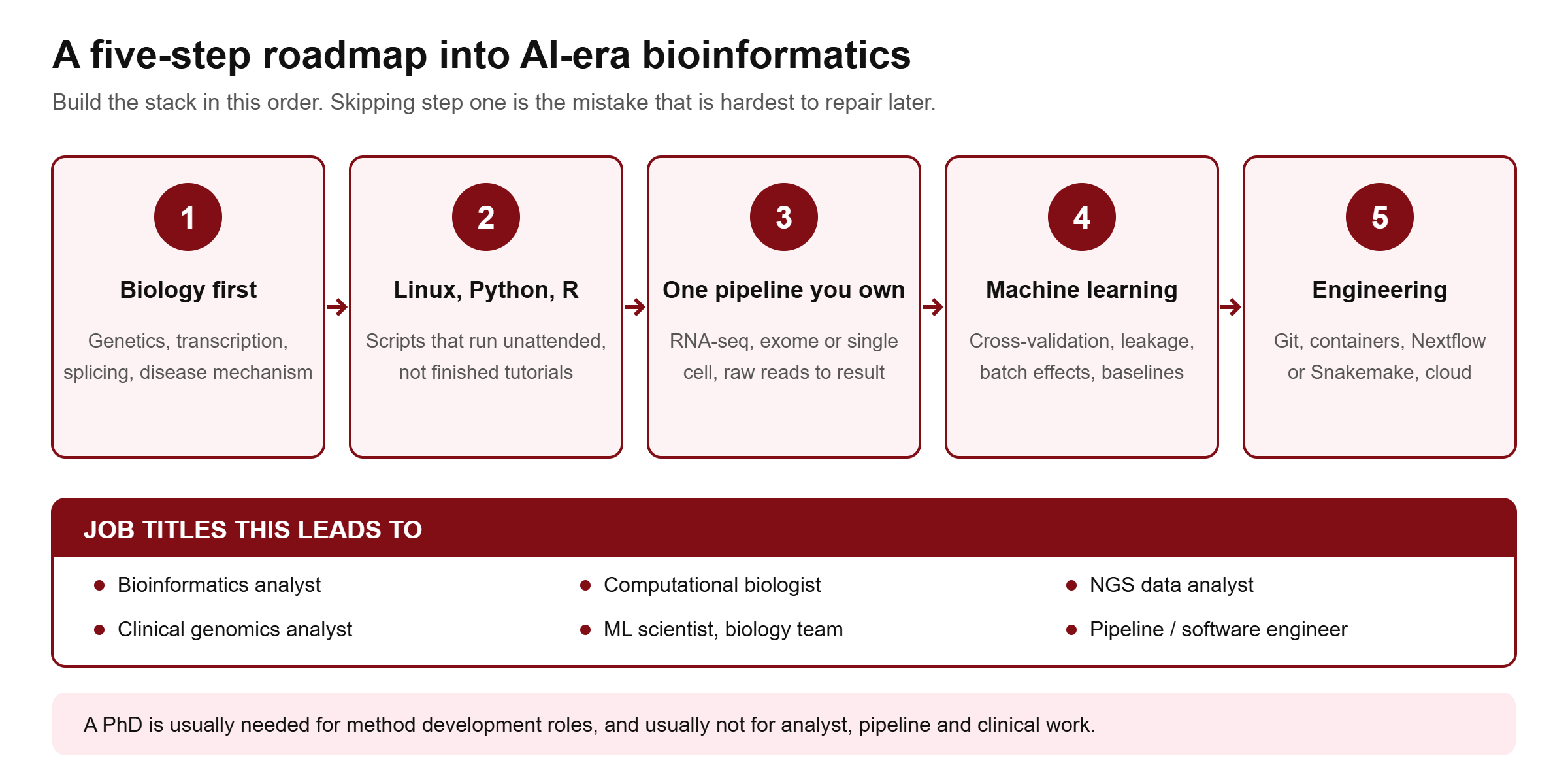
A realistic order to build the stack, if you are starting from a life-science degree:
Step one, the biology. You cannot evaluate a variant effect predictor if you do not understand transcription, splicing and inheritance. This is your advantage over a computer science graduate, and it is the part that is hard to acquire later.
Step two, Linux, Python and R. Non-negotiable. Comfortable means writing a script that processes a directory of files without supervision, not having completed a tutorial. Our Python for biologists course is built for exactly this gap, and the Python project list gives you something to show.
Step three, one domain pipeline end to end. Pick RNA-seq, exome or single-cell and take it from raw FASTQ to an interpreted result, with quality control you can defend. One pipeline you genuinely own beats five you followed.
Step four, machine learning properly. Not just calling a library. Cross-validation, data leakage, class imbalance, the difference between a model that generalises and one that memorised your batch effects. Biological data is small, correlated and confounded, which is why so many published models fail on new cohorts. Our AI and machine learning for bioinformatics course is aimed at this step.
Step five, engineering. Git, environments, containers, a workflow manager such as Nextflow or Snakemake, and enough cloud literacy to run a job that does not fit in memory. This is frequently what separates two candidates with identical biology backgrounds.
The roles this leads to carry titles such as bioinformatics analyst, computational biologist, NGS data analyst, clinical genomics analyst, machine learning scientist on a biology team, and bioinformatics software or pipeline engineer. On the industry side in India, genomics diagnostics companies, contract research organisations, pharma informatics groups and the research arms of hospitals are the main employers, alongside a growing set of startups; our list of bioinformatics companies in India and the guide to where to find bioinformatics jobs in India are the practical starting points. For the route into the field from scratch, see how to become a bioinformatician.
Do you need a PhD? For a method development or research scientist role, usually yes. For analyst, pipeline and clinical interpretation roles, usually no, and a strong portfolio plus a domain speciality will often beat a generic doctorate. We have argued both sides of this in is a PhD in bioinformatics worth it, and the related question of displacement in will AI replace bioinformaticians.
Where to learn this in India, including for free
Start with the free university material, because it is better than most paid content. NPTEL runs bioinformatics and machine learning courses taught by IIT and IISc faculty, with free enrolment and video lectures and an optional paid proctored exam if you want the certificate; searching the NPTEL catalogue for bioinformatics, computational biology and machine learning will usually surface several running or archived options. Archived runs remain watchable even when enrolment has closed, which is often the fastest way to cover a topic.
For degrees, central universities and institutes offering MSc Bioinformatics or MSc Computational Biology remain the standard route, and a biotechnology or life-science MSc with a computational dissertation works just as well in practice; our list of bioinformatics colleges in India covers the options. Alongside that, the openly available materials from major bioinformatics institutes, tool documentation and the Bioconductor and Galaxy training collections cost nothing.
Where structured industry training helps is in the gap that universities rarely fill: running a real pipeline on real data with someone to ask when it breaks. Our free bioinformatics courses and tutorials are the place to start before paying for anything, and for hardware, the laptop guide will save you from overspending.
What AI in bioinformatics still cannot do
An article that lists only successes is marketing. These are the limits that matter in practice.
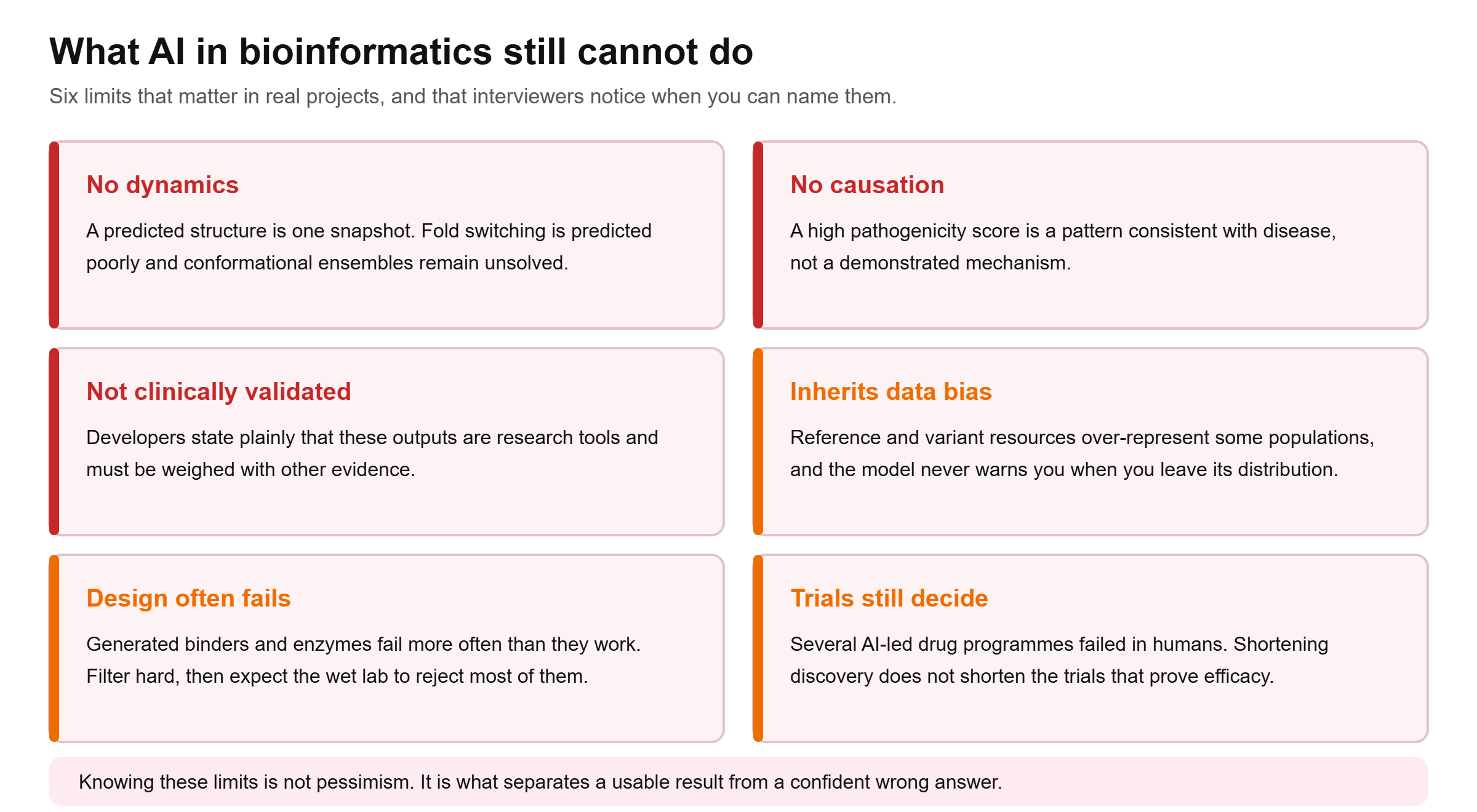
It does not give you dynamics. A predicted structure is one static snapshot. Proteins that switch folds are predicted poorly, allosteric movement is not captured, and conformational ensembles remain an open research problem rather than something you can download. If the biology is in the motion, you still need molecular dynamics or an experiment.
It does not establish causation. A model that scores a variant as likely pathogenic has learned a pattern consistent with pathogenicity. It has not demonstrated a mechanism. The same applies to a regulatory prediction: knowing that accessibility changes at a locus does not tell you that the change causes the disease phenotype, which also depends on development and environment.
It is not clinically validated by default. The developers of both the missense and regulatory models state explicitly that their outputs are research tools, not diagnostics, and must be weighed with other evidence. Treating a score as a verdict is the single most common misuse in student projects.
It inherits every bias in the training data. Human genomic reference and variant resources over-represent populations of European ancestry, so a predictor trained on them performs unevenly across populations. Well-studied protein families are modelled better than obscure ones. The model does not warn you when you have left the distribution it knows.
Generative output is a hypothesis, not a result. Designed binders fail more often than they succeed, and the published success rates for functional design are sobering. The lab is still the arbiter.
And the clinical record in drug discovery is genuinely mixed. BenevolentAI’s eczema candidate failed to reduce itch or inflammation in human trials and the programme was dropped; Exscientia shut down a cancer trial and subsequently merged with Recursion after years of share-price decline; Recursion set out to put a hundred clinical candidates into trials within a decade and has five; a schizophrenia treatment developed partly with AI at Sumitomo Pharma performed no better than placebo in two expanded efficacy trials; Deep Genomics halted its Wilson disease programme and dropped dozens of models. Around 90 per cent of all drug candidates fail in clinical trials, so this is partly just biology being hard, but the point stands: no drug designed solely by AI is on the market, and shortening discovery does not shorten the trials that actually decide whether a molecule works.
Frequently asked questions
Is AI going to replace bioinformaticians?
Not on current evidence. Benchmarks of agentic analysis show models performing far below a competent analyst on realistic multi-step tasks. What is changing is the mix of work: less manual scripting and boilerplate, more model evaluation, interpretation and pipeline engineering. The person at risk is the one whose only skill is running standard tools by hand.
Do I need to know deep learning to work in bioinformatics?
To apply these tools, no, but you do need to understand how they fail. To develop methods, yes, and you will want linear algebra, probability and practical experience with PyTorch. Most jobs sit closer to the first case than people assume.
Which AI tools should a beginner learn first?
Use the AlphaFold database and read pLDDT correctly. Run a variant calling pipeline with DeepVariant and compare it against a classical caller on the same data. Then pick one interpretation tool relevant to your interest. Three tools understood deeply is a better portfolio than a list of twenty names.
Can AI analyse my RNA-seq or exome data for me end to end?
Not reliably and not unsupervised. A language model can help you write and debug the pipeline, which is genuinely useful, but letting it make the analysis decisions produces results that look plausible and cannot be defended. Learn the pipeline, then accelerate it.
Is a predicted protein structure good enough for docking?
Often yes for a well-predicted, ordered binding pocket with high confidence scores, with the caveat that side-chain positions and induced fit are where predicted models are weakest. Check the confidence at the pocket specifically, not the average for the whole chain.
Which programming language matters most?
Python, because the entire machine learning ecosystem lives there. R remains essential for statistics and for single-cell and expression analysis. Learn Python first, add R when your data demands it, and get comfortable on the command line in parallel.
Do these models work for non-human species?
Structure predictors generalise well because protein folding is universal. Human-centric variant and regulatory models generalise far less well, because they were trained on human annotation. For a non-model organism, check what the model was trained on before trusting a score.
Is AI in bioinformatics worth specialising in?
Yes, provided you specialise in the biology plus the methods rather than in the tools. Tools turn over every couple of years. The ability to frame a biological question, choose an appropriate model, and prove it beats a sensible baseline does not.
Key takeaways
- AI in bioinformatics is already production infrastructure in basecalling, variant calling and structure prediction, not a future prospect.
- Predicted structures and variant scores come with confidence estimates, and reading them correctly is the main skill separating careful users from careless ones.
- The newest genome and single-cell foundation models are impressive but uneven; published evaluations found several beaten by simple baselines in zero-shot settings.
- Generative design produces hypotheses that still fail more often than they succeed, and the clinical record of AI-led drug programmes includes several high-profile failures.
- Careers reward biology plus programming plus honest model evaluation plus engineering, in that order, and most roles do not require a PhD.
- Free, high-quality learning routes exist, including NPTEL and open institute training material, so cost is not the barrier it used to be.
References and further reading
- Varadi M. et al. AlphaFold Protein Structure Database in 2024: providing structure coverage for over 214 million protein sequences. Nucleic Acids Research. Paper
- Cheng J. et al. Accurate proteome-wide missense variant effect prediction with AlphaMissense. Science. Paper
- Advancing regulatory variant effect prediction with AlphaGenome. Nature. Paper and the model announcement
- Brixi G. et al. Genome modelling and design across all domains of life with Evo 2. Preprint and the Arc Institute release
- Kedzierska K. et al. Zero-shot evaluation reveals limitations of single-cell foundation models. Genome Biology. Paper
- Watson J. et al. De novo design of protein structure and function with RFdiffusion. Nature. Paper
- Mitchener L. et al. BixBench: a comprehensive benchmark for LLM-based agents in computational biology. Preprint
- DeepVariant documentation and case studies. Repository
- ESM Metagenomic Atlas. About page
- Boltz-2: towards accurate and efficient binding affinity prediction. MIT Jameel Clinic
- Revolution, interrupted: why AI has failed to live up to the hype in drug development. The Globe and Mail. Article
- NPTEL online courses catalogue. nptel.ac.in