Twenty-five years ago, reading one human genome took an international consortium more than a decade and billions of dollars. Today a single lab can sequence a genome in a day, and a hospital team has done it in about five hours. The sequencing machines got faster, but that is only half the story. The other half is software: the algorithms, pipelines and databases that turn billions of short DNA fragments into something a doctor or researcher can actually use.
So what is genomics, and why do people say bioinformatics changed it completely? In simple words, genomics is the study of an organism’s entire DNA, all at once, rather than one gene at a time. Bioinformatics is the toolkit that made that possible once the data became too big for any human to read.
In this article you will learn what genomics is and how it differs from genetics, how the field moved from the Human Genome Project to population-scale projects like GenomeIndia, the specific ways bioinformatics altered each step of genome analysis, what skills a genomics career needs in India, and, just as important, what genomics still cannot do.
What Is Genomics? A Simple Definition
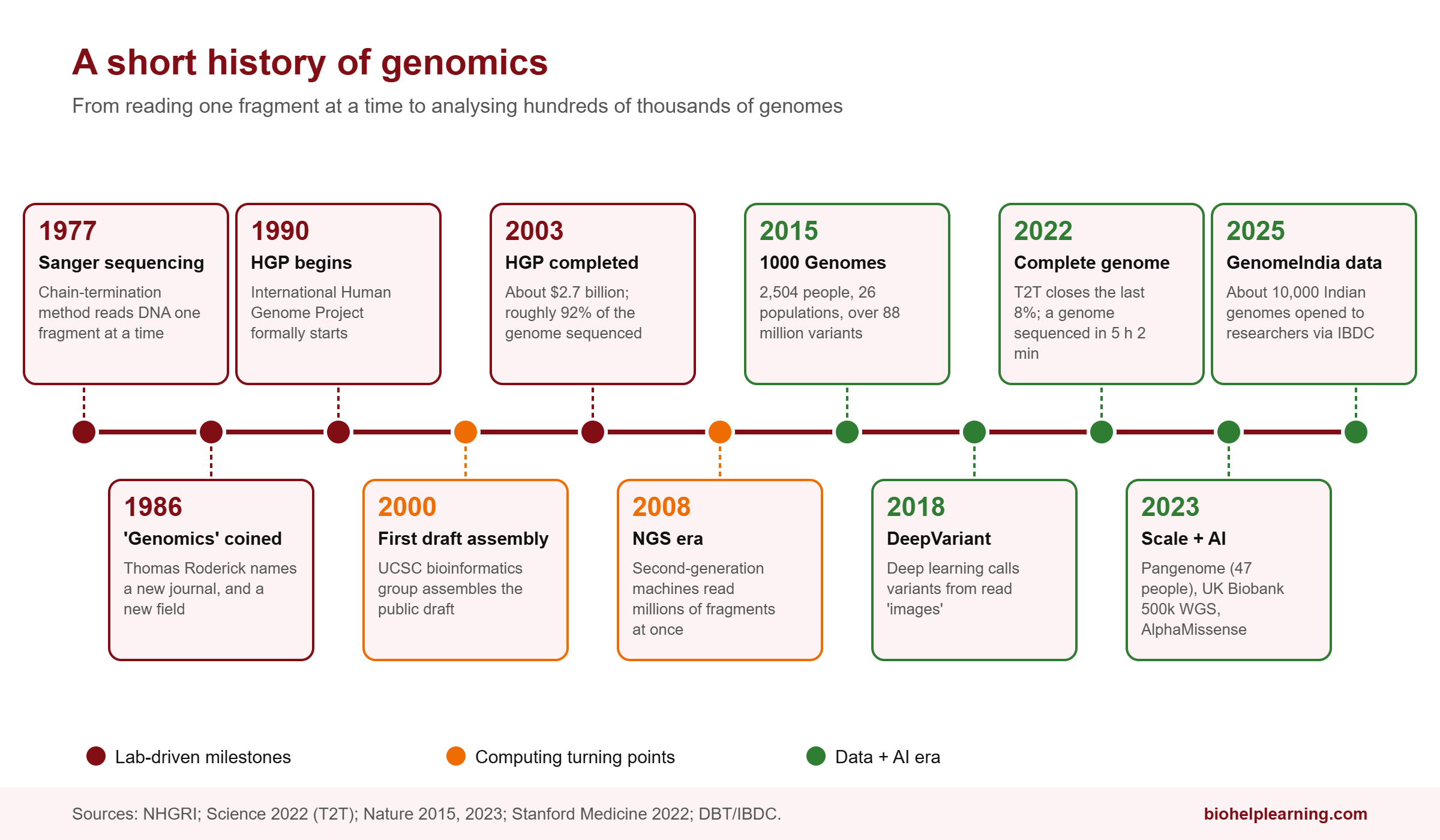
A genome is the complete set of DNA in a cell, including every gene and all the DNA between genes. The word itself is old: the German botanist Hans Winkler introduced the term “genome” in 1920. The word genomics is much younger. It was coined in 1986 by Thomas Roderick, a geneticist at the Jackson Laboratory, as the name for a new journal during a meeting on mapping the human genome. The journal is still called Genomics.
The human genome is large. The first truly complete human sequence, published by the Telomere-to-Telomere (T2T) Consortium in 2022, is about 3.055 billion base pairs long for one set of chromosomes. Most of your cells carry two sets, one from each parent.
Genetics vs genomics: what is the difference?
Students often mix these two up. Genetics studies individual genes and how they are inherited. For example, how one mutation in the HBB gene causes sickle cell disease. Genomics looks at all genes and non-coding DNA together: how they interact, how they vary between people, and how that variation links to health, evolution or crop yield. Genetics asks about one sentence. Genomics reads the whole book, and compares thousands of copies of it.
Main branches of genomics
- Structural genomics: sequencing and assembling genomes, and mapping where genes sit.
- Functional genomics: finding out what genes and regulatory regions actually do, often with RNA sequencing (RNA-seq).
- Comparative genomics: comparing genomes across species to understand evolution.
- Population genomics: measuring how DNA varies across groups of people, animals or plants.
- Clinical genomics: using a patient’s DNA to diagnose disease or choose treatment.
- Metagenomics: sequencing all the DNA in a sample, such as gut microbes or soil, without growing each organism in the lab.
- Epigenomics: studying chemical marks on DNA, such as methylation, that switch genes on or off without changing the sequence.
Every one of these branches depends on computing. That dependence is the main theme of this article. If you are new to the field, our overview of what bioinformatics is and its branches is a useful companion read.
From Sanger Sequencing to the Human Genome Project
Modern sequencing began in 1977, when Frederick Sanger’s group published the chain-termination method. For the next three decades, “Sanger sequencing” was the standard way to read DNA. It was accurate but slow, reading one fragment of a few hundred bases at a time.
The Human Genome Project (HGP) was the first attempt to read a whole human genome. It formally began in 1990, led in the United States by the National Human Genome Research Institute (NHGRI) and the Department of Energy, with major centres in the UK, France, Germany, Japan and China. Congress had been told it would cost about $3 billion and finish by 2005. The consortium announced completion on 14 April 2003, more than two years early, at about $2.7 billion in FY 1991 dollars.
Here is a detail many textbooks skip: bioinformatics was already central to the HGP. The first publicly available draft assembly of the genome, in 2000, was put together by the Genome Bioinformatics Group at the University of California, Santa Cruz. Much of that assembly work was done by a graduate student, Jim Kent, working with his adviser David Haussler. Lab machines produced the fragments. Software turned them into a genome.
“Completed” in 2003 also did not mean 100%. The HGP sequence covered roughly 92% of the genome. The remaining 8%, mostly long repetitive regions such as centromeres and the short arms of five chromosomes, stayed hidden for almost two more decades until the T2T Consortium closed the gaps in 2022.
The Data Explosion: Why Genomics Became a Computing Problem
Around 2007–2008, next-generation sequencing (NGS) arrived. Instead of reading one fragment at a time, NGS machines read millions of short fragments in parallel. The cost of sequencing fell faster than almost any technology in history. (Not sure whether a project needs a whole genome, an exome or a gene panel? Read WGS vs WES vs targeted sequencing.)
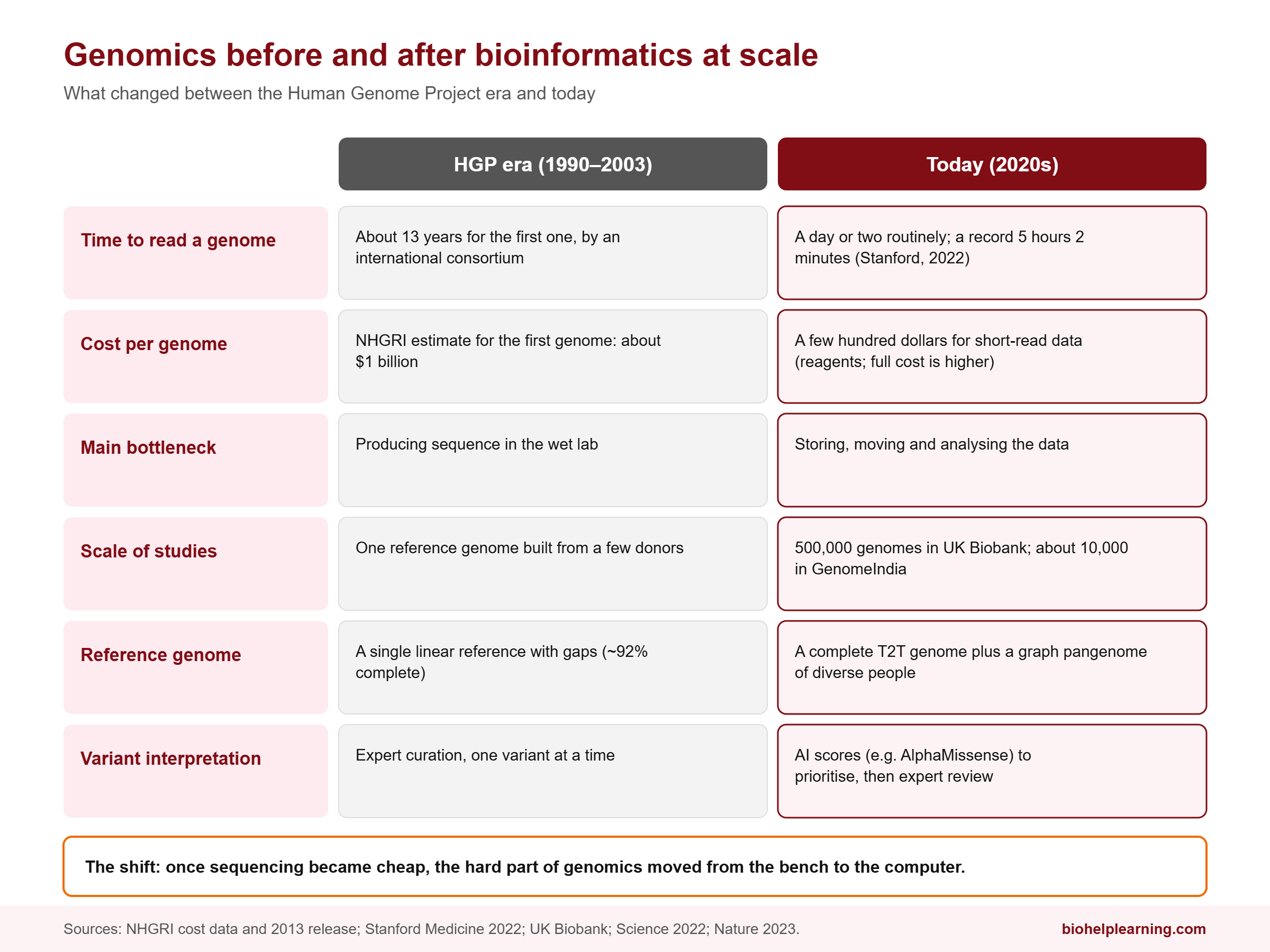
NHGRI estimates that sequencing the first human genome cost about $1 billion. A decade after the HGP, in 2013, the institute said a genome cost less than $5,000 and took a day or two. By 2022, NHGRI noted that a short-read human genome cost only a few hundred dollars. Manufacturers now go further: Illumina has said its NovaSeq X can deliver a genome for about $200, and Ultima Genomics announced a $100 genome in 2024.
Treat those headline prices carefully. A “$200 genome” usually means the reagent cost on a fully loaded high-end machine. It does not include the instrument, staff, sample preparation, storage or analysis. Analyses that include those costs give much higher figures, which is why published numbers rarely match what a lab actually pays.
Cheap sequencing created a new problem: too much data. In a widely cited 2015 paper in PLOS Biology, Stephens and colleagues projected that genomics could need between 2 and 40 exabytes of storage per year by 2025, more than the projections for YouTube at the time. Part of the reason is that the raw data for one genome is many times larger than the genome itself, because each base is read about 30 times to correct errors. The authors called genomics a “four-headed beast”: data acquisition, storage, distribution and analysis are all hard at once.
That is the turning point. Once a single machine could produce terabytes per run, the bottleneck in genomics moved from the wet lab to the computer. Biology became, in large part, a data science.
How Bioinformatics Altered the Field of Genomics
“Bioinformatics changed genomics” is easy to say and vague. Here are the specific shifts, step by step.
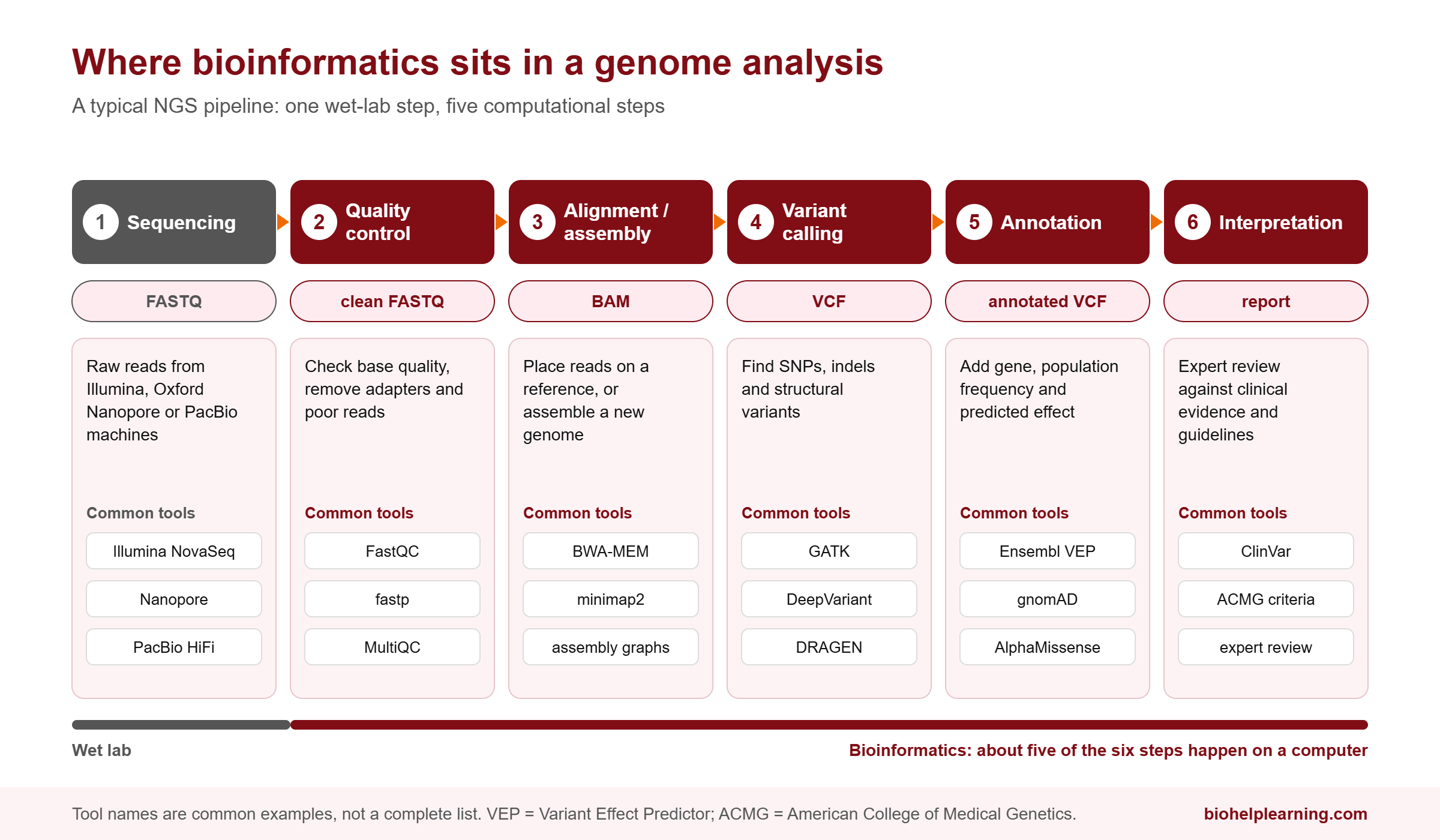
1. Genome assembly: from fragments to chromosomes
Sequencers do not read a chromosome from end to end. They produce short or long “reads”. Genome assembly is the computational puzzle of stitching those reads into continuous sequences. For a new species, there is no reference to guide you, so assembly algorithms build graphs of overlapping reads and search for the most likely path through them.
The 2022 T2T genome shows how far this has come. The consortium combined PacBio HiFi long reads with Oxford Nanopore “ultra-long” reads of more than 100,000 bases, and built the assembly from a high-resolution string graph. The result added nearly 200 million base pairs of new sequence and corrected errors in the earlier reference. That was an algorithmic achievement as much as a laboratory one.
2. Alignment: placing billions of reads on a reference
For humans, most projects now re-sequence: they compare a person’s reads against an existing reference genome. Aligning billions of 150-base reads to a 3-billion-base reference in hours requires clever indexing. Tools such as BLAST (Basic Local Alignment Search Tool) made fast sequence search routine from 1990, and later short-read aligners such as BWA made whole-genome alignment practical on ordinary servers. If you want to understand the ideas behind these tools, see our guide to top bioinformatics algorithms.
3. Variant calling: finding what makes you different
After alignment, the question becomes: where does this genome differ from the reference? This step is called variant calling. Classic tools like the GATK (Genome Analysis Toolkit) use statistical models to separate true variants from sequencing errors.
In 2018, Google researchers published DeepVariant in Nature Biotechnology. It treats the reads around each candidate variant as an image and uses a deep convolutional neural network to decide the genotype. The model was trained without hand-coded genomics rules, yet it won the PrecisionFDA Truth Challenge award for highest SNP (single nucleotide polymorphism) accuracy in 2016. It is a clear example of machine learning replacing a stack of hand-tuned statistics.
These tools now run at enormous scale. The UK Biobank’s 500,000 genomes were first processed with BWA-MEM and GATK, then reprocessed with Illumina’s DRAGEN pipeline.
4. Interpretation: deciding which variants matter
Each person carries millions of variants. Most are harmless. Finding the one that causes a disease is the hardest part of clinical genomics, and it is mostly a bioinformatics task: annotating each variant, checking population databases, predicting its effect on the protein, and comparing with disease records such as ClinVar.
AI has entered this step too. In 2023, Google DeepMind published AlphaMissense in Science. A missense variant changes one amino acid in a protein. Of the 71 million possible missense variants in humans, only about 0.1% had been confirmed by experts. AlphaMissense, built on AlphaFold, classified 89% of them, predicting 57% as likely benign and 32% as likely pathogenic. The predictions are free to use, and EMBL-EBI has added them to the Ensembl Variant Effect Predictor.
Not everyone was comfortable with the labels. Some clinical geneticists pointed out that experts do not call a variant pathogenic without patient data, family inheritance patterns and lab tests. A prediction is a lead to follow, not a diagnosis.
5. Population-scale genomics
Bioinformatics made it possible to analyse not one genome but hundreds of thousands together:
- The 1000 Genomes Project reported in 2015 on 2,504 people from 26 populations and catalogued more than 88 million variants.
- The UK Biobank released whole-genome data for all 500,000 participants in November 2023, the world’s largest single sequencing dataset, after more than 350,000 hours of sequencing and over £200 million of investment.
- The Human Pangenome Reference Consortium published a draft pangenome in Nature in 2023, built from 47 genetically diverse people. It added 119 million base pairs missing from the standard reference. Using the pangenome reduced small-variant discovery errors by 34% and more than doubled the structural variants detected per haplotype compared with the standard GRCh38 workflow.
The pangenome matters for a reason that is easy to miss. A single reference genome biases every analysis towards the people it came from. A graph-based pangenome reference, which is itself a bioinformatics idea, lets analyses represent human diversity more fairly.
6. Speed: genomics in the intensive care unit
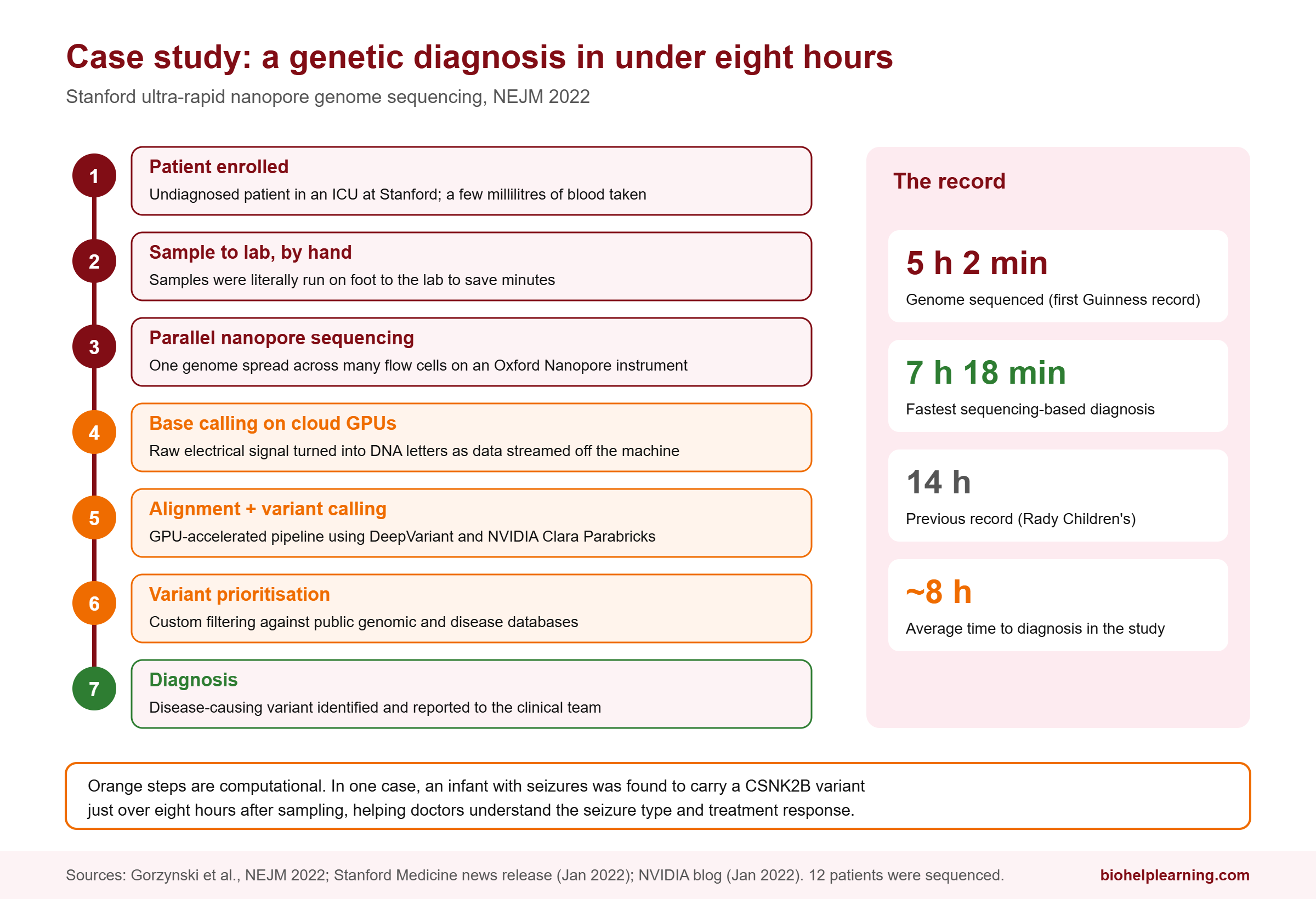
Clinical genome testing used to take weeks. Even “rapid” tests took two or three days. In 2022, a Stanford-led team published in the New England Journal of Medicine a workflow that sequenced a patient’s genome in 5 hours and 2 minutes, the first Guinness World Record for fastest DNA sequencing. The fastest diagnosis took 7 hours and 18 minutes. The speed came as much from computing as from chemistry: base calling and variant calling ran on GPUs (graphics processing units) in the cloud, using DeepVariant and NVIDIA Clara Parabricks.
7. Public-health genomics
India saw this shift directly during COVID-19. In December 2020, the government launched the Indian SARS-CoV-2 Genomics Consortium (INSACOG), a network of 10 national laboratories including CSIR-IGIB Delhi, CSIR-CCMB Hyderabad, NIBMG Kalyani and NCBS/InStem Bengaluru. Its job was to sequence virus samples and track variants. Sequencing was only the first step; deciding which lineage each sample belonged to, and whether a new variant was spreading, was pure bioinformatics.
Case Study: A Genetic Diagnosis in Under Eight Hours
The Stanford ultra-rapid study is worth walking through, because it shows where the computing sits in a real clinical workflow.
The team offered rapid sequencing to undiagnosed patients in intensive care units at Stanford Hospital and Lucile Packard Children’s Hospital. They sequenced 12 patients, most of them children. Samples were literally run by foot to the lab. DNA was spread across many flow cells on an Oxford Nanopore instrument so one genome could be read in parallel. Raw signal was converted to DNA letters (base calling) on cloud GPUs as it streamed off the machine. Variants were then called and filtered against disease databases with a custom prioritisation step.
In one case, a three-month-old infant arrived with seizures. Just over eight hours after sampling, the team identified a disease-causing mutation in the CSNK2B gene, which helped doctors understand the seizure type and response to anti-seizure medicine. In the record case, sequencing took 5 hours 2 minutes and the full diagnosis 7 hours 18 minutes, about twice as fast as the previous 14-hour record. Five patients received a genetic diagnosis in about eight hours.
The lesson for students: the “sequencing” in rapid sequencing is now a small part of the clock. Data movement, base calling, alignment, variant calling and interpretation are where the time goes, and that is where bioinformaticians work.
What Is Genomics Doing in India Today?
India’s flagship programme is the GenomeIndia Project, funded by the Department of Biotechnology and launched in 2020. Scientists from 20 research institutes sequenced the whole genomes of just over 10,000 healthy, unrelated Indians, working through the pandemic. Most reports give the final count as 10,074 genomes. The number of population groups varies by source: government announcements in January 2025 said 83, while the Nature Genetics paper published in April 2025 described 85 populations (32 tribal and 53 non-tribal).
The data was released to researchers on 9 January 2025 through the Indian Biological Data Centre (IBDC) in Faridabad, under controlled access following the Biotech-PRIDE guidelines. Indian-specific data matters because variants common in Indian populations can be rare or absent in European-dominated databases, which affects diagnosis and drug response.
There are honest criticisms too. India has around 4,600 population groups, and some researchers argue that 10,000 genomes cannot capture that diversity. Others note that India’s Digital Personal Data Protection Act of 2023 does not treat genetic data as a separate sensitive category. Both points are worth knowing if you plan to work with Indian genomic data.
On the industry side, Indian genomics companies include MedGenome (Bengaluru, founded 2013), Strand Life Sciences (Bengaluru; Reliance Industries acquired an 80% stake in 2021 for Rs 393 crore), Mapmygenome (Hyderabad) and 4baseCare (Bengaluru, cancer genomics). For a wider list, see our guide to top bioinformatics companies in India.
Careers in Genomics and Bioinformatics
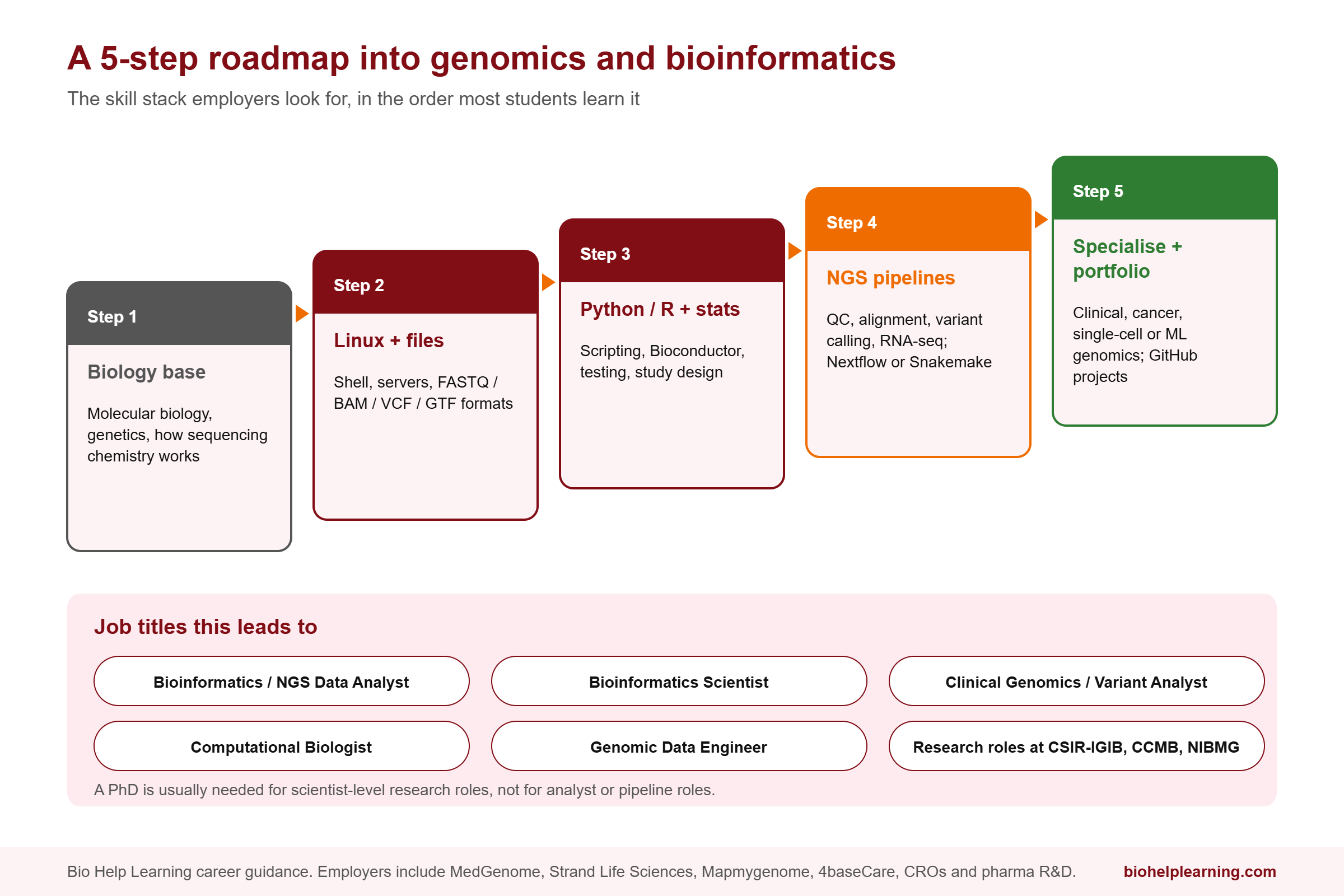
The shift from wet lab to computer created a new kind of job. Labs and companies still need people who can prepare samples, but they increasingly need people who can turn raw reads into answers. Here is a practical roadmap.
Step 1: Strengthen the biology
Molecular biology, genetics, and the basics of how sequencing chemistry works. You need to understand what a read, a variant and a gene model are before any tool makes sense.
Step 2: Learn Linux and the command line
Almost all genomics tools run on Linux. Get comfortable with the shell, file formats (FASTQ, BAM, VCF, GTF) and working on a remote server.
Step 3: Learn Python or R, plus statistics
Python is common for pipelines and machine learning. R and Bioconductor dominate expression and statistical analysis. Statistics is not optional: multiple testing, distributions and study design come up every day.
Step 4: Run real NGS pipelines
Practise quality control (start with our free tutorial on quality control of NGS reads with FastQC and MultiQC), alignment, variant calling and RNA-seq on public data from NCBI SRA or ENA. Then learn a workflow manager such as Nextflow or Snakemake, so your analysis is reproducible. Our list of bioinformatics project ideas for students and bioinformatics projects using Python can give you a starting point.
Step 5: Specialise and build a portfolio
Pick a direction: clinical variant interpretation, cancer genomics, single-cell, microbial genomics, or machine learning for genomics. Put your code on GitHub and write up two or three complete projects.
Common job titles
- Bioinformatics Analyst / NGS Data Analyst
- Bioinformatics Scientist
- Clinical Genomics Analyst or Variant Interpretation Scientist
- Computational Biologist
- Genomic Data Engineer (pipelines, cloud, workflow managers)
Employers include genomics diagnostics companies such as MedGenome, Strand Life Sciences, Mapmygenome and 4baseCare, CROs (contract research organisations), pharma R&D centres, and public institutes such as CSIR-IGIB, CSIR-CCMB and NIBMG.
Do you need a PhD?
Not for analyst and pipeline roles, where a strong master’s degree plus a solid portfolio is often enough. A PhD becomes important for scientist-level research positions, academic careers and roles where you design new methods rather than run existing ones. We discuss this trade-off in detail in is a PhD in bioinformatics worth it in the AI era. For the bigger picture, read how to become a bioinformatician and our bioinformatics career scope in India guide.
Courses to Learn Genomics and Bioinformatics in India
Free university courses (NPTEL / SWAYAM)
- BioInformatics: Algorithms and Applications – Prof. Michael Gromiha, IIT Madras. The January–April 2026 run had over 5,000 learners; the certification exam is optional for a fee.
- Next Generation Sequencing Technologies: Data Analysis and Applications – Prof. Riddhiman Dhar, IIT Kharagpur. Expects basic programming and statistics.
- Biological Data Analysis and Visualization with R – Prof. Riddhiman Dhar, IIT Kharagpur.
- Functional Genomics – Prof. S. Ganesh, IIT Kanpur.
NPTEL runs courses in fixed semesters, so check the current enrolment dates on the course page.
Degree routes
MSc Bioinformatics, MSc Biotechnology with a computational track, MTech in Computational Biology, and integrated programmes at IITs, IISERs and central universities. A PhD in genomics or computational biology follows for research careers.
Industry-focused training
If you want hands-on pipeline skills, Bio Help Learning offers practical courses in RNA-seq data analysis, whole exome sequencing (WES) data analysis and whole genome sequencing (WGS) data analysis, plus an AI and machine learning for bioinformatics course for those moving towards ML-based genomics.
Free self-study resources
- Galaxy Training Network – free, browser-based NGS tutorials.
- nf-core documentation – community-built Nextflow pipelines for RNA-seq, variant calling and more.
- GATK Best Practices documentation from the Broad Institute.
- NCBI, Ensembl and UCSC Genome Browser tutorials.
What Genomics and Bioinformatics Still Cannot Do
An honest article on genomics must cover the limits. Here are the important ones.
Most variants still have unknown meaning
Even after AlphaMissense, the vast majority of possible missense variants have never been confirmed by clinical or experimental evidence. AI predictions help prioritise, but a “likely pathogenic” score is not proof. Patients still get reports with “variants of uncertain significance” that cannot be acted on.
Reference bias and missing diversity
The standard reference genome comes from a small number of people, and large genomic databases are dominated by people of European ancestry. Analyses on under-represented groups, including most Indian communities, are less accurate. Pangenomes and projects like GenomeIndia are steps forward, not a solution yet.
DNA is not destiny
For most common diseases, such as diabetes and heart disease, genes explain only part of the risk. Lifestyle, environment and chance matter a great deal. Risk scores built from genome data are probabilities, not predictions about one person.
Business failures and privacy risks
Consumer genomics has had painful lessons. 23andMe, once a symbol of personal genomics, filed for Chapter 11 bankruptcy on 23 March 2025 after years of losses and a 2023 data breach. In June 2025 a US bankruptcy court approved the sale of its assets, including the genetic data of more than 13 million customers, to TTAM Research Institute, a nonprofit founded by co-founder Anne Wojcicki, for $305 million. Regeneron had earlier won the auction at $256 million before bidding reopened. Twenty-seven US states and the District of Columbia had sued to block a sale of customers’ genetic data without consent. The case showed how genetic data can change hands when a company fails.
Industry consolidation has also run into regulators. Illumina, a global leader in DNA sequencing, bought the cancer-test developer GRAIL for about $7.1 billion without waiting for European approval. The European Commission fined Illumina €432 million, ordered it to unwind the deal, and approved its divestment plan in April 2024. Early cancer detection from blood is promising, but this saga is a reminder that genomics is shaped by business and law, not just science.
Cheap sequencing is not cheap analysis
Headline costs exclude interpretation, storage and staff. For many Indian hospitals, the barrier is not the sequencing reagent but trained analysts, computing infrastructure and genetic counsellors to explain the results.
AI does not replace the expert
Deep learning has improved variant calling and effect prediction, but models trained on one population, one sequencing platform or one disease set can fail silently on another. Someone still needs to check the output. We explore this question in will AI replace bioinformaticians.
Frequently Asked Questions
What is genomics in simple words?
Genomics is the study of an organism’s complete DNA, called its genome. Instead of studying one gene at a time, genomics looks at all genes and the DNA between them together, to understand how they work, how they vary between individuals, and how they affect health and traits.
What is the difference between genomics and bioinformatics?
Genomics is the biological question: what does this genome contain and what does it do? Bioinformatics is the computational method used to answer it: assembling, aligning, analysing and interpreting the DNA data with software, statistics and databases. Modern genomics is almost impossible without bioinformatics.
How did bioinformatics change genomics?
It turned sequencing output into usable knowledge. Bioinformatics enabled genome assembly, fast alignment of billions of reads, accurate variant calling (including deep-learning tools like DeepVariant), AI-based variant interpretation, analysis of hundreds of thousands of genomes together, and same-day clinical diagnosis.
How much does it cost to sequence a human genome now?
NHGRI estimates the first genome cost about $1 billion. Today, short-read sequencing costs a few hundred dollars per genome, and some manufacturers claim $100–$200 in reagent costs. Full costs, including analysis, storage and staff, are higher, and they vary widely by lab and country.
Is genomics a good career in India?
It is a growing field, driven by projects such as GenomeIndia and by diagnostics companies such as MedGenome and Strand Life Sciences. The strongest demand is for people who combine biology with programming and NGS data analysis skills. Pure wet-lab roles are fewer and more competitive.
Can I learn genomics data analysis without a computer science background?
Yes. Many bioinformaticians in India start with a biology or biotechnology degree. Start with Linux and Python or R, then practise standard NGS pipelines on public data. Free NPTEL courses and the Galaxy Training Network are good starting points.
What is the GenomeIndia Project?
GenomeIndia is a Department of Biotechnology project, launched in 2020, that sequenced the whole genomes of just over 10,000 healthy Indians from diverse population groups. The data was opened to researchers in January 2025 through the Indian Biological Data Centre in Faridabad.
Key Takeaways
- Genomics studies an organism’s entire DNA at once; genetics studies individual genes and inheritance.
- The Human Genome Project (1990–2003) cost about $2.7 billion and covered about 92% of the genome; the final gaps were closed only in 2022.
- Next-generation sequencing made genomes cheap, which moved the bottleneck from the lab bench to the computer.
- Bioinformatics altered every step: assembly, alignment, variant calling, interpretation, population analysis and clinical speed.
- India’s GenomeIndia Project and INSACOG show the same shift at national scale, and create demand for trained analysts.
- Genomics still has real limits: uncertain variants, missing diversity, privacy risks and costs beyond the headline price.
References and Further Reading
- International Human Genome Sequencing Consortium completion announcement, NHGRI, 14 April 2003. genome.gov
- Nurk S. et al. The complete sequence of a human genome. Science 376, 44–53 (2022). DOI: 10.1126/science.abj6987
- Liao W.-W. et al. A draft human pangenome reference. Nature 617, 312–324 (2023). DOI: 10.1038/s41586-023-05896-x
- The 1000 Genomes Project Consortium. A global reference for human genetic variation. Nature 526, 68–74 (2015). DOI: 10.1038/nature15393
- Stephens Z.D. et al. Big Data: Astronomical or Genomical? PLOS Biology 13(7): e1002195 (2015). DOI: 10.1371/journal.pbio.1002195
- Poplin R. et al. A universal SNP and small-indel variant caller using deep neural networks. Nature Biotechnology 36, 983–987 (2018). DOI: 10.1038/nbt.4235
- Google DeepMind. AlphaMissense: a catalogue of genetic mutations to help pinpoint the cause of diseases (2023). deepmind.google
- Stanford Medicine. Fastest DNA sequencing technique helps undiagnosed patients find answers in mere hours (January 2022). med.stanford.edu
- NHGRI. DNA Sequencing Costs: Data. genome.gov
- UK Biobank whole genome sequencing data (Category 180). biobank.ctsu.ox.ac.uk
- DBT/PIB. INSACOG launched (30 December 2020). dbtindia.gov.in
- Kuska B. Beer, Bethesda, and biology: how “genomics” came into being. J Natl Cancer Inst 90(2):93 (1998). DOI: 10.1093/jnci/90.2.93
- Illumina. Planned divestment of GRAIL approved by the European Commission (12 April 2024). illumina.com
- NPTEL. BioInformatics: Algorithms and Applications (IIT Madras). onlinecourses.nptel.ac.in