
What is Bioinformatics? A Complete Beginner’s Guide to Bioinformatics and Computational Biology
Chapter 5 of 5: My journey, practice, FAQ and what to learn next
Dream Built from Scratch: my journey (Ujjawal Solanki)
I am Ujjawal Solanki, the founder of Bio Help Learning. I want to share how I started, because if I could begin from where I did, you can begin from where you are.
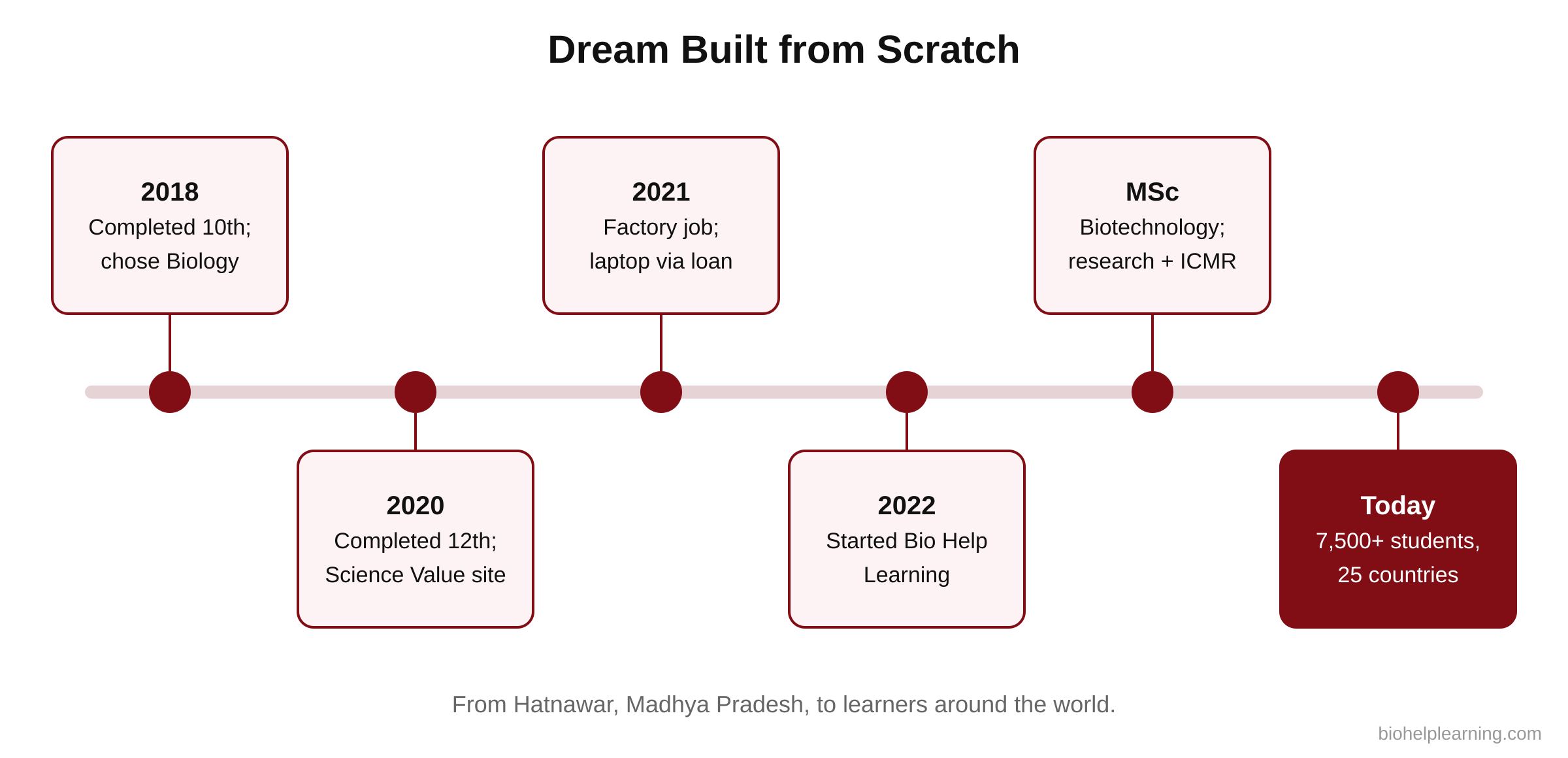
2018: choosing my own path
I grew up in Hatnawar, a small village in Madhya Pradesh, and I still work from here. I completed my 10th standard in 2018 and then had to choose between Mathematics and Biology. There was no one around me to guide me, so I searched for information myself on a basic keypad phone. I chose Biology.
2020: discovering biotechnology, and my first failure
I completed my 12th in 2020. In 12th, the subject of biotechnology, DNA, genetic engineering, cloning, the idea that we could understand diseases like cancer, fascinated me. My family hoped I would become a doctor but never forced me, so I followed my interest.
During the COVID-19 lockdown in 2020 I started my first website, Science Value, for science news. I bought the domain and hosting and managed everything from my mobile phone, because I had no laptop. It did not grow. I had enthusiasm but no coding, SEO or business knowledge. That first failure taught me that an idea needs skills, execution and a sustainable plan.
2021: a factory job and a crop loan for my first laptop
In my undergraduate studies I discovered NCBI: databases, BLAST, DNA sequences. I barely understood them, and I knew I needed a laptop to learn. My family could not afford one. At a telecalling job interview I was asked about Ctrl+C and Ctrl+V and did not know the answer; I had hardly used a computer. I was rejected.
On the way home I asked at a factory and started work as a factory worker, about 8 AM to 8 PM, for ₹9,000 a month. After a month or two, the COVID second wave stopped the work. In the end I took a crop loan from a bank to buy my first laptop. For me it was not just a computer; it was the door to learning.
2022: starting Bio Help Learning
With my laptop I explored biotechnology and slowly fell in love with bioinformatics. I looked at bioinformatics training programmes, and some were really good, but their fees of ₹5–7 lakh were far beyond anything I could pay. I thought: many students must be facing the same problem. In 2022 I started Bio Help Learning. At first I hired educators to teach, and I learned alongside the students. Bio Help Learning became my own classroom.
Research, MSc and professional experience
After my bachelor’s in Biotechnology, I did my M.Sc. in Biotechnology. I worked on research in transcriptome data analysis and gene regulatory network development, and I worked as Project Technical Support-II on an ICMR-funded project. I explored NGS data analysis, WGS, WES, RNA-seq, metagenomics, gene regulatory networks, and programming in Python, R and shell.
Today: still learning
After my research project I returned home and rebuilt Bio Help Learning as a structured learning platform with our own LMS, which I designed and developed myself.
When I started Bio Help Learning, I never imagined how far this journey would take us. Through our training programmes, workshops and educational initiatives, we have now trained more than 7,500 students across 25 countries. A platform that started from a small village in Madhya Pradesh now reaches students around the world. For me this is not about numbers: every student is a learning journey, a new opportunity and a reason to keep improving. I am grateful to every student, educator and person who has been part of it, and I believe this is only the beginning.
I am still learning, every week, because this field never stops growing.
My message to you: your starting point does not decide your destination. I started with a keypad phone, no guidance and no technical knowledge. I faced rejection, money problems and failed projects. I kept learning. You can too. Start with the next tutorial today.
— Ujjawal Solanki, Founder, Bio Help Learning
Practice exercise
Try these before opening the solution. You don’t need any software installed for questions 1–3.
- Calculate the GC% of
ATATGCGCAATT. - For each task, write “bioinformatics” or “computational biology”: (a) building a database of all variants found in 10,000 Indian genomes; (b) simulating how a drug molecule binds a protein over time; (c) writing a pipeline that trims and aligns reads for 200 samples.
- Using the roadmap table, which months would you spend learning Python or R, and what should you be able to do at the end?
- Open the NCBI website, search the Nucleotide database for “human TP53 mRNA”, and write down one accession number and the length of the sequence.
FAQ: what is bioinformatics, careers and learning
Can I learn bioinformatics without coding knowledge?
Yes. Most bioinformaticians started without coding. Begin with the Linux command line, then Python or R. Our series starts from the very first command.
Do I need a powerful computer?
No. A normal laptop with 8 GB RAM is enough for learning with small datasets. Windows users can use WSL2 (Linux inside Windows). For big projects, you will use servers, HPC clusters or the cloud, which you access from your laptop.
Which is better to learn first, Python or R?
Either works. Python is more general and widely used for pipelines and machine learning; R is very strong for statistics and RNA-seq analysis (DESeq2, Bioconductor). Learn one well first, then learn enough of the other to read it.
Is a PhD necessary for a bioinformatics job?
Not for analyst, pipeline or engineer roles; an MSc or MTech with strong practical skills is common. A PhD helps for scientist roles that design new methods or lead research.
Will AI replace bioinformaticians?
AI is changing the work, not removing the need for people who understand both biology and data. Learn to use AI tools well and to check their output carefully.
How do I get my first bioinformatics job?
Build two or three complete projects on public data, put them on GitHub with clear READMEs, apply widely (including project positions at institutes), and follow openings on Jobs Bio Help Learning.
How do I write tool versions in my thesis Methods section?
Use a sentence like this, and fill in your own details: “Raw reads were assessed with FastQC (v0.12.1) and summarised with MultiQC (v1.x). Reads were aligned to the GRCh38 reference genome with BWA-MEM (v0.7.x) … All tools were installed from Bioconda; the full environment is provided in environment.yml.” Always give the exact versions you used.
Glossary
| Term | Meaning |
|---|---|
| Bioinformatics | Using computers and statistics to store, organise and analyse biological data |
| Computational biology | Using mathematical models and simulations to understand biological systems |
| Genome | The complete DNA of an organism |
| NGS | Next-generation sequencing: methods that read millions of DNA fragments in parallel |
| FASTQ | Text file format for sequencing reads and their quality scores |
| Alignment (mapping) | Finding where each read comes from in a reference genome |
| Variant | A difference in DNA compared with the reference, such as a SNP or indel |
| WES / WGS | Whole exome sequencing (protein-coding parts) / whole genome sequencing (everything) |
| Pipeline | A series of analysis steps run in order, often automated |
| Conda / Bioconda | A package manager and the bioinformatics software channel used to install tools |
| GC content | Percentage of G and C bases in a DNA sequence |
| CAGR | Compound annual growth rate: average yearly growth over a period |
References
- Hogeweg P. The roots of bioinformatics in theoretical biology. PLoS Comput Biol. 2011;7(3):e1002021. doi:10.1371/journal.pcbi.1002021
- Altschul SF, Gish W, Miller W, Myers EW, Lipman DJ. Basic local alignment search tool. J Mol Biol. 1990;215(3):403–410. doi:10.1016/S0022-2836(05)80360-2
- International Human Genome Sequencing Consortium (Lander ES et al.). Initial sequencing and analysis of the human genome. Nature. 2001;409:860–921. doi:10.1038/35057062
- Nurk S et al. The complete sequence of a human genome. Science. 2022;376:44–53. doi:10.1126/science.abj6987
- Wetterstrand KA. DNA Sequencing Costs: Data from the NHGRI Genome Sequencing Program. genome.gov/sequencingcostsdata
- Stephens ZD et al. Big Data: Astronomical or Genomical? PLoS Biol. 2015;13(7):e1002195. doi:10.1371/journal.pbio.1002195
- Richards S et al. Standards and guidelines for the interpretation of sequence variants (ACMG/AMP). Genet Med. 2015;17:405–424. doi:10.1038/gim.2015.30
- Jumper J et al. Highly accurate protein structure prediction with AlphaFold. Nature. 2021;596:583–589. doi:10.1038/s41586-021-03819-2
- Abramson J et al. Accurate structure prediction of biomolecular interactions with AlphaFold 3. Nature. 2024;630:493–500. doi:10.1038/s41586-024-07487-w
- Brixi G et al. Genome modeling and design across all domains of life with Evo 2. Nature. 2026. doi:10.1038/s41586-026-10176-5
- Google DeepMind. AlphaGenome: AI for better understanding the genome. deepmind.google (2025; published in Nature 2026)
- Li H, Durbin R. Fast and accurate short read alignment with Burrows–Wheeler transform. Bioinformatics. 2009;25(14):1754–1760. doi:10.1093/bioinformatics/btp324
- Danecek P et al. Twelve years of SAMtools and BCFtools. GigaScience. 2021;10(2):giab008. doi:10.1093/gigascience/giab008
- Di Tommaso P et al. Nextflow enables reproducible computational workflows. Nat Biotechnol. 2017;35:316–319. doi:10.1038/nbt.3820
- Ewels PA et al. The nf-core framework for community-curated bioinformatics pipelines. Nat Biotechnol. 2020;38:276–278. doi:10.1038/s41587-020-0439-x
- Grüning B et al. Bioconda: sustainable and comprehensive software distribution for the life sciences. Nat Methods. 2018;15:475–476. doi:10.1038/s41592-018-0046-7
- Ison J et al. Tools and data services registry: a community effort to document bioinformatics resources. Nucleic Acids Res. 2016;44(D1):D38–D47. doi:10.1093/nar/gkv1116
- Mangul S et al. Challenges and recommendations to improve the installability and archival stability of omics computational tools. PLoS Biol. 2019;17(6):e3000333. doi:10.1371/journal.pbio.3000333
- Sandve GK et al. Ten simple rules for reproducible computational research. PLoS Comput Biol. 2013;9(10):e1003285. doi:10.1371/journal.pcbi.1003285
- Wilkinson MD et al. The FAIR Guiding Principles for scientific data management and stewardship. Sci Data. 2016;3:160018. doi:10.1038/sdata.2016.18
- O*NET OnLine. 19-1029.01 Bioinformatics Scientists – wages. onetonline.org; PayScale salary pages for India, UK, Germany and Canada (accessed November 2026): payscale.com
- BCC Research. Bioinformatics: Technologies and Global Markets (2026). bccresearch.com
- Department of Biotechnology, Government of India. Genome India Project data release (January 2025). indiascienceandtechnology.gov.in
- Seqera. Nextflow 26.04 release notes. seqera.io/blog/nextflow-26-04
What to learn next
You now know what bioinformatics is, where it is used, what the jobs look like and how to learn it. The next step is to open a terminal. Start with Tutorial 1: Linux Command Line for Bioinformatics, then continue to Quality Control of NGS Reads with FastQC and MultiQC. Find both on the Bioinformatics Tutorials page.
If you prefer guided live training, see our courses: Introduction to NGS Sequencing & QC, RNA-Seq Data Analysis, Whole Exome Sequencing (WES) Data Analysis and Reproducible Pipelines with Nextflow, Snakemake, Docker and HPC.